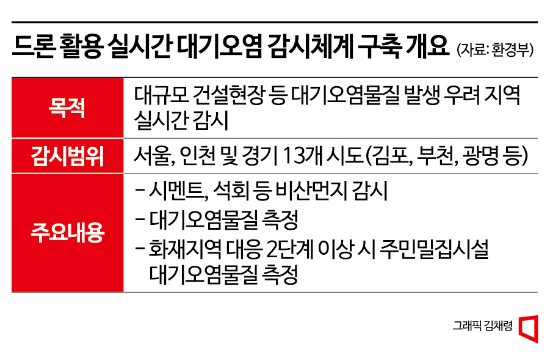
The government is establishing a system to monitor air pollutant emission areas in the Seoul metropolitan area in real time using drones. Until now, monitoring networks were conducted as special crackdowns for a certain period in cooperation with local governments, but the plan is to conduct real-time crackdowns in areas with a high frequency of pollutant emissions, such as large construction sites.
According to related ministries on the 17th, the Seoul Metropolitan Air Quality Management Office under the Ministry of Environment started a service last month for "Utilizing ultralight flying devices to establish and operate a real-time remote monitoring system." It plans to continuously monitor smoke and fugitive dust in areas of concern for air pollutant emissions within the metropolitan area and focus on checking for illegal activities. The crackdown areas include 13 cities and provinces in Gyeonggi-do, including Seoul, Incheon, Gimpo, Bucheon, Gwangmyeong, and Siheung. It is also known that a customs center will be installed in the drone warehouse of the Metropolitan Air Quality Management Office, and there are plans to expand the areas of concern nationwide in the future.
The reason the government is using drones to monitor areas with a high frequency of air pollution emissions in real time is that the number of businesses emitting air pollutants annually is steadily increasing. According to the Ministry of Environment’s Environmental Statistics Yearbook, the number of air pollutant emitting businesses increased by 18.0%, from 48,035 in 2012 to 56,685 in 2020. While the number of Type 1 businesses emitting more than 80 tons of pollutants annually decreased by 10.4% during the same period, Type 4 businesses emitting 20,000 to 100,000 tons and Type 5 businesses (less than 2 tons) increased sharply by 26.5% and 17.4%, respectively.
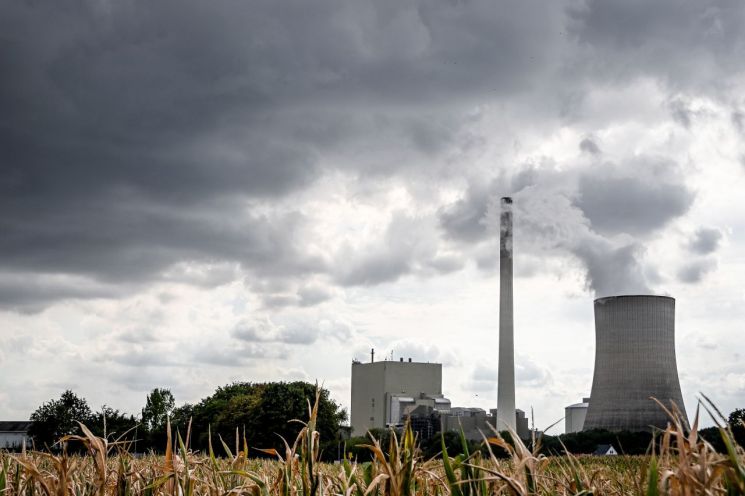
This real-time monitoring system plan also focuses on crackdowns on fugitive dust generated at construction sites such as cement and lime. Fugitive dust refers to dust directly emitted into the atmosphere without a fixed outlet like a chimney, such as from stockyards. Businesses generating fugitive dust must report the dust-generating operation at least three days before starting and install related suppression facilities.
The problem is that there are limitations in the monitoring system for fugitive dust emitted from construction sites and waste landfill facilities. To measure air pollutants from chimneys, safety managers must climb the site chimneys to collect samples, but safety issues such as falls, burns, and slips among workers have been continuously raised. On the 12th, Han Hwa-jin, Minister of Environment, met with air pollutant measurement workers and stated, "We will continuously improve the work environment," signaling efforts to resolve related issues.
The government will first use drones to measure pollutants from industrial complexes or air emission businesses that illegally discharge air pollutants. In cases of fire response at stage 2 or higher, pollutants in densely populated facilities such as apartments nearby will also be measured and the data shared with related agencies. A Ministry of Environment official said, "As the frequency of abnormal climate events due to air pollution increases and the global climate crisis intensifies, we plan to establish a real-time monitoring system to frequently check for illegal activities."
© The Asia Business Daily(www.asiae.co.kr). All rights reserved.
![User Who Sold Erroneously Deposited Bitcoins to Repay Debt and Fund Entertainment... What Did the Supreme Court Decide in 2021? [Legal Issue Check]](https://cwcontent.asiae.co.kr/asiaresize/183/2026020910431234020_1770601391.png)
















