OECD SME and Entrepreneurship Outlook 2023
SME Support Trend is 'Innovation Networks'
60% of Japanese SME Policies Focus on Knowledge and Innovation
Only 12.5% in Korea... South Korea Falling Behind
An analysis has revealed that the innovativeness of South Korean small and medium-sized enterprises (SMEs) is close to failing. While SMEs worldwide are building networks to foster innovation, South Korea appears to be lagging behind this global trend. The underlying reason seems to be a government policy focus on supporting production and supply rather than fostering innovation potential.
According to the ‘OECD SME and Entrepreneurship Outlook 2023’ report recently released by the Organisation for Economic Co-operation and Development (OECD) on the 17th, South Korean SMEs ranked among the lowest in evaluations of knowledge and innovation networks. The OECD categorized SMEs’ knowledge and innovation capabilities into three groups (top 5 groups, bottom 5 groups, and middle range), and South Korea fell into the bottom 5 groups for most indicators. This means that the workforce, external support, and platforms necessary for SMEs to innovate were severely lacking.
One representative evaluation indicator is the level of adoption of platform and network technologies. South Korea was classified in the bottom 5 groups for supply chain sharing and cloud service capabilities. The cause was a lack of essential technologies for improving corporate efficiency, such as Supply Chain Management (SCM) and Customer Relationship Management (CRM) software. Few companies purchased cloud computing services or used social media.
The cooperation scores were similarly low. For small SMEs, building cooperative networks with various institutions is crucial for innovation. However, the score for ‘collaboration with international companies’ was the lowest. While SMEs worldwide are cooperating globally for corporate innovation, South Korea is being left out. Cooperation with domestic companies, collaboration with higher education institutions, and women’s networks were also in the bottom 5 groups.
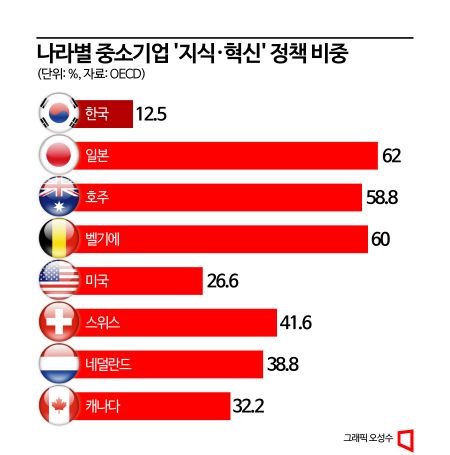
60% of Japanese SME Policies Focus on 'Knowledge and Innovation'... South Korea Only 12%
The reason South Korean SMEs lag in innovation networks is due to the government’s support approach. Only 18.7% of policies aimed at expanding SME networks in South Korea target innovation. This is about 30 percentage points lower than the OECD average of 48.6%, ranking sixth lowest among OECD countries. Specifically, knowledge and innovation policies accounted for only 12.5%. Strategic partnership policies were 6.25%, and cluster policies were 0%, not even calculated. Instead, production and supply sector policies made up 81.2%, the majority.
In contrast, major countries are focusing all efforts on supporting innovation networks. Japan, known for its strong SMEs that have even produced Nobel laureates, dedicates 62% of its national capacity to knowledge and innovation policies. It also allocates a certain portion to clusters (3.4%) and strategic partnerships (10.3%). Meanwhile, production and supply support policies account for 24.1%, less than in South Korea. Advanced countries such as Belgium (60%), Australia (58.8%), Germany (33.3%), and Canada (32.2%) also emphasize knowledge and innovation policies.
The reason major countries emphasize innovation networks is due to the ripple effects of such policies. Smaller companies generally have fewer business opportunities and find it difficult to meet cooperative partners compared to large corporations. It is also challenging to conduct research and development with external institutions. The way to overcome this is through networks. When the government connects SMEs with other companies and institutions, innovation can be induced at a low cost.
Mathias Cormann, Secretary-General of the OECD, said, "SMEs are key drivers of the economy, growth, and innovation," adding, "Governments should support an environment where entrepreneurs can harness their potential and increase their contributions so they can seize opportunities and take on challenges."
© The Asia Business Daily(www.asiae.co.kr). All rights reserved.
![User Who Sold Erroneously Deposited Bitcoins to Repay Debt and Fund Entertainment... What Did the Supreme Court Decide in 2021? [Legal Issue Check]](https://cwcontent.asiae.co.kr/asiaresize/183/2026020910431234020_1770601391.png)















