Raw Material Prices Turn Downward Trend
Cases of Delivery Payment Reductions Occur
SME Industry Wants Electricity Fees Reflected
As the delivery price linkage system is set to officially begin this October, concerns are rising that small and medium-sized enterprises (SMEs) may face a 'headwind' due to the declining trend in raw material prices. In fact, there have been reports of cases where delivery prices were reduced following decreases in raw material costs.
The delivery price linkage system was designed to alleviate the burden on SMEs when supplying goods to large corporations amid rising raw material prices. SMEs, which are relatively in a subordinate position, found it difficult to reflect increases in raw material prices in their delivery prices. The SME sector had been pushing for the introduction of this system since 2008, but efforts were thwarted by opposition from large corporation-centered economic organizations.
However, in December last year, the 'Act on Promotion of Mutual Growth between Large and Small-Medium Enterprises' was passed in the National Assembly, successfully legalizing the delivery price linkage system. The issue lies in the law's stipulation that delivery prices must be adjusted not only when major raw material prices rise but also when they fall. In other words, if raw material prices drop, SMEs may be forced to reduce their delivery prices.
According to the raw material price index operated by the Ministry of Trade, Industry and Energy, iron ore prices peaked at $133/dt in March but have fallen more than 16% to $111/dt as of July. Lead prices, which reached $2,330 per ton in January, have dropped about 9% to $2,115 currently, and aluminum prices have declined 15% from $2,636 per ton to $2,236 during the same period. Pulp prices, which soared to $1,030 per ton as recently as December last year, have halved to $565 as of last month.
According to the 'Analysis of the Pilot Operation of the Delivery Price Linkage System' conducted by the Ministry of SMEs and Startups in November last year, steel products accounted for the largest share of raw materials subject to linkage at 49%, followed by non-ferrous metals such as copper, aluminum, and lead at 31%. The most common adjustment cycle for delivery prices was quarterly (39%), with 29% of respondents indicating a one-month cycle.
Regarding the adjustment criteria based on raw material price fluctuation rates, 48.6% answered '0%,' the highest proportion. The adjustment criterion refers to the level of raw material price change that triggers delivery price adjustments. A 0% adjustment criterion means that delivery prices are adjusted even if the raw material base price changes by just 1 won. The second most common response (28.8%) was that delivery prices would be adjusted when major raw material prices rise or fall by 5%.
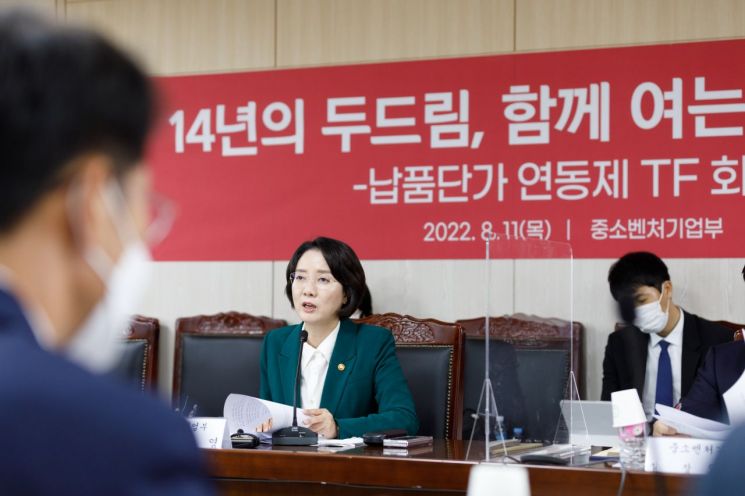
Although the law will take effect in October, the number of companies participating in the pilot project for the delivery price linkage system is steadily increasing. There are already about 1,000 companies involved, with 96 consignors and 965 consignees. If the downward trend in raw material prices continues, the delivery price linkage system could become a 'double-edged sword' for SMEs. No Hyung-seok, Director of the Transaction Environment Improvement Division at the Ministry of SMEs and Startups, stated, "We received performance data from about 300 companies participating in the pilot project, and some companies actually reduced their prices," adding, "The agreement is structured that way due to raw material price fluctuations, so it is unavoidable."
Meanwhile, the SME sector argues that not only raw materials but also major expenses such as electricity and gas fees should be included in the linkage system. Although raw material prices have recently declined, public utility charges have risen significantly. Yang Ok-seok, Director of the Win-Win Cooperation Office at the Korea Federation of SMEs, said, "Manufacturing costs include not only raw material costs but also various expenses such as electricity fees and labor costs," adding, "We will propose to the government to specify in the enforcement decree or guidelines that electricity fees can also be reflected in the linkage system and to provide tax benefits to the relevant companies."
© The Asia Business Daily(www.asiae.co.kr). All rights reserved.

















