Starting from the 20th of this month, held in Australia and New Zealand
Failure to meet the target for the first exclusive broadcasting rights sales is a limitation
The world's attention is focused on the '2023 International Federation of Association Football (FIFA) Australia-New Zealand Women's World Cup' to be held on the 20th (local time). Compared to four years ago when the previous World Cup was held, the popularity of women's soccer has increased, leading to broadcasting contracts with major broadcasters and securing the largest sponsorship scale from global companies, intensifying the excitement.
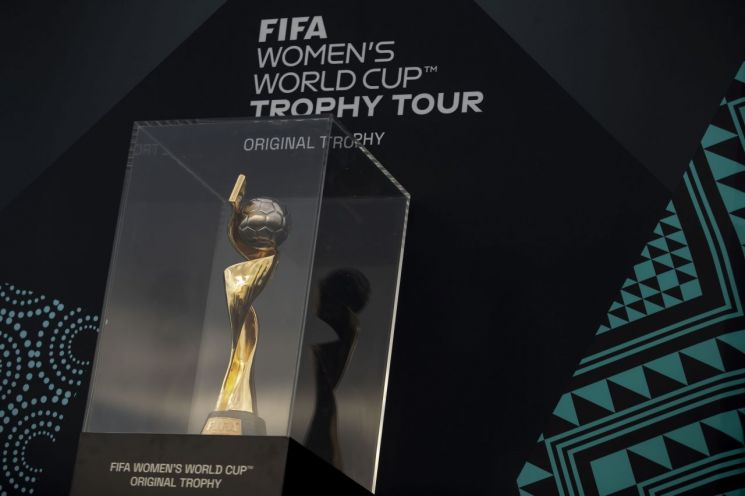
Although it remains a disappointment that the financial rewards are still less than those of the men's World Cup and the sale of broadcasting rights fell short of plans, it is expected that this World Cup will provide momentum for the further growth of women's soccer worldwide.
◆ Rapidly Growing Women's Soccer... "First Prize Money Paid to All Participants"
The 2023 Women's World Cup will be held for a month from the 20th of this month to the 20th of next month in Australia and New Zealand. This World Cup will expand the number of participating countries from the previous 24 to 32. The South Korean women's national soccer team, led by Ji So-yeon and Cho So-hyun, will also compete, facing Colombia, Morocco, and Germany in Group H.
According to Bloomberg News on the 14th, regarding the broadcasting of the ninth Women's World Cup, the European Broadcasting Union, composed of public broadcasters including the UK's BBC, finalized contracts last month, and Japan's NHK also signed a broadcasting contract. The scale of sponsorship from global companies for the Women's World Cup has reached its highest in recent years. As of the previous day, 1.25 million tickets had been sold.
Interest in women's soccer is higher than ever. In the previous World Cup held in France in 2019, the U.S. women's national soccer team drew great attention by winning the championship for the second consecutive tournament. Last year, the UEFA Women's Euro 2022 final match in the UK recorded the highest viewership in the history of women's sports, becoming a hot topic.
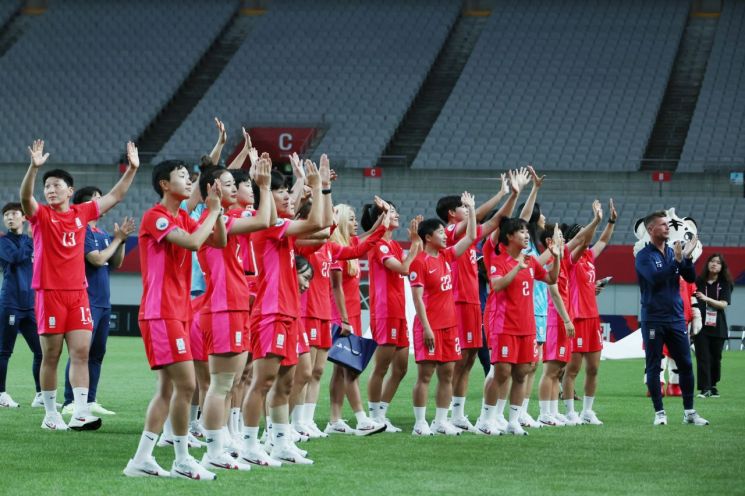 On the 8th, at the Seoul World Cup Stadium, players greeted the audience at the send-off ceremony for the 2023 FIFA Australia-New Zealand Women's World Cup.
 [Image source=Yonhap News]
FIFA stated that 1.1 billion people worldwide watched the games during the 2019 Women's World Cup and expects the number of viewers to increase for this tournament. Considering that the viewership for last year's Qatar Men's World Cup was 5 billion, there is a difference, but the growth rate is fast, according to the Wall Street Journal (WSJ).
Until 20 years ago, the prize money related to the Women's World Cup was 'zero,' but this year it has expanded to $110 million (approximately 138.8 billion KRW), Bloomberg explained. The winning team of this tournament will receive $10.5 million, of which $6.2 million will be distributed to the players. Also, for the first time in history, all players participating in this tournament will receive a minimum reward of $30,000. Bloomberg introduced that this is more than twice the average annual salary of a professional female soccer player, which is $14,000.
◆ First Time Selling Broadcasting Rights Separately from Men's... Results Are Disappointing
Although interest in women's soccer has increased compared to the past, foreign media reported that it still does not match men's soccer. It is true that the total prize money for the Women's World Cup has expanded to over $100 million, but last year's Qatar Men's World Cup total prize money was $440 million, and the winning team Argentina received $42 million.
Prize money mainly comes from broadcasting revenue contracts FIFA makes with broadcasters. Previously, FIFA sold the women's World Cup broadcasting rights together with the men's World Cup rights, but this time they separated and sold the women's World Cup broadcasting rights separately. In this process, FIFA initially expected revenue of $150 million but now it is anticipated to be around $50 million, WSJ reported citing sources.
 Argentina men's national football team player Lionel Messi is kissing the trophy after winning the Qatar World Cup last year.
 [Image source=Reuters Yonhap News]
In particular, the fact that this Women's World Cup is held in Australia and New Zealand has been analyzed to have affected the broadcasting rights contracts due to time differences. Bloomberg pointed out that with the possibility of the U.S. women's national team winning three consecutive championships, the 14-hour time difference between the U.S. and Australia makes it difficult to broadcast during prime time. Europe also has a time difference of over 8 hours with Australia.
Given this situation, FIFA predicted in an internal report that the increase in viewers in Asia might outweigh the decrease in viewers in Europe due to the time difference for this tournament. It was noted that during the 2007 Women's World Cup held in China, viewers from Korea, China, and Japan accounted for 59% of the global audience. However, during the 2015 Canada and 2019 France tournaments, the Asian viewer share dropped to 43% and 28%, respectively.
Although the time difference was favorable and Japan won the Women's World Cup in 2011, NHK's broadcasting rights contract was only signed on the 13th, a week before the games.
FIFA expects the 2023 Women's World Cup to continue the upward trend following 2019 and to set global viewership records. Sarah Berman, FIFA's head of women's soccer, explained, "The decision in 2021 to separate the broadcasting rights for women's and men's games was to invest in women's soccer and bring the revenue back to women's soccer."
Bloomberg stated, "The 2023 World Cup will advance women's soccer," adding, "Games tend to proceed at a frightening pace. Since the start of the Women's World Cup in 1991, female players have scored more goals per game on average than male players in every tournament."
© The Asia Business Daily(www.asiae.co.kr). All rights reserved.



















