The Devastating Power of Cluster Munitions as Weapons of Mass Destruction
Controversy over Cluster Munitions from Ukraine Raises International Concerns
The so-called "steel rain," cluster bombs, a type of weapon of mass destruction, have become a source of fear in the international community.
As the United States decided to provide cluster bombs to Ukraine, concerns have also been raised by allied countries such as Canada and the United Kingdom. Russia may respond by using similar weapons, which could lead to increased civilian casualties. Analysts also suggest that if Ukraine and Western countries use cluster bombs in civilian residential areas, it will be difficult for them to maintain a moral high ground compared to Russia, which has been criticized by the international community.
Earlier, the United States announced it would supply cluster bombs to fill the gap caused by a shortage of artillery shells in Ukraine.
In response, Ukraine welcomed the move, evaluating cluster bombs as a game changer that could alter the course of the war. Oleksii Reznikov, Ukraine's Minister of Defense, said on the 11th, "I hope cluster bombs will become the next-generation game changer as weapons and ammunition for reclaiming territory."
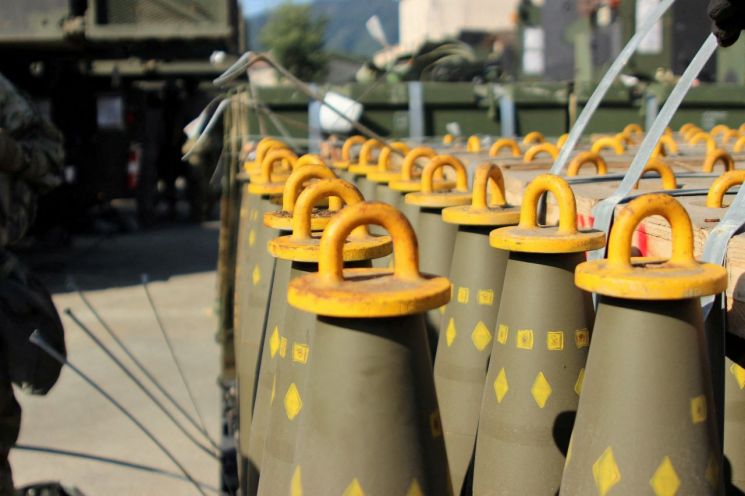
However, countries such as the United Kingdom, Spain, and Canada have expressed concerns due to the dangers of cluster bombs.
Cluster bombs are weapons of mass destruction developed during World War II. After the main bomb explodes in the air, the submunitions inside simultaneously attack multiple targets, which is why they are also called "steel rain." The scale of the attack is large, and unexploded ordnance often remains buried underground for years before suddenly detonating, causing civilian casualties.
In fact, during the Vietnam War in the 1960s and 1970s, the United States heavily dropped cluster bombs and other explosives in neighboring Cambodia. As a result, it is estimated that over 20,000 people have died and more than 45,000 have been injured in Cambodia since 1970.
On the 10th, Hun Sen, Prime Minister of Cambodia, issued a statement opposing the use of cluster bombs, saying, "If Ukraine drops cluster bombs on its territory occupied by Russian forces, our people could face great danger for hundreds of years. More than 50 years have passed, but there is no way to remove all the bombs."
Consequently, many countries have already ceased using cluster bombs. In 2010, 123 countries signed the United Nations Convention on Cluster Munitions (CCM), which prohibits the use, manufacture, possession, and transfer of cluster bombs. However, the United States, Ukraine, Russia, China, South Korea, and North Korea have not joined the treaty.
Russia declared that if the United States supplies cluster bombs, it will also deploy similar weapons in combat. In response to NATO's military support for Ukraine, Russia even mentioned the possibility of a "Third World War."
On the 11th, Sergey Shoigu, Russia's Minister of Defense, warned, "If the United States continues to supply cluster bombs to Ukraine, Russia will have no choice but to use similar means against the Ukrainian forces." If Russia retaliates with weapons of mass destruction, civilian casualties could increase further.
There are also concerns that the Western world will lose its moral high ground. Russia has been criticized for invading Ukraine and using lethal weapons such as cluster bombs during combat, resulting in civilian massacres. If the United States supplies cluster bombs and Ukraine actually deploys them in battle, it will face the same moral criticism as Russia.
Jens Stoltenberg, NATO Secretary General, stated in March last year, "We have seen cluster bombs being used," criticizing Russia for using internationally banned weapons such as cluster bombs and vacuum bombs.
On the 9th, Representative Barbara Lee said in an interview with CNN, "The use of cluster bombs is absolutely unacceptable. It crosses the line," and warned, "If we supply cluster bombs to Ukraine, we risk losing our moral high ground."
© The Asia Business Daily(www.asiae.co.kr). All rights reserved.
![User Who Sold Erroneously Deposited Bitcoins to Repay Debt and Fund Entertainment... What Did the Supreme Court Decide in 2021? [Legal Issue Check]](https://cwcontent.asiae.co.kr/asiaresize/183/2026020910431234020_1770601391.png)















