Attached origin stickers on sacks removed just before sale
QR codes on sacks must be scanned to verify history
Amid rising prices of solar salt due to concerns over the discharge of contaminated water from the Fukushima nuclear power plant in Japan, and a resulting shortage, a group was caught by the Coast Guard for selling 60 tons of Chinese solar salt disguised as domestic salt.
On the 13th, the Incheon Coast Guard announced that six people, including distributor A (30) and seller B (51), were booked without detention on charges of violating the Act on the Labeling of Origin of Agricultural and Fishery Products.
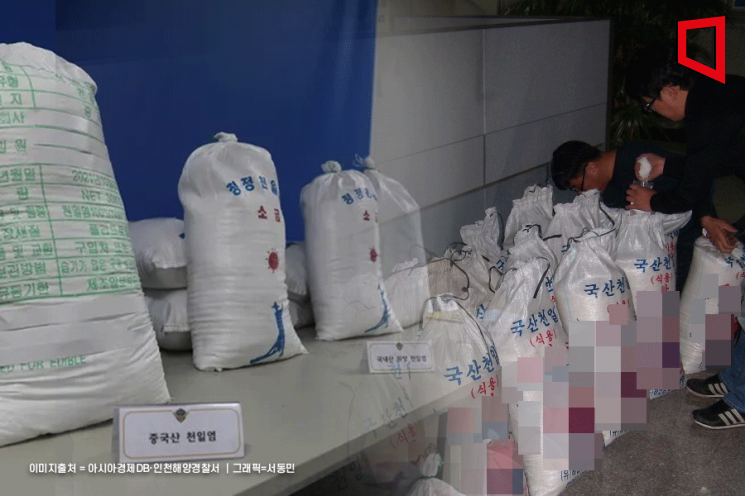
A is suspected of distributing and selling 60 tons (3,000 bags of 20 kg each) of Chinese solar salt as domestic salt from March until early this month.
Investigations revealed that A and others used a method of attaching origin labeling stickers to the bags to prepare for inspections, then removing them just before sale. Additionally, sellers like B deceived customers by selling Chinese solar salt as domestic salt in the market or broadcasting via truck speakers that the salt was "directly brought from Jeolla Province" while traveling through regions such as Incheon, Gyeonggi, Chungcheong, and Gangwon, where distribution history verification is weak, thus passing it off as domestic salt.
It was confirmed that A and others sold Chinese solar salt, which costs only 4,000 won per 20 kg, as domestic salt for up to 30,000 won, more than seven times the price.
The Coast Guard is strengthening crackdowns, anticipating an increase in the act of selling foreign salt as domestic salt due to the price rise and shortage of solar salt ahead of the Fukushima nuclear power plant contaminated water discharge.
An Incheon Coast Guard official said, "It is safer to buy domestic solar salt after verifying it through the traceability system," and added, "We will expand investigations nationwide through close cooperation with related agencies to eradicate illegal distribution of solar salt."
The official also stated, "By scanning the QR code attached to the salt bags with a smartphone, consumers can access traceability information such as the production area, producer, and production year of the solar salt."
© The Asia Business Daily(www.asiae.co.kr). All rights reserved.
![Clutching a Stolen Dior Bag, Saying "I Hate Being Poor but Real"... The Grotesque Con of a "Human Knockoff" [Slate]](https://cwcontent.asiae.co.kr/asiaresize/183/2026021902243444107_1771435474.jpg)
















