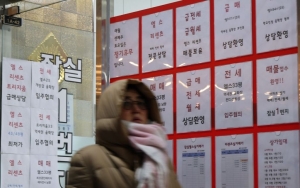
General Strike Begins at 7 AM on the 13th
45,000 Participants Across 140 Workplaces
On the 13th, the Korean Health and Medical Workers' Union (KHMU), which launched a nationwide general strike, expressed regret over concerns about work disruptions and medical service gaps, stating, "We apologize for causing worry and inconvenience due to our strike" and "We ask the public to support and encourage us so that the strike can be resolved quickly."
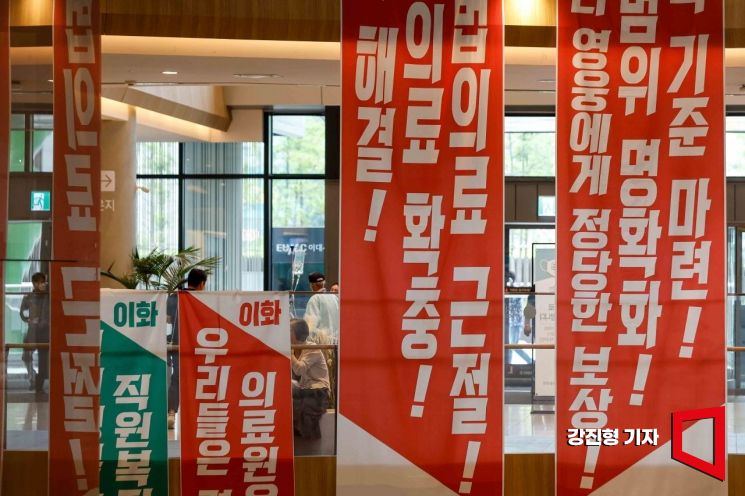 On the 13th, when the Health and Medical Workers' Union began a large-scale general strike for the first time in 19 years, a banner reflecting the union members' opinions was hung at Ewha Seoul Hospital in Gangseo-gu, Seoul. Photo by Jinhyung Kang aymsdream@
In a press release announcing the sector-wide general strike, KHMU stated, "The ongoing manpower crisis that health and medical workers can no longer endure, the exposure of patients to various medical accidents and illegal medical damages, and the situations where expensive caregiving costs lead to caregiving bankruptcies and even caregiving-related deaths must now change."
They added, "During the strike, tasks directly related to patient lives, such as emergency rooms and intensive care units, will operate at 100% capacity," emphasizing, "This policy will be adhered to until the general strike ends." To this end, the union plans to deploy essential personnel and form and operate an emergency standby team (CPR) to prepare for emergencies, assuring, "Contrary to some concerns, there will be no medical crisis or serious medical service gaps."
Regarding some medical institutions canceling surgeries and discharging or transferring inpatients, the union criticized, "Aggressive and excessive measures are not actions to reduce patient harm and inconvenience but acts that harm patients," and added, "These hospitals are avoiding dialogue and negotiations to resolve the strike situation and are taking hardline measures such as canceling surgeries and forcibly discharging inpatients. This is a malicious intent by the employers to cover up their insincere negotiation responsibilities and to shift the blame for the strike onto the union by creating unfavorable public opinion."
The union also rebutted the opposition from the '14 Health and Welfare Medical Solidarity,' a coalition of 14 health and medical professional organizations, which expressed concerns about the union's general strike the previous day. The union stated, "Members of each professional association are members of the Korean Health and Medical Workers' Union and have embarked on a legitimate struggle to protect patient safety and public life and to improve poor working conditions," adding, "Professional associations that directly oppose the struggle to realize the desperate demands of their members should reflect on their identity."
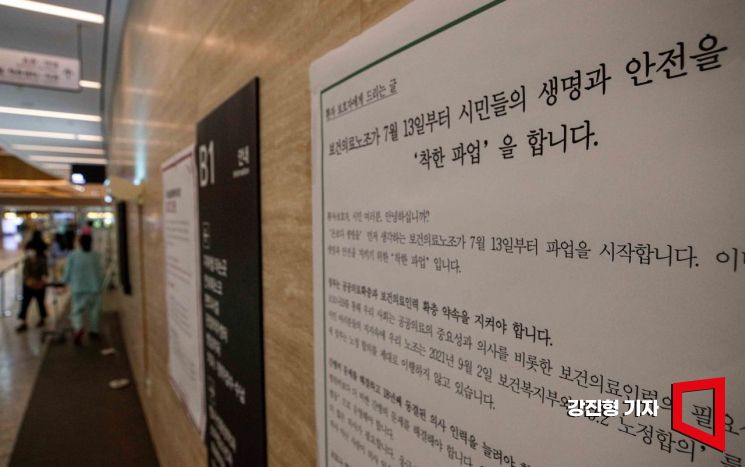 On the 13th, when the Health and Medical Workers' Union began a large-scale general strike for the first time in 19 years, a large poster containing the union members' opinions was posted at Ewha Seoul Hospital in Gangseo-gu, Seoul. Photo by Kang Jin-hyung aymsdream@
While drawing a line regarding negotiations with the government, the union left room for dialogue. The union said, "The Ministry of Health and Welfare has drawn a line by calling it a 'political strike' and has closed the door to dialogue and negotiation," but also mentioned, "If the government opens the door to dialogue and negotiation and sincerely presents advanced solutions, the sector-wide general strike can reach a dramatic turning point toward resolution," urging, "What is needed now is not a simple strike situation check but a solution to restore abnormal conditions in the medical field to normal."
The union announced that about 60,000 total union members from 122 branches and 140 workplaces, which have secured the final right to strike, will participate in this general strike. Excluding 15,000 essential workers deployed, the actual number of strikers is 45,000.
The participating branches include 20 private university hospital branches (28 workplaces) such as Korea University Medical Center, Kyung Hee Medical Center, Ajou University Medical Center, Ewha Medical Center, Hallym University Medical Center, and Hanyang University Medical Center; 7 national university hospital branches (12 workplaces) including Pusan National University Hospital, Chonnam National University Hospital, Jeonbuk National University Hospital, and Chungnam National University Hospital; 12 special-purpose public hospital branches (12 workplaces) such as National Medical Center, National Cancer Center, Veterans Hospital, and Korea Institute of Radiological & Medical Sciences; 26 Korean Red Cross branches (26 workplaces) including Red Cross Blood Center, Red Cross Hospital, and Testing Center; 26 local medical center branches (26 workplaces) such as Gyeonggi Provincial Medical Center, Busan Medical Center, Incheon Medical Center, and Hongseong Medical Center; 19 private small and medium hospital branches (19 workplaces) including Bupyeong Serim Hospital, Gwangju Christian Hospital, and Jeongeup Asan Hospital; 6 mental health, rehabilitation, and nursing medical institution branches (6 workplaces); and 6 non-regular worker branches (11 workplaces) including cleaning, parking, facilities, and security. Among the total 45 tertiary general hospitals, 20 are participating in the KHMU general strike.
© The Asia Business Daily(www.asiae.co.kr). All rights reserved.
![User Who Sold Erroneously Deposited Bitcoins to Repay Debt and Fund Entertainment... What Did the Supreme Court Decide in 2021? [Legal Issue Check]](https://cwcontent.asiae.co.kr/asiaresize/183/2026020910431234020_1770601391.png)