Design Feature with Fully Visible Internal Components
Rear Lights Indicate Food Delivery Status
UK IT startup Nothing has launched the Phone (2), commonly known as the 'transparent phone,' in the Korean market.
On the 12th, Nothing held a media briefing in Seongsu-dong, Seoul, unveiling the new Phone (2).
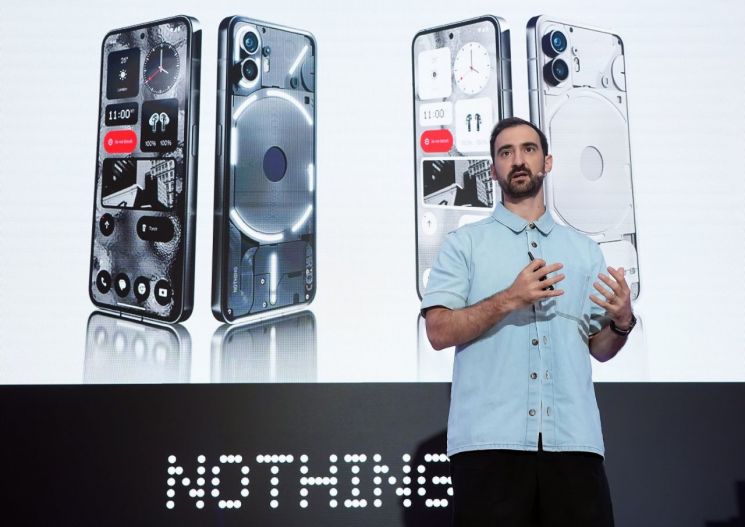 Akis Evangelidis, co-founder and head of marketing at Nothing, is introducing the product at the launch briefing held on the 12th.
 [Photo by Nothing]
This is the first time a Nothing smartphone has been officially released in Korea. The newly launched Phone (2) inherits the 'transparent phone' design of Phone (1) while enhancing performance and usability. Akis Evangelidis, co-founder and head of marketing at Nothing, said, "Nothing aims to provide consumers with products of the highest quality through fun technology and innovative hardware and software design. While Phone (1) focused on hardware innovation, this time we concentrated on software innovation, focusing on a fast and smooth experience."
Nothing is an IT startup founded by Carl Pei, a Chinese-Swedish entrepreneur and co-founder of the Chinese smartphone company OnePlus. Its unique design, which reveals the internal components, attracted global IT industry attention when Phone (1) was released last year. It has recorded cumulative global sales of 800,000 units. Although it is difficult to compare with Samsung and Apple, this is a meaningful achievement for a new brand.
The mobile application processor (AP), considered the brain of the smartphone, uses the Qualcomm Snapdragon 8+ Gen 1. It has 12GB of RAM and a 6.7-inch flexible OLED display (LTPO). The operating system, Nothing OS 2.0, has been optimized to make app launch speeds twice as fast as Phone (1). In particular, the Glyph interface, which emits light from the back, has been enhanced. The number of LED array units has been increased compared to before, allowing users to receive essential information without constantly looking at the screen. Users can directly set sounds and lighting, enabling them to know who is contacting them or which app's notification it is just by the light and sound. For example, when ordering food through a delivery app, the delivery status is displayed on the rear lighting.
Camera performance has also been strengthened. For photo and video shooting, it is equipped with a 50-megapixel dual rear camera using cutting-edge algorithms and a 32-megapixel front camera. Evangelidis introduced the camera performance by showing photos he took himself. Photographer Ko Hoon-cheol then shared his work and impressions using the Phone (2) camera.
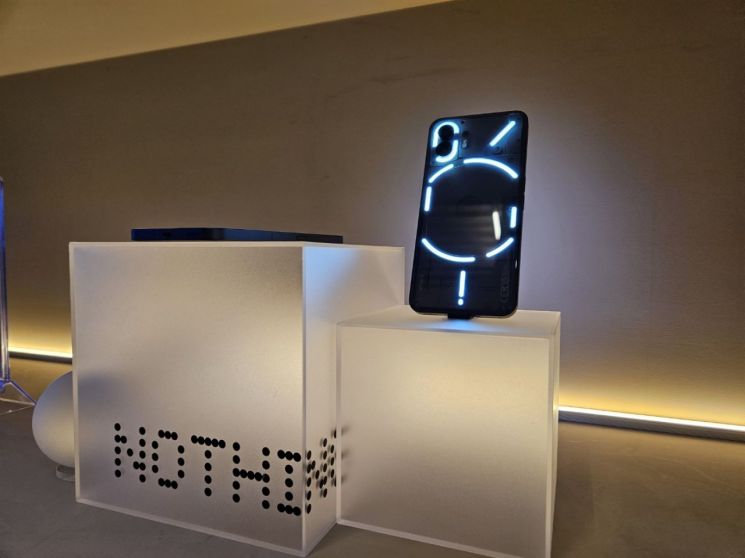
Nothing began accepting pre-orders from midnight through 11st, Kream, Kakao Gift, and Prism on the same day. The company will start limited quantity sales from the 15th at the 'Kream Sangsu Showroom' in Sangsu-dong, Seoul. From the 21st, purchases will be available without restrictions. The retail price is 899,000 KRW for the 256GB model and 1,099,000 KRW for the 512GB model. The colors come in two options: White and Dark Gray.
The Korean market is dominated by Samsung and Apple, often called a graveyard for other manufacturers. According to Counterpoint Research, Samsung held a 63% market share in the fourth quarter of last year, and Apple had 34%. Other manufacturers accounted for only 3%. However, their market share has recently increased from the 1% range in the past. When Nothing launched its predecessor Phone (1) last year, it did not sell the product directly in Korea but offered it through overseas direct purchase channels like Coupang. It gained popularity by selling out within about two hours of the sales start. Gaining confidence from this success, Nothing appears to be expanding distribution channels and officially releasing the new model in Korea.
However, as it is still early, the company is proceeding cautiously. Overseas IT media such as GSA Arena reported that Nothing plans to open five dedicated service centers in India within this year and add 20 more by next year. However, there are no such plans yet in Korea. Evangelidis said, "Since the Korean market is in its early stages, we will first find partners and gradually open after-sales service centers."
© The Asia Business Daily(www.asiae.co.kr). All rights reserved.


















