Estimated Decline in South Korea's Nominal GDP Ranking Last Year
Brazil, Australia, and Other Commodity Exporters Show Strong Growth
Bank of Korea Uses Preliminary Figures, Not Official UN Statistics
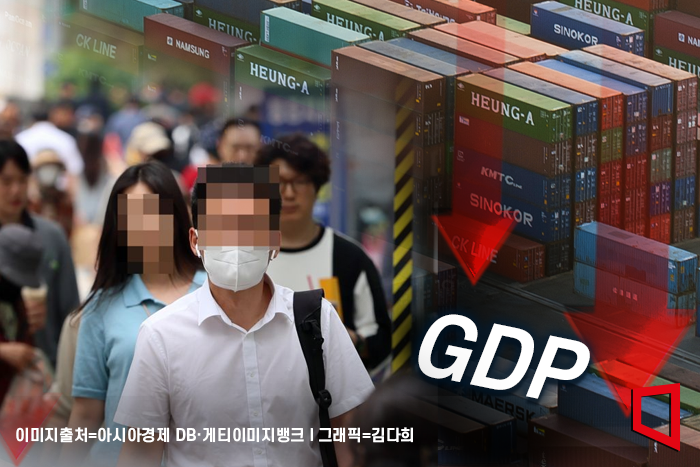
Last year, South Korea's nominal Gross Domestic Product (GDP) fell to 13th place globally, seemingly failing to maintain its position in the 'Top 10.'
According to the Bank of Korea on the 12th, South Korea's nominal GDP (based on market exchange rates) last year was estimated at $1.6733 trillion, ranking around 13th worldwide.
The United States led with $25.4627 trillion, followed by China at $17.876 trillion. Also, Japan with $4.2256 trillion, Germany with $4.0752 trillion, and the United Kingdom with $3.0798 trillion made up the 'Top 5.'
India ($3.0096 trillion), France ($2.7791 trillion), Canada ($2.1436 trillion), Russia ($2.0503 trillion), and Italy ($2.0105 trillion) ranked in the Top 10, while Brazil was 11th with $1.8747 trillion, and Australia was 12th with $1.7023 trillion.
Nominal GDP is an indicator showing how much goods and services are produced in a country, representing the size of a nation's economy.
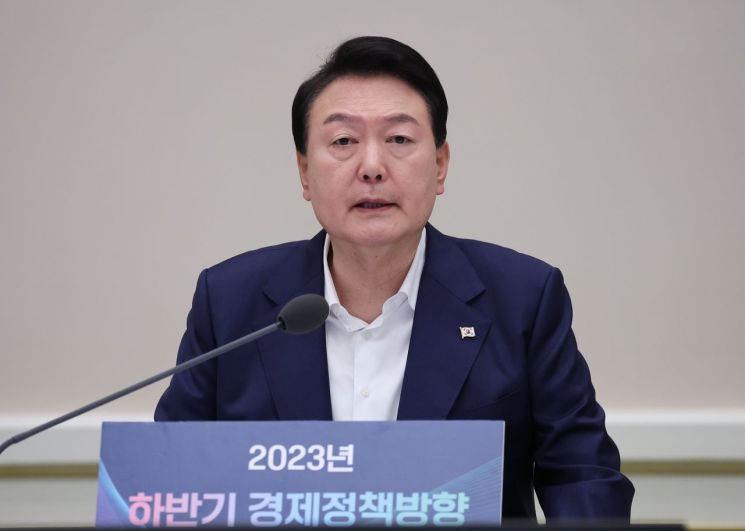 President Yoon Suk-yeol is speaking at the 18th Emergency Economic and Livelihood Meeting on the Economic Policy Direction for the Second Half of 2023, held on the 4th at the Blue House State Guesthouse. [Image source=Yonhap News]
South Korea's economic size entered the Top 10 in 2018, dropped to 12th in 2019, reclaimed 10th place in 2020 and 2021, but slipped back three places after two years.
The decline in ranking last year is attributed not only to an overall slowdown in growth momentum but also significantly to the strength of the US dollar. Last year, the US Federal Reserve's aggressive tightening caused the dollar's value to soar, reducing nominal GDP when converted into US dollars.
In fact, South Korea's nominal GDP in Korean won last year was 2,161.8 trillion won, a 3.9% increase from the previous year. However, when calculated in US dollars, it decreased by 7.9% during the same period. Countries like Russia, Brazil, and Australia, which surpassed South Korea in economic size last year, are commodity exporters and are estimated to have benefited.
The outlook for re-entering the Top 10 this year is not optimistic. The International Monetary Fund (IMF) lowered South Korea's growth forecast for this year from 1.7% to 1.5%, and both the government and the Bank of Korea expect even lower growth at 1.4%.
South Korea's economic growth rate has fallen below 2% only five times: in 1956 (0.6%) shortly after the country's founding, in 1980 (-1.6%) following the second oil shock, in 1998 (-5.1%) during the foreign exchange crisis, in 2009 (0.8%) amid the global financial crisis, and in 2020 (-0.7%) during the COVID-19 pandemic.
This economic size ranking is not an official United Nations (UN) statistic.
The Bank of Korea explained that, aside from South Korea, the US, Japan, China, Germany, the UK, India, France, Italy, and Australia, the rankings used forecasts from the IMF and the Organisation for Economic Co-operation and Development (OECD), so changes may occur later.
A Bank of Korea official said, "The statistics for countries competing with South Korea are still provisional," adding, "The official UN rankings are expected to be released in January next year."
© The Asia Business Daily(www.asiae.co.kr). All rights reserved.


















