Confirmation of Willingness to Resolve Various Issues Including Economy After Normalization in March
Warmth in Korea-Japan Relations Through Somac and Cheongju, 'Contaminated Water Discharge' as the Biggest Variable
Attention to Yoon's Message... Need to Maintain Bilateral Relations and Ensure Public Safety
President Yoon Suk-yeol and Japanese Prime Minister Fumio Kishida will hold a summit on the 12th (local time) in Lithuania, where the North Atlantic Treaty Organization (NATO) summit is taking place. This meeting comes just over two months after the restoration of 'shuttle diplomacy' through reciprocal visits in March and May, serving as an occasion to confirm their differing positions on the contentious issue of 'nuclear wastewater discharge.' There is also a possibility that an awkward atmosphere may resurface between the two countries, which had been recovering mainly in the economic sector.
A senior official from the Presidential Office told reporters at the press center set up in Vilnius on the 11th, "Korea-Japan relations have normalized since March, and the two leaders will hold their sixth official summit tomorrow," adding that "the issue of contaminated water is also likely to come up" as a major agenda item.
If the Korea-Japan summit is finalized without last-minute variables, Prime Minister Kishida is expected to explain the safety of the ocean discharge of contaminated water to President Yoon and seek understanding from the Korean government. This is to minimize opposition grounds by obtaining consent from the closest neighboring country, South Korea, amid concerns and opposition from Pacific island nations about damage caused by the contaminated water.
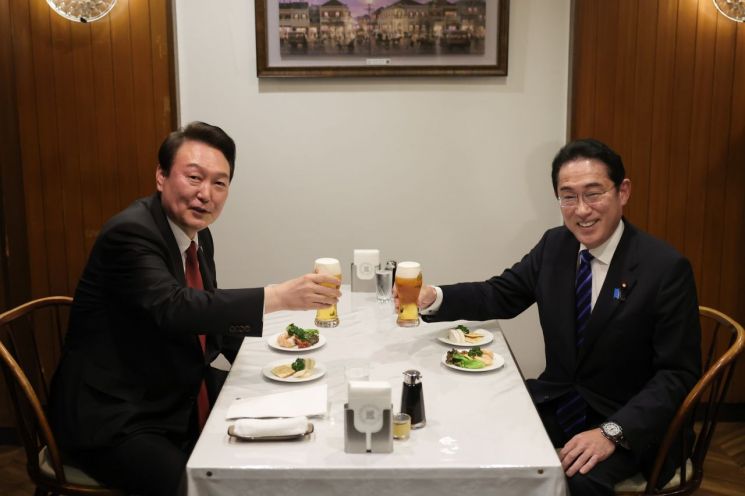
The official conveyed the position that "both Japan and we think it would be good to use this opportunity to strengthen mutual trust, open our hearts to each other, cooperate, and develop together." However, it is clear that bilateral relations have reached a turning point with the negotiation over contaminated water. In fact, President Yoon and Prime Minister Kishida have steadily narrowed their differences on various issues during their previous six meetings. Despite grappling with the difficult issue of 'historical matters,' the two leaders showed strong determination to resolve economic issues by toasting with somaeck and cheongju in Tokyo and Seoul in March and May.
Solutions also emerged quickly. Japan lifted its export restrictions on semiconductor materials to South Korea, and the Korean government withdrew its World Trade Organization (WTO) complaint against Japan's measures. The Korea-Japan General Security of Military Information Agreement (GSOMIA) also entered a full restoration phase. A joint visit by the Japanese Prime Minister to the Hiroshima Peace Memorial Park was arranged, security cooperation between Korea and Japan was strengthened in response to North Korea's nuclear and missile advancements and provocations, and a 'semiconductor supply chain' was established between Korean semiconductor manufacturers and Japanese materials, parts, and equipment (SoBuJang) companies.
However, the issue of 'contaminated water discharge,' which has attracted the attention of not only the political circles but the entire nation, is different. Since Prime Minister Kishida may bring up related agendas such as contaminated water treatment, ocean discharge, and the import of Fukushima seafood all at once, President Yoon must deliver a message that reflects public safety while maintaining bilateral relations.
The upcoming general election, just half a year away, is also expected to influence the tone of President Yoon's remarks. On the 9th, the Democratic Party of Korea strongly criticized the International Atomic Energy Agency (IAEA) comprehensive report on the 'safety assessment of Japan's Fukushima nuclear wastewater discharge,' accusing the IAEA of conducting a "Japan-biased verification" during a meeting with Rafael Grossi, IAEA Director General. Depending on the situation, the Democratic Party's offensive may intensify, potentially changing the ruling party's position.
The Presidential Office distances itself from interpreting the contaminated water issue in connection with the election schedule. This is because various agendas are expected to be addressed together at this summit, including joint safety measures against foreign exchange crises, advanced technology research, cooperation to stabilize supply chains, and mutual security cooperation including with the United States. With the recent restoration of the Korea-Japan currency swap after eight years, joint responses to foreign exchange crises or security enhancement among Korea, the U.S., and Japan ahead of the Nuclear Consultative Group (NCG) inaugural meeting between Korea and the U.S. on the 18th may also be on the agenda. Furthermore, following U.S. President Joe Biden's proposal at the Hiroshima G7 summit in May to invite President Yoon and Prime Minister Kishida to Washington D.C., there is an intention not to let this become a variable in the trilateral cooperation among Korea, the U.S., and Japan.
The senior official added, "Contaminated water ultimately stems from a natural disaster that occurred 12 to 13 years ago, and as Asia-Pacific countries have suffered together, Korea-Japan relations have normalized while overcoming these difficulties, and both Korea and Japan share the view that this is an opportunity to strengthen trust between the two leaders."
© The Asia Business Daily(www.asiae.co.kr). All rights reserved.
![Clutching a Stolen Dior Bag, Saying "I Hate Being Poor but Real"... The Grotesque Con of a "Human Knockoff" [Slate]](https://cwcontent.asiae.co.kr/asiaresize/183/2026021902243444107_1771435474.jpg)
















