Second Half Ends US Interest Rate Hikes... Weakening of the Dollar
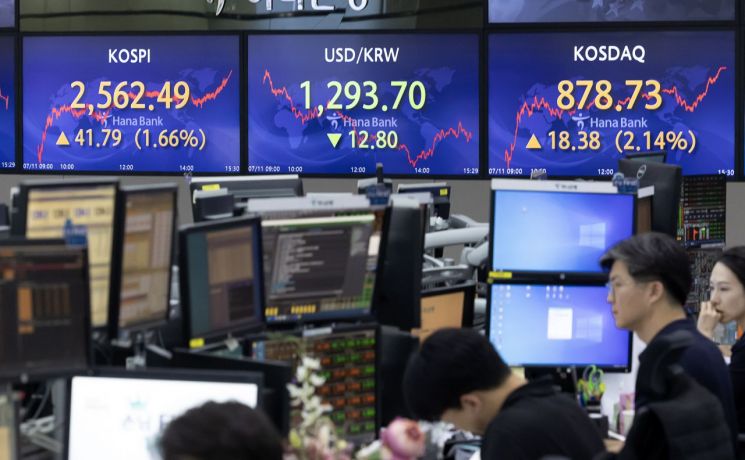
The won-dollar exchange rate is attempting to enter the 1,200-won range, leading to analyses that the dollar's strength phase is entering its final stage. With growing expectations for price stability ahead of the U.S. Consumer Price Index (CPI) announcement and the possibility of the end of U.S. interest rate hikes in the second half of this year, forecasts suggest the dollar will weaken in the medium to long term.
According to the Seoul foreign exchange market on the 11th, the won-dollar exchange rate closed at 1,293.7 won, down 12.8 won from the previous trading day. This is the lowest level in 13 trading days since June 21 (closing price basis). The exchange rate started at 1,300 won, down 6.5 won from the previous day, and at one point fell to 1,290.4 won, widening the decline.
The decline in the exchange rate on this day was influenced by revived risk asset preference due to expectations of slowing inflation ahead of the U.S. June CPI announcement on the 12th (local time). Accordingly, U.S. Treasury yields fell, and the dollar weakened. The offshore yuan-dollar exchange rate also fell, exerting downward pressure on the won-dollar exchange rate.
Seunghyuk Kim, a researcher at NH Futures, said, "Ahead of the U.S. CPI announcement, the decline in the Mannheim used car price index is temporarily raising expectations for price stability," adding, "Not only the non-farm payroll data but also the employment trend index is increasing the possibility of cooling in the labor market, contributing to the weak dollar trend."
Expectations for Economic Rebound and Foreign Net Buying Strengthen the Won
Experts predict that the dollar's strength trend, which has lasted about two years since the fourth quarter of last year, will gradually come to an end, and the won-dollar exchange rate will show a downward stabilization trend. Changseop Oh, a researcher at Hyundai Motor Securities, said, "Recently, as risk asset preference has revived, the won-dollar exchange rate is attempting again to enter the 1,200-won range," adding, "With the possibility of the end of U.S. interest rate hikes in the third quarter of this year highlighted, the dollar is expected to weaken in the medium to long term."
Globally, growing expectations for an economic rebound and the foreign net buying trend of domestic stocks from a foreign exchange supply and demand perspective are also cited as factors strengthening the won. Researcher Oh explained, "The domestic trade balance recorded its peak deficit in January this year and turned to a surplus in June for the first time in 16 months," adding, "From an investment fund perspective, foreign investors' net investment in domestic bonds continues, and since the second half of last year, foreign net buying of domestic stocks has continued, which is a positive signal."
In particular, as the global economy has entered a phase of resolving supply chain instability since the second half of last year and inflation has slowed, it is analyzed that the global monetary tightening is entering its final stage, which will drive the dollar's weakness. Researcher Oh said, "Since December last year, the G20 Organization for Economic Cooperation and Development (OECD) leading economic index has turned to an upward trend, raising expectations for global economic recovery," adding, "Assuming a global economic recovery, given Korea's high dependence on external factors, the won is likely to strengthen from a foreign exchange supply and demand perspective."
U.S. Additional Rate Hike Variable... Largest Ever Korea-U.S. Interest Rate Gap
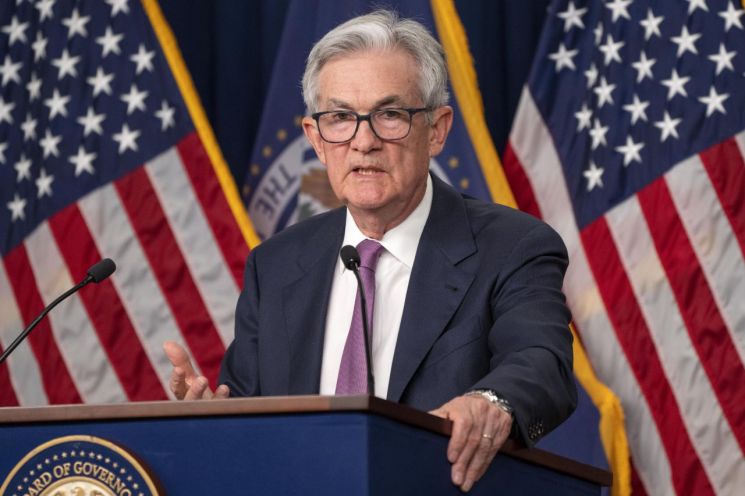
However, the possibility of foreign exchange market volatility due to additional U.S. interest rate hikes is expected to be the biggest variable for the direction of the won-dollar exchange rate. While the Bank of Korea's Monetary Policy Committee is widely expected to keep the base rate unchanged on the 13th, the U.S. Federal Reserve (Fed) is expected to raise the policy rate by 0.25 percentage points on the 25th (local time).
If the U.S. Fed raises rates by 0.25 percentage points this month, the interest rate gap between Korea and the U.S. will widen to a record high of 2.00 percentage points, which could burden the foreign exchange market. From the perspective of the won, which is not a key currency (the basic currency for international settlement and financial transactions), if the base rate is significantly lower than that of the U.S., foreign investment funds may flow out in pursuit of higher yields. Yoonmin Baek, a researcher at Kyobo Securities, said, "Regarding the Korea-U.S. interest rate gap, if foreign exchange market volatility does not fundamentally expand, the possibility of policy responses due to the widening gap will be limited," adding, "However, if the interest rate gap widens beyond 2.00 percentage points, concerns about policy responses such as rate hikes may increase."
There are also many views that excessive concerns are unnecessary as the exchange rate has shown a stable trend despite the Korea-U.S. interest rate gap already widening to a record 1.75 percentage points. Foreign capital inflows and outflows are determined not only by interest rate gaps but also by the attractiveness of each country's assets. Jina Kim, a researcher at Eugene Investment & Securities, explained, "There is a lack of empirical evidence that funds consistently flowed out when the Korea-U.S. base rate gap widened in the past, and the Bank of Korea also emphasizes this point." Yonggu Cho, a researcher at Shin Young Securities, added, "Compared to last year, the won's depreciation pressure has significantly eased, and with the trade balance turning to surplus and semiconductor market rebound expected in the second half, there seems to be no need for the Bank of Korea to raise rates further due to the exchange rate."
© The Asia Business Daily(www.asiae.co.kr). All rights reserved.


















