The government has introduced a groundbreaking condition by significantly reducing the 5G 28GHz band frequency allocation fee to about one-third for new mobile carriers and allowing them to select regions by service area.
On the 11th, the Ministry of Science and ICT held a public hearing on the '5G 28GHz New Carrier Frequency Allocation Plan' at EL Tower in Yangjae, Seoul, revealing these details.
The frequencies subject to allocation consist of two options. The 28GHz band (26.5~27.3GHz, 800MHz bandwidth) frequency returned by KT will be fixed, and one of the anchor frequencies in the 700MHz band (20MHz bandwidth) or the 1.8GHz band (20MHz bandwidth) will be bundled and provided.
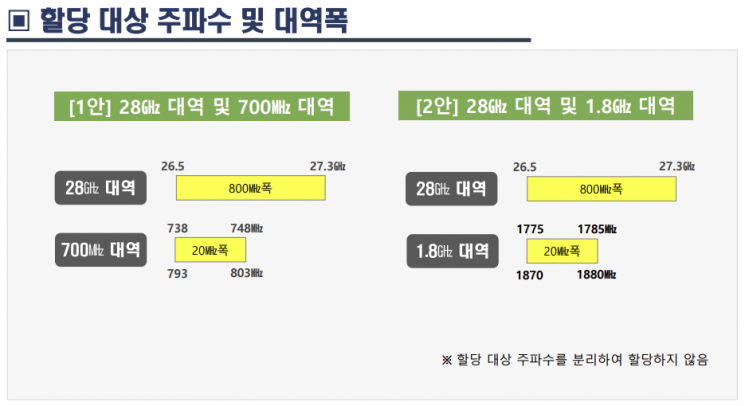
The frequency usage period is five years from the allocation date. Applications for allocation will be accepted in the fourth quarter, and if a new carrier that receives the actual frequency allocation emerges, they will hold the rights to use the 28GHz band from next year until 2028. The minimum competitive price for this frequency, based on nationwide allocation, has been set at approximately 74 billion KRW.
Previously, when KT was allocated this band in 2018, excluding the anchor frequency, they received the 28GHz 800MHz bandwidth for 207.8 billion KRW. Compared to then, the price has been reduced to about one-third.
Additionally, to reduce the market entry burden for new carriers, the government allows payment of 10% of the total fee, 7.4 billion KRW, in the first year of allocation. Thereafter, the payment structure increases incrementally: 15% in the second year, 20% in the third year, 25% in the fourth year, and 30% in the fifth year.
New carriers can receive allocations by service area units such as the metropolitan area, Honam region, or Chungcheong region without building a nationwide network on the 28GHz band. When allocated only by service area, the allocation fee is applied proportionally compared to the nationwide network. For example, if a new carrier is allocated the metropolitan area, the minimum competitive price will be 33.3 billion KRW, which is 45% of 74 billion KRW.
Ha Junhong, head of the Frequency Policy Division at the Ministry of Science and ICT, explained, "The fundamental policy direction is to lower the market entry barriers for new carriers," adding, "The allocation unit allows new carriers to choose between nationwide and regional options themselves."
Although the government has lowered the entry barriers to the telecommunications market, opinions suggest that it will still not be easy for new carriers to enter the market. Professor Kim Beomjun of the Department of Accounting at Catholic University pointed out at the forum that "In a situation where the telecommunications market growth is stagnant, new carriers in the 28GHz band also have to invest in networks," and "It is also problematic that a business model specialized for 28GHz has not yet emerged."
Concerns were also raised that new carriers lacking the capability to develop their business might fall behind in quality competition with MVNO operators. Shin Minsu, co-representative of the Green Consumer Network, said, "If a new carrier invests in certain regions and resolves nationwide coverage through roaming, we need to consider whether actual quality competition can occur," adding, "Also, since 28GHz is expected to be effective mainly in the B2B (business-to-business) sector, new carriers should consider ways to enhance welfare for general consumers."
© The Asia Business Daily(www.asiae.co.kr). All rights reserved.
![Clutching a Stolen Dior Bag, Saying "I Hate Being Poor but Real"... The Grotesque Con of a "Human Knockoff" [Slate]](https://cwcontent.asiae.co.kr/asiaresize/183/2026021902243444107_1771435474.jpg)
















