2nd Secondary Battery Materials Business Value Day
Sales Reach 62 Trillion Won... 51% Increase from Last Year's 41 Trillion
"Profit Generation to Begin in Earnest After 2026"
POSCO Holdings announced that it will secure a production capacity of 1 million tons of cathode materials and 670,000 tons of lithium and nickel by 2030, aiming to achieve sales of 62 trillion KRW, which is a 51% increase from its previous target.
On the 11th, POSCO Holdings held the "2nd POSCO Group Secondary Battery Materials Business Value Day" at the POSCO Center in Gangnam-gu, Seoul, where it unveiled the group’s growth vision and goals for the secondary battery materials business. About 200 people attended, including POSCO Holdings CEO Jung Ki-seop (Chief Strategy Officer), Vice President Yoo Byung-ok (Head of Eco-friendly Future Materials), Hong Young-jun, Head of the Secondary Battery Materials Research Institute at the Future Technology Research Institute, as well as domestic and international institutional investors and securities analysts.
CEO Jung stated, “Over the next three years, 46% of the group’s total investment will be allocated to the secondary battery materials business, and from 2026 onward, we will begin generating substantial profits.” He added, “POSCO Group’s secondary battery materials business is a sustainable business model where economic, environmental, and social values create a virtuous cycle.”
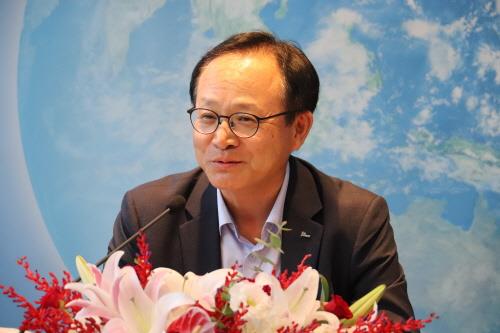 CEO Jeong Gi-seop stated on the 11th at the '2nd POSCO Group Secondary Battery Materials Business Value Day' held at the POSCO Center in Gangnam-gu, Seoul, "We will invest 46% of the group's total investment over the next three years in the secondary battery materials business." The photo shows CEO Jeong speaking at a business agreement ceremony in Taiwan on the 19th of last month. [Image source=Yonhap News]
Vice President Yoo said, “We will realize the business vision of ‘becoming a global leading company in secondary battery materials by 2030’ through building a full value chain from core raw materials to materials, achieving ‘quantitative growth’ by increasing production capacity and securing high profitability simultaneously, and ‘qualitative growth’ by expanding the product portfolio and advancing technology development.”
On this day, POSCO Holdings announced that it aims to achieve total sales of 62 trillion KRW in the secondary battery materials sector by 2030, which is a 51% increase from the target announced last year. Specifically, the targets include ▲lithium production capacity of 423,000 tons with sales of 13.6 trillion KRW ▲securing 240,000 tons of high-purity nickel with sales of 3.8 trillion KRW ▲securing production capacity of 70,000 tons of lithium, nickel, and cobalt through recycling business with sales of 2.2 trillion KRW ▲establishing a 1 million ton cathode material system with sales of 36.2 trillion KRW ▲a 370,000 ton anode material system with sales of 5.2 trillion KRW ▲and 9,400 tons of next-generation materials.
First, the goal for the lithium business is to become the world’s third-largest lithium company. To achieve this, POSCO will expand its business areas to include non-traditional lithium resources such as clay lithium, based on the salt lakes and mines it has already invested in. It will simultaneously develop the 3rd and 4th phases of the Argentine salt lakes to establish a salt lake lithium production system of 100,000 tons by 2027.
In the nickel business, POSCO plans to secure supply chain stability and prepare flexible responses to global trade barriers such as the U.S. Inflation Reduction Act (IRA) through joint ventures with smelters and technology development in Indonesia and other locations where economic feasibility is easier to secure. In the recycling business, POSCO plans to establish global hubs in key markets such as Europe and the U.S. to build a preemptive eco-friendly ecosystem that processes raw materials from used batteries and supplies them back to customers.
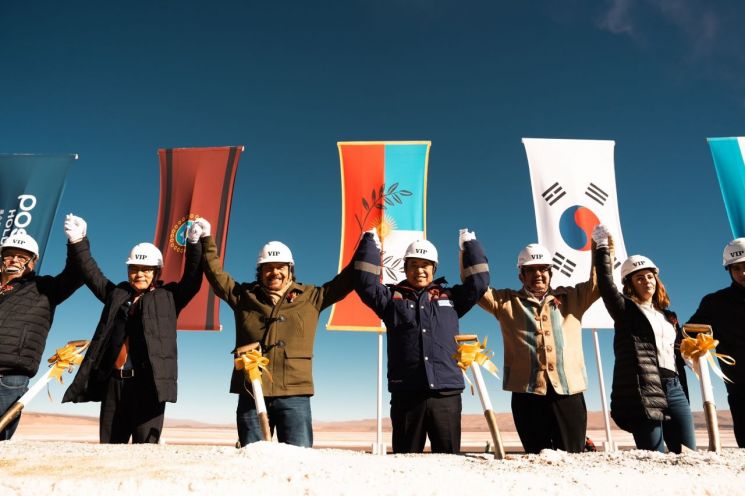 On the 28th of last month, attendees expressed their gratitude after the groundbreaking ceremony for the second phase of the lithium brine processing plant of POSCO Holdings in Argentina. (From left) Jose Ignacio, Federal Deputy Minister of Industry; Lee Yong-su, Ambassador of Korea to Argentina; Gustavo Saenz, Governor of Salta Province; Yoo Byung-ok, Vice President of POSCO Holdings; Raul Haril, Governor of Catamarca Province; Fernanda Avila, Federal Deputy Minister of Mining.
 [Photo by POSCO Holdings]
In the cathode materials business, POSCO will secure investment competitiveness through domestic-centered production integration and expand partnerships to increase global production capacity based on order backlog. In the anode materials business, it will establish a production and sales system for all products including natural and artificial graphite and silicon-based materials. In the next-generation materials business, POSCO plans to develop a lithium metal anode material business as a high-capacity anode material for all-solid-state batteries, and is preparing to gradually expand production capacity of solid electrolytes based on the production line of POSCO JK Solid Solutions.
This year marks the inaugural year of commercial lithium production for the group. Following the completion of the POSCO HY Clean Metal recycling plant, the POSCO Pilbara Lithium Solutions lithium hydroxide plant is also nearing completion. Subsequently, with phased commercial production of brine lithium and nickel, once substantial profits begin, POSCO plans to complete a fully ‘closed-loop’ eco-friendly resource circulation system in the secondary battery materials industry, from raw materials to used battery recycling.
From the 12th to the 14th, POSCO Group will also hold the "POSCO Group Secondary Battery Materials Business Value Day" for over 100 overseas investors in Hong Kong and Singapore.
© The Asia Business Daily(www.asiae.co.kr). All rights reserved.


















