Excluding Essential Medical Staff Such as Emergency Room Personnel
Demands for Expanding Medical Workforce and Integrated Nursing Care Services
The Korean Health and Medical Workers' Union (KHMU), which has announced a general strike on the 13th, plans to proceed with the strike as scheduled. If the strike actually takes place, it will be the first in 19 years since the general strike in 2004. Since the KHMU includes healthcare workers such as nurses, confusion in the medical field is expected to be inevitable.
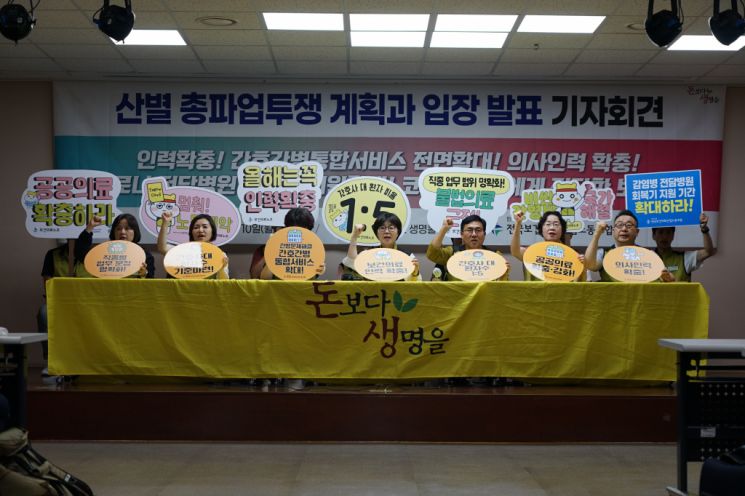 The Health and Medical Workers' Union held a press conference on the 10th at the union headquarters in Yeongdeungpo-gu, Seoul, announcing their general strike plans and stance.
 [Photo by Health and Medical Workers' Union]
On the morning of the 10th, the KHMU held a press conference at its headquarters in Yeongdeungpo-gu, Seoul, announcing that it will launch a general strike starting on the 13th of this month. From the 28th of last month to the 7th of this month, a strike vote was conducted among 64,257 union members across 127 branches and 145 workplaces, resulting in a turnout rate of 83.07% and 91.63% (48,911 members) voting in favor, thus approving the general strike.
The union explained that the members who secured the right to strike account for 75.49% of the total, marking the largest scale in history. Na Sun-ja, chairperson of the KHMU, stated, "If the employers' side continues to negotiate insincerely and the government maintains its irresponsible attitude, the KHMU will launch a full-scale general strike starting at 7 a.m. on the 13th as planned."
The KHMU has presented '7 major demands,' including ▲ resolving nursing care fees and fully expanding integrated nursing care services ▲ assigning one nurse per five patients ▲ establishing appropriate staffing standards by occupation ▲ eradicating illegal medical practices and expanding physician workforce ▲ expanding public healthcare and recovery support ▲ fair compensation and wage increases ▲ blocking labor deterioration. To this end, the union has been negotiating with employers and the government since May, but points out that no party has shown a responsible willingness to resolve the issues.
The union plans to hold a pre-strike rally on the 12th at various medical institutions and regions, then gather in Seoul on the first day of the strike, the 13th, for a large-scale rally. On the 14th, they will gather in four key strike locations?Seoul, Busan, Gwangju, and Sejong?to continue the strike actions. The strike on the 13th and 14th will be conducted jointly with the Korean Confederation of Trade Unions (KCTU), the higher-level organization, and from the 17th onward, the KHMU will proceed with its own strike. Even if the strike begins, the union has decided to deploy essential personnel in life-critical areas such as emergency rooms, operating rooms, intensive care units, delivery rooms, and neonatal units to protect patient lives and safety. The number of participants in the strike is expected to be around 45,000.
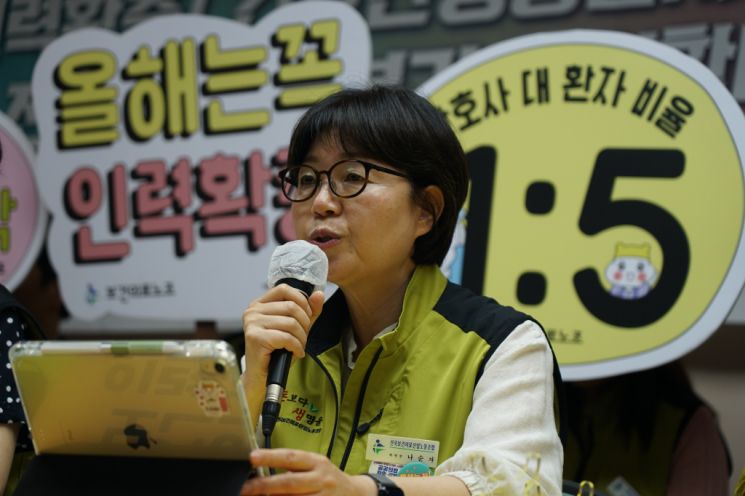 Na Sun-ja, Chairperson of the Health and Medical Workers' Union, is delivering the general strike plan and stance at a press conference on the 10th.
 [Photo by Health and Medical Workers' Union]
If the KHMU's general strike materializes, it will be the first in 19 years since the general strike for the five-day workweek in 2004. Although strikes have occurred at branch levels under the KHMU, actual general strikes have been extremely rare. During the COVID-19 pandemic in September 2021, a general strike resolution was made, raising tensions, but it was withdrawn after a dramatic agreement between the government and the union. Given that the KHMU represents workers who protect public health, the weight of this general strike is inevitably different.
However, this time the union is taking a firm stance. They cannot stand by as the imminent collapse of the healthcare system unfolds. The union points out that the recurring 'emergency room cycling' incidents, gaps in essential medical services, and shortages of medical personnel have not been resolved at all. The union appealed, "If the attitudes of employers and the government do not change, Korea's healthcare will inevitably move beyond crisis to collapse. Without solutions, the public suffering and damage caused by healthcare collapse cannot be overcome, and healthcare workers will be driven to the brink of despair due to poor working conditions and a bleak future."
Earlier, the simultaneous dispute mediation application by the KHMU included participation from 21 private university hospital branches (29 institutions), 12 special-purpose public hospital branches, 26 Korean Red Cross branches, 26 local medical center branches, 19 private small and medium hospital branches, 7 branches from psychiatric, rehabilitation, and nursing medical institutions, and 10 irregular worker branches (16 institutions) including cleaning, parking, facilities, and security, covering all sizes and types of medical institutions. The Ministry of Health and Welfare formed a 'Medical Institution Strike Situation Monitoring Team' led by Second Vice Minister Park Min-su last month and has issued a 'concern' level alert for the healthcare disaster crisis to respond accordingly.
© The Asia Business Daily(www.asiae.co.kr). All rights reserved.


















