GIST Develops 'Organometallic Halide Perovskite Photoelectrode'
Achieves 12.8% Photoelectrode Efficiency, Only 10.2% Efficiency Loss After 12 Hours Use
Domestic researchers have developed a new technology that can raise the productivity and efficiency of green hydrogen production using solar energy to a world-class level.
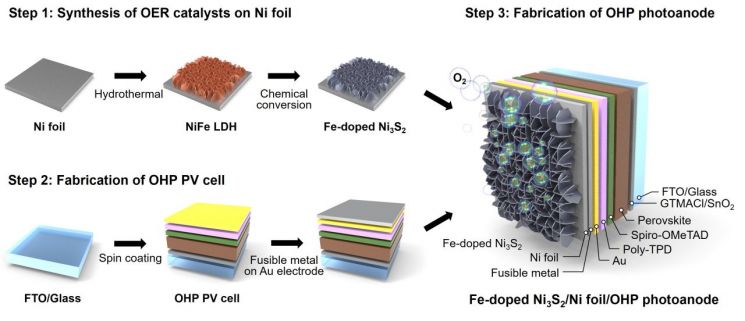 [Figure 1] Schematic of perovskite photoanode combined with Fe-Ni3S2 synthesized on nickel foil as a protective layer. Image source provided by GIST
The Gwangju Institute of Science and Technology (GIST) announced on the 10th that Professor Lee Sang-han of the Department of New Materials Engineering, together with Professor Seo Jang-won of KAIST, developed an "organic metal halide perovskite photoelectrode" that achieves world-class efficiency and lifespan by applying a new technology that suppresses the loss of "photogenerated carriers."
In today's world, where carbon neutrality is gaining attention globally, hydrogen energy is an essential eco-friendly energy source that must be produced. However, most hydrogen is produced from fossil fuels and emits carbon dioxide as a byproduct, making the technology for producing "green hydrogen" using solar energy indispensable. When producing green hydrogen using solar energy, the photoelectrochemical water-splitting method is mainly used. In this method, the photoelectrode absorbs sunlight to generate photogenerated carriers, which then split water to produce green hydrogen. If these photogenerated carriers are lost, the efficiency of the photoelectrode decreases.
The research team succeeded in developing a world-class perovskite photoelectrode by applying two key technologies to suppress the loss of photogenerated carriers. By coating glycidyltrimethylammonium chloride, a monomolecular organic compound, onto the tin oxide of the photoelectrode, they controlled defects at the interface between tin oxide and perovskite, reducing the phenomenon where photogenerated carriers are released as thermal energy instead of being converted into electrical energy.
Furthermore, they replaced the nickel-iron bilayer hydroxide catalyst synthesized on the nickel foil protective layer of the photoelectrode with an iron-doped nickel sulfide catalyst, which promoted the water-splitting reaction between the photoelectrode and the electrolyte. By controlling defects inside the photoelectrode and promoting the water-splitting reaction externally, the team effectively suppressed the loss of both internal and external photogenerated carriers. As a result, they achieved a world-class photoelectrode efficiency of 12.8% and high stability, with efficiency decreasing by only 10.2% after 12 hours of use.
Professor Lee said, "We demonstrated that it is possible to manufacture perovskite photoelectrodes with world-class efficiency and stability through 'loss control' technology, departing from conventional methods," adding, "It is expected to be applied to next-generation photoelectrodes to enhance green hydrogen productivity."
The research results were published on the 17th of last month in the international energy journal 'Advanced Energy Materials'.
© The Asia Business Daily(www.asiae.co.kr). All rights reserved.
!["I'd Rather Live as a Glamorous Fake Than as a Poor Real Me"...A Grotesque Success Story Shaking the Korean Psyche [Slate]](https://cwcontent.asiae.co.kr/asiaresize/183/2026021902243444107_1771435474.jpg)
















