Seoul City Confirms Rapid Integrated Plan on the 10th
"Maximizing Han River's Appeal to Transform into a World-Class Waterfront City"
Improving Accessibility for Citizens to Enjoy the Han River in Daily Life
Apgujeong Districts 2 to 5, the most affluent neighborhoods in South Korea, will be transformed into a mini new town with up to 50 floors and a total of 11,800 households through Seoul City's Rapid Integrated Planning. A pedestrian bridge connecting Apgujeong and Seongsu will be constructed, and a covered park will be built over the apartment complexes and the Han River, which are currently separated by the Olympic Expressway. Cultural and leisure facilities will be established along the waterfront, allowing citizens to enjoy the Han River in their daily lives. Seoul City has drawn a future blueprint to develop Apgujeong as a single space that maximizes the charm of the Han River beyond the scale of individual complexes.
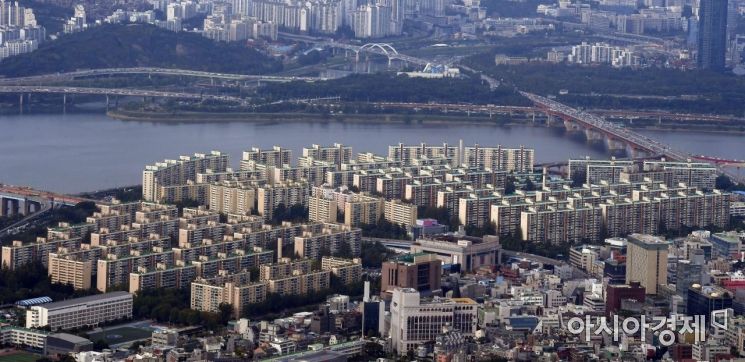
On the 10th, Seoul City announced the confirmation of the Rapid Integrated Planning for the reconstruction of Apgujeong Districts 2 to 5, which will change the paradigm of riverside living along the Han River.
Despite being located in the heart of Seoul's Han River area, the Apgujeong apartments, which are over 40 years old, have formed a uniform landscape with slab-type apartments. Until the 1950s, the Han River was a place where boats floated and swimming was possible, but since the mid-1960s when Han River development began, it has been covered with concrete, and large apartment complexes have sprung up, making the surrounding scenery barren.
In response, Seoul City prepared the Rapid Integrated Planning for Apgujeong Districts 2 to 5 with the goal of creating residential complexes that embody the charm and value of the Han River. Through this plan, the Apgujeong apartments will be reconstructed into complexes with around 50 floors and 11,800 households, leading the future attractive riverside residential culture of the Han River.
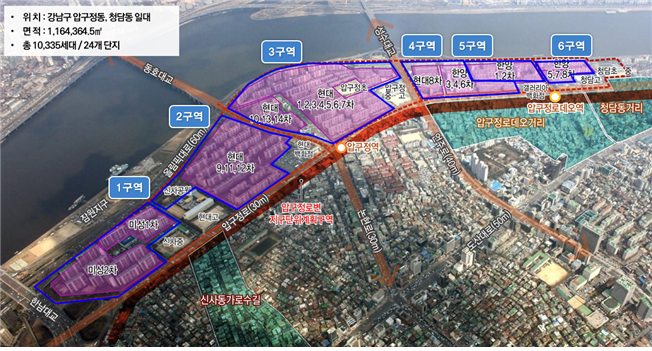
In particular, Seoul City has prepared the 'Comprehensive Plan for Apgujeong Districts 2 to 5' to ensure consistency in landscape, pedestrian pathways, green spaces, and transportation systems as one city, beyond the scale of individual complex plans, by promoting rapid integrated planning simultaneously for Apgujeong Districts 2 to 5. Currently, in Apgujeong-dong, about 10,000 households in apartments such as Miseong, Hyundai, and Hanyang are divided into six districts pursuing integrated reconstruction.
The three strategies of the Comprehensive Plan for Apgujeong Districts 2 to 5 are ① forming a Han River panoramic view with creative and innovative design ② creating a leisure and cultural ecosystem connecting Seongsu and Apgujeong as one living area ③ activating pedestrian streets and planning future residential spaces.
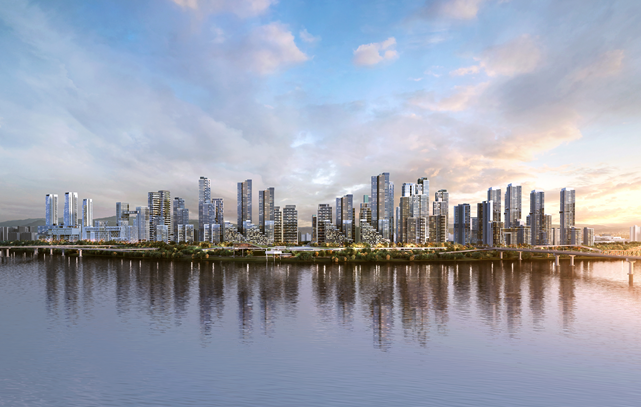
Relaxed Height Regulations through Innovative Design... Panoramic Views Harmonizing with the Han River
Seoul City has leveraged Apgujeong's fan-shaped characteristics to form a panoramic view along the Han River by introducing 'creative and innovative design' and removing rigid height regulations. In March, Seoul Mayor Oh Se-hoon announced the 'Great Han River Project,' promising urban planning support to strengthen the public nature of the monotonous and privatized Han River-side reconstruction and create a rhythmic urban landscape.
Additionally, a wide-area visual corridor was formed along Dongho Bridge and Seongsu Bridge, which connect Gangnam and Gangbuk, linking major resources in Gangbuk such as Seoul Forest, Eungbongsan, and Dalmaji Peak Park with Apgujeong's pedestrian visual corridor to induce a three-dimensional landscape.
Along with this, the 30-meter section along the Han River will be designated as a waterfront-specialized zone, creating a Han River edge where the city and nature merge seamlessly through specialized designs such as shared resident facilities, open spaces, and scenic spots.
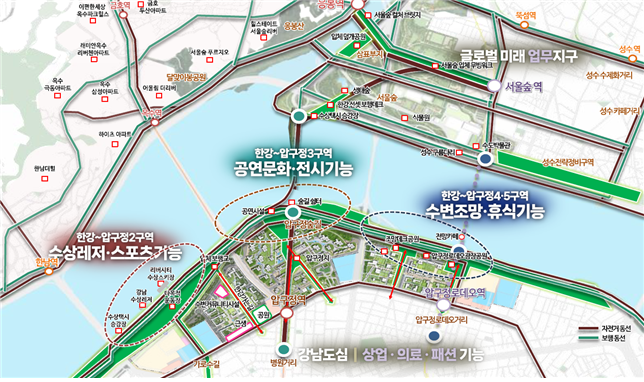
Creating a Leisure and Cultural Ecosystem Connecting Seongsu and Apgujeong as One Living Area
The plan is to connect Gangbuk (Seongsu) and Gangnam (Apgujeong) as one living area, making the waterfront the center of daily life. By creating specialized waterfront hubs in each district, the bond with the river will be restored, fostering a leisure and cultural ecosystem for Seoul citizens.
In particular, with the acceptance by the city of the pedestrian (bicycle) bridge from Apgujeong to Seongsu proposed as a public contribution by the Apgujeong District 3 union, the commercial and cultural functions of Gangnam (Garosu-gil, Rodeo Street, etc.) and the global future business district of Gangbuk (Sampyo site, Seongsu-dong), along with the nature of Seoul Forest, will be connected within a 30-minute walking radius.
Each district will feature a waterfront community facility (leisure hub) in District 2, a covered facility (cultural hub) in District 3, and an observation deck park (viewpoint hub) in Districts 4 and 5, transforming the Han River edge into a place that offers special impressions to Seoul citizens.
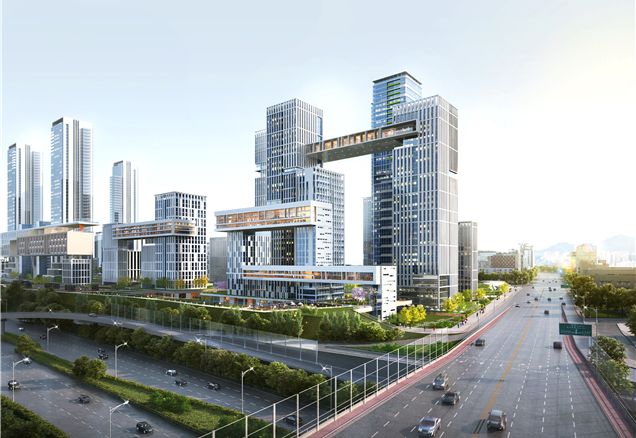 Hangang Riverside Skyline in Apgujeong District 4, featuring innovative designs including community facilities and void spaces along the Hangang River. Photo by Seoul City
The 'Path to the Han River' Cut Off by Apartments Will Be Revitalized
To restore vitality to the currently apartment-blocked 'path to the Han River,' various neighborhood living facilities and shared resident facilities will be arranged, and living space designs embodying future residential culture will upgrade residents' lives.
Along the north-south pedestrian axes connecting the waterfront hubs in each district, street-type commercial facilities, community facilities, and ecological green spaces will be developed together. East-west along Apgujeong-ro, neighborhood living facilities and parks will be alternately arranged to create streets with diverse pedestrian activities for walking and lingering.
In particular, part of District 3 near Apgujeong Station will be upgraded from Type 3 to semi-residential area to induce various mixed functions such as commercial, office, and cultural uses, contributing to the activation of the station area.
Furthermore, the arrangement and quality of public rental housing and sale units within the districts will be planned equally to actively achieve social mix. After comprehensively reviewing public contribution principles and fairness in securing public rental housing by district, about 1,200 public housing units are planned to be secured.
To facilitate smooth progress of the maintenance project, Seoul City will open the draft of the Apgujeong Apartment District Unit Plan for public inspection from June 30 to July 13, and then promptly decide and announce the unit plan after legal procedures such as review by the Urban and Architecture Joint Committee.
Moreover, the city plans to strictly manage the project so that the purpose of rapid integrated planning is consistently maintained. Districts that do not meet the intent of rapid integrated planning will proceed as general projects.
Jo Nam-jun, Director of Urban Planning, said, "The reconstruction of Apgujeong apartments, once a symbol of South Korea's economic development, is significant in that it not only improves the residential environment but also incorporates the city's public nature so that citizens can enjoy the Han River in their daily lives," adding, "We hope this case will lead as a world-class waterfront city model that realizes the potential of the Han River and pioneers a leading residential culture."
© The Asia Business Daily(www.asiae.co.kr). All rights reserved.



















