As the peak summer vacation season approaches, accommodation and dining prices are soaring. This is due to the prolonged high inflation and the first vacation peak season since the lifting of COVID-19 quarantine requirements. In particular, considering the characteristic that service prices such as dining and travel expenses rarely fall once they rise, concerns are emerging that the burden of outing costs will persist for a long time.
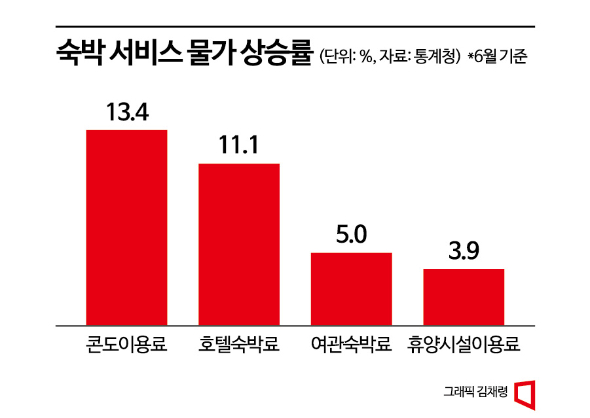
According to Statistics Korea on the 10th, the condominium usage fee in June this year rose 13.4% compared to the same month last year. This is the largest increase since November 2018 (14.9%), before the COVID-19 outbreak. The sharp upward trend has continued from 2.0% in January this year to 6.4% in March and 10.8% in May. During the same period, hotel accommodation fees also rose 11.1%, maintaining double-digit growth rates since March this year. Motel accommodation fees have also maintained an average monthly increase rate of around 5% since October last year.
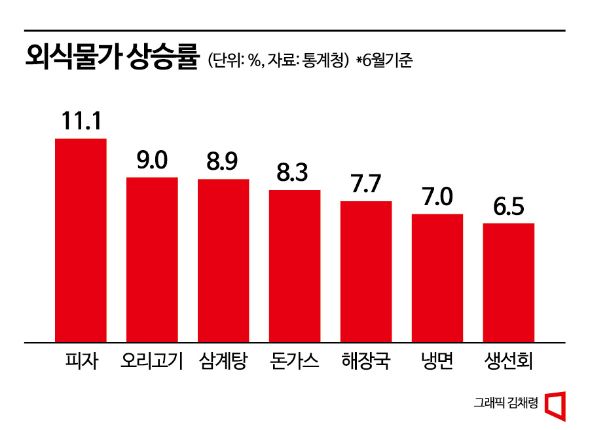
The overall dining price index in June was 6.3%, which is 3.6 percentage points higher than the consumer price inflation rate (2.7%). The dining price index only slowed by 1.4 percentage points compared to 7.7% in January this year. This is significantly lower compared to the consumer price inflation rate, which slowed by 2.5 percentage points during the same period. Specifically, prices for pizza (11.1%), hamburgers (9.8%), duck meat (9.0%), pork cutlets (8.3%), hangover soup (7.7%), and cold noodles (7.0%) rose sharply.
In particular, dining costs are increasing contrary to the consumer price trend, adding to the burden. Last month, while the consumer prices of pork fell by 7.2%, domestic beef by 5.1%, and imported beef by 8.0% compared to a year ago, restaurant prices using these raw materials rose, with pork ribs increasing by 6.4% and pork belly by 5.4%.
Because service prices that have risen once are hard to fall, there is an analysis that high inflation will continue into the second half of the year. Professor Sung Tae-yoon of Yonsei University’s Department of Economics said, "Dining costs are a business form that combines food material costs, public utility fees such as electricity, and labor costs, so even if food material costs decrease, dining prices do not immediately slow down."
As the cost burden grows, more people are giving up on summer vacations this year. According to PMI, an online survey specialist, 73% of respondents said they either have no plans to go on vacation this summer or have not yet made plans. There is also a widening gap in cultural expenses according to income levels. As of the first quarter, the entertainment and cultural expenses of the top 20% income group (quintile 5) were 382,000 KRW, about twice that of the bottom 20% income group (quintile 1), which was 194,000 KRW.
© The Asia Business Daily(www.asiae.co.kr). All rights reserved.
![User Who Sold Erroneously Deposited Bitcoins to Repay Debt and Fund Entertainment... What Did the Supreme Court Decide in 2021? [Legal Issue Check]](https://cwcontent.asiae.co.kr/asiaresize/183/2026020910431234020_1770601391.png)
















