New Tube Allowing Diameter Adjustment and Side Effect Prevention
Domestic researchers have developed an 'aqueous humor outflow tube' that can control intraocular pressure (IOP) according to the progression of glaucoma.
The research team led by Professor Hakjun Sung from the Department of Medical Engineering at Yonsei University College of Medicine, Professor Gyubae Lee from the Department of Biomedical Sciences, Professor Chanyoon Kim from the Department of Ophthalmology at Severance Hospital, and Professor Woongrak Choi from the Department of Ophthalmology at Gangnam Severance Hospital announced on the 10th that they have created an aqueous humor outflow tube capable of adjusting IOP according to the stage of glaucoma caused by increased IOP.

Glaucoma is a chronic disease in which the optic nerve is damaged due to increased intraocular pressure. It occurs when the aqueous humor, which maintains IOP, is not sufficiently drained. One treatment method involves inserting a tube that drains aqueous humor into the eye. The problem is that it is difficult to adjust the amount of aqueous humor according to changes in the patient's IOP. The amount of aqueous humor varies depending on the tube diameter, but once a silicone tube is inserted into the eyeball, the diameter cannot be adjusted.
Initially, because the diameter is large, it lowers the IOP significantly. In fact, the proportion of patients experiencing this initial hypotony is between 50% and 70%. Over time, as the eye recognizes the silicone as a foreign substance, excessive fibrous tissue forms around the aqueous humor outlet, obstructing smooth drainage and causing a rebound increase in IOP.
The research team developed a new tube that can solve these side effects and confirmed its effectiveness in a rabbit model. First, they developed a tube using a shape-memory polymer material provided by TMD Lab, which can have its diameter adjusted by argon laser, an ophthalmic treatment laser. They also coated the inside of the tube with a hydrogel capable of containing the anti-fibrotic drug fluorouracil. This not only reduced the tube diameter to prevent initial hypotony but also allowed the drug to be released steadily over a long period, preventing fibrous tissue formation on the eye surface. When this completed tube is inserted into the eye, the hydrogel decomposes, gradually increasing the diameter over 14 days, preventing excessive initial IOP reduction. Afterward, the diameter can be adjusted with the argon laser, enabling stable IOP maintenance.
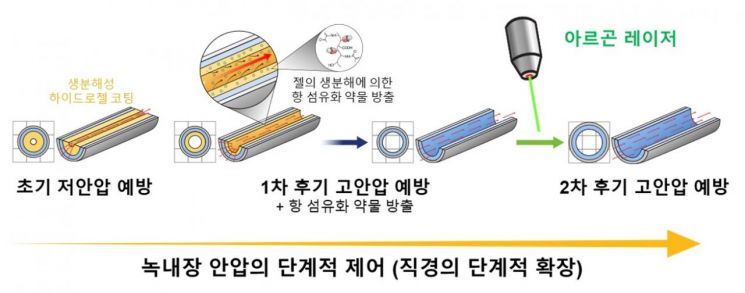 The principle of intraocular pressure regulation according to the glaucoma pathology of the waterproof tube developed by the Yonsei University research team. [Photo by Yonsei Medical Center]
The research team verified the effect of the developed tube over 42 days in a rabbit model induced with glaucoma. During the first 14 days after tube insertion, the average IOP of the conventional tube was below 5 mmHg, indicating severe hypotony, whereas the research team's tube maintained a normal IOP level of about 7.5 mmHg, showing excellent prevention of initial hypotony. Additionally, the anti-fibrotic drug suppressed fibrous tissue formation, ensuring smooth aqueous humor drainage, and by expanding the diameter with the argon laser, they were able to prevent the side effect of IOP increase throughout the study period.
Professor Hakjun Sung said, "Tubes used in glaucoma aqueous humor treatment have limited diameter adjustability, making it difficult to respond to changes in patient IOP. The tube developed this time can adjust its size, preventing not only initial hypotony but also late-stage ocular hypertension, thereby enhancing the commercialization value of TMD Lab, which licensed the technology."
The research results were published in the internationally renowned materials science journal Advanced Functional Materials (IF=19.924).
© The Asia Business Daily(www.asiae.co.kr). All rights reserved.


















