5 Months Since Implementation... 16 Trillion Won Spent on New Home Purchases
Interest Rate Frozen at 4% Range... More Competitive Than Commercial Banks
Likely to Influence BoK's Base Rate Decision on the 13th
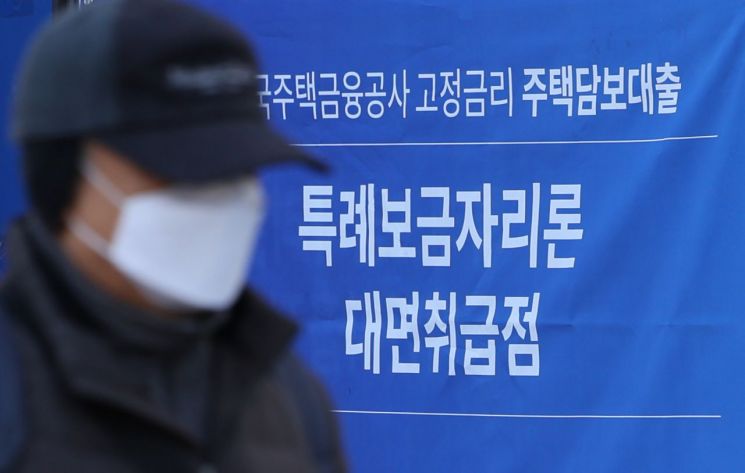
Since the beginning of this year, the Special BoGeumJari Loan has been driving the increase in household loans, with more people buying homes using this loan. Initially, many used the Special BoGeumJari Loan to refinance at lower interest rates. However, within five months of its launch, loans amounting to 16 trillion won were issued for new home purchases. At the Bank of Korea's Monetary Policy Committee meeting held in May, the Special BoGeumJari Loan was cited as a cause of the increase in household loans. Concerns were raised that this was leading to an increase in new loans from banks.
"At the early stage of the Special BoGeumJari Loan implementation, many refinancing loans were made to switch from variable to fixed interest rates. However, recently, this policy has led to new loans. The increase in household loans in the financial sector since April was influenced by the decline in market interest rates, but the impact of the Special BoGeumJari Loan is significant." (Bank of Korea Monetary Policy Committee, May 25)
Real Estate Market is the Biggest Variable
Ahead of the Bank of Korea's base rate decision on the 13th, Asia Economy conducted a survey from the 4th to the 7th among 24 domestic and international securities analysts and economic research institute researchers. According to the survey, the biggest variable for future domestic monetary policy was most frequently identified as the "real estate market" (10 respondents, multiple answers allowed). They predicted that if house prices rise and household loans increase, the tightening stance could last longer than expected.
In the financial sector, the Special BoGeumJari Loan is considered one of the barometers for real estate loans. The supply target for this year alone is 39.6 trillion won. Since its launch at the end of January, about 28.236 trillion won has been disbursed. Of this, the amount used for "new home purchases" (15.9191 trillion won) accounted for 56.4%. The amount used for "repayment of existing loans" for refinancing (10.1382 trillion won) was 35.9%. The amount borrowed by tenants to return deposits under the "rental deposit return" purpose (2.1787 trillion won) accounted for 7.7%.

At the end of March, the proportions of "new home purchases" (46.0%) and "repayment of existing loans" (45.4%) among total applications were similar. As the housing market gradually loosened, the funds allocated for new home purchases increased. A financial authority official explained this as "housing purchase demand is reviving," adding, "Initially, refinancing demand was high, but recently, applications for new home purchases have become much more frequent."
Increase in Household Loans in the Banking Sector
Recently, as bank interest rates have risen, the interest rate conditions for the Special BoGeumJari Loan have become relatively favorable. As of July, the preferential type applies interest rates of 4.05% (10 years) to 4.35% (50 years) per annum, and the general type applies 4.15% (10 years) to 4.45% (50 years) per annum. Compared to commercial banks' mortgage loan variable rates of 4-6% and fixed rates of 4-5%, these rates are lower.
The pace of increase in household loans in the banking sector, centered on mortgage loans, is also accelerating. The household loan balance of the five major banks (KB Kookmin, Shinhan, Hana, Woori, NH NongHyup) in June was 678.2454 trillion won, an increase of 633.2 billion won compared to the previous month (677.6122 trillion won). This marks two consecutive months of increase since the five major banks' household loan balance turned to an upward trend in May after one year and five months. The increase was also larger than in May (143.1 billion won).
Mortgage loans had the greatest impact. The mortgage loan balance of the five major banks in June was 511.4007 trillion won, up 1.7245 trillion won from the previous month (509.6762 trillion won). Although unsecured loans decreased from 109.6731 trillion won to 108.9289 trillion won, the increase in mortgage loans offset this decline, maintaining the overall upward trend in household loans.
© The Asia Business Daily(www.asiae.co.kr). All rights reserved.


















