11 Independent and Opposition Lawmakers Depart
"Block as Much as Possible Until Safety Is Guaranteed"
Request to IAEA for 'Postponement of Japan's Discharge'
Members of the National Assembly affiliated with the Democratic Party of Korea have embarked on a trip to Japan to prevent the discharge of contaminated water from the Fukushima nuclear power plant into the ocean. They plan to visit the Prime Minister's Office and the IAEA (International Atomic Energy Agency) Japan branch during their 3-day, 2-night visit to hold protest rallies.
On the 10th, 11 members of the Democratic Party and independents, along with a delegation of fishermen representatives, will visit Japan to stop the ocean discharge of contaminated water. The delegation includes co-leader Assemblyman An Min-seok and the party’s Fukushima Nuclear Contaminated Water Ocean Discharge Countermeasure Committee Chair Assemblyman Wi Seong-gon.
Before departure, they met with reporters at Gimpo Airport’s departure hall that morning and stated, "From July 10 to 12, during our 3-day, 2-night stay, we will meet with local politicians, experts, and civil society in Japan to strengthen solidarity struggles and raise awareness of South Korea’s opposition to Fukushima nuclear contaminated water through global media."
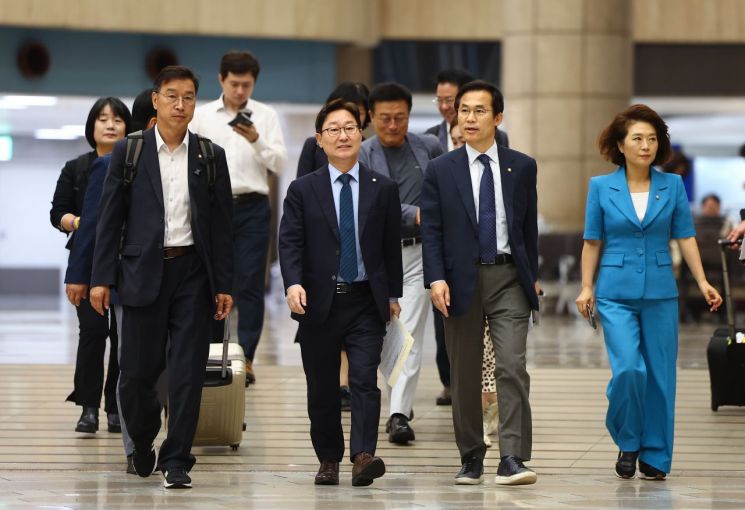
They said, "The Japanese government’s ocean discharge of Fukushima nuclear contaminated water is an irreversible act, and marine pollution is a disaster affecting all humanity," adding, "We cannot pass such a fatal burden on to future generations."
They continued, "We must prevent the discharge as much as possible until safety is guaranteed," and said, "We will meet with Japanese politicians, experts, and civil society to devise joint response measures and do our utmost to stop the ocean discharge of Fukushima nuclear contaminated water through international cooperation before returning."
Earlier, Assemblymen Wi Seong-gon, Yang Yi-won-young, Yoon Young-duk, and Yoon Jae-gap had visited Japan once in April.
The Democratic Party met with Rafael Grossi, Director General of the IAEA, at the National Assembly the day before to express concerns about the ocean discharge of Fukushima nuclear contaminated water. The Fukushima Nuclear Contaminated Water Ocean Discharge Countermeasure Committee requested Director General Grossi to ask Japan to postpone the discharge and to explore alternative measures in solidarity with the international community. Director General Grossi stated, "A conclusion was reached in accordance with international safety standards," and pledged to remain stationed in Fukushima, Japan, for monitoring purposes for several years to decades.
On this day, the delegation also pointed out issues with the review report released by the IAEA. They criticized, "The IAEA (International Atomic Energy Agency) released a report solely responding to the Japanese government’s demands and repeated the same content like a parrot during its visit to South Korea," adding, "The IAEA claims it does not take responsibility for the report’s content."
They further questioned, "What is the Yoon Suk-yeol administration doing in this urgent and grave situation?" and said, "The government and ruling party, responsible for protecting the safety of the people and the sea, which is the livelihood of fishermen, are consistently without measures." They also pointed out, "Instead, they are dismissing the natural voices of the people concerned about public health and marine environmental damage as rumors."
The delegation plans to hold a rally in front of Prime Minister Fumio Kishida’s office, visit the IAEA Japan branch to protest, and begin a sit-in protest in front of the Japanese National Diet on the same day. On the 11th, they will meet with the Japanese Parliamentary Group for Zero Nuclear Power and 100% Renewable Energy to issue a joint declaration, and meet with the Social Democratic Party’s parliamentary group. On the 12th, they will hold a press conference at the Foreign Correspondents’ Club in Japan and participate in a walking protest to stop the ocean discharge of nuclear contaminated water.
Additionally, the Democratic Party is considering legislative measures such as compensation for damages to fisheries and fishery workers that may occur if the contaminated water is discharged, and a bill to ban all imports of Japanese seafood products.
© The Asia Business Daily(www.asiae.co.kr). All rights reserved.

















