As the discharge of contaminated water from the Fukushima nuclear power plant in Japan enters its final countdown, a shortage of 천일염 (cheonil salt) continues. The government has decided to supply about 400 tons of 천일염 from its reserves to the market, but there are still concerns that it remains difficult to purchase in stores.
According to Seoul City on the 9th, the average retail price of 20 kg of 천일염 last month surged 83.4% compared to the previous month, reaching 57,840 KRW. In 2019, a 20 kg bag was priced in the low 3,000 KRW range, but production decreased due to the impact of COVID-19, and demand has recently surged amid concerns over Japan’s contaminated water discharge.
In response to the shortage of 천일염 supply in the market, the government released 5,600 tons of stock held by Nonghyup earlier this month, selling it at 485 local Hanaro Mart stores nationwide. Additionally, 100,000 tons of new-season salt have begun to be shipped from production areas. From the 29th of last month to the 11th of this month, the government has also strengthened supply by selling reserved 천일염 at about 180 supermarkets nationwide.
However, at some large supermarkets and other locations, purchasing of 천일염 is still restricted, with limits such as allowing only two purchases per person when buying 1 kg or more, indicating ongoing difficulties in supply and demand.
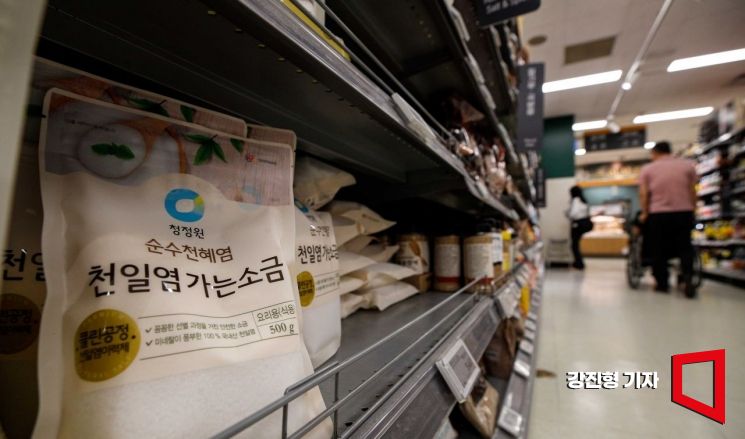 On the 7th, interest in sea salt surged following Japan's plan to discharge contaminated water from its nuclear power plant, leading to hoarding behavior. Salt is being sold at a large supermarket in Seoul. Photo by Jinhyung Kang aymsdream@
These concerns arose after Tokyo Electric Power Company (TEPCO) revealed that rockfish caught inside the harbor of Fukushima Daiichi Nuclear Power Plant contained radioactive cesium at 18,000 Bq (becquerels), which is 180 times above the Japanese Food Sanitation Law standard. Although the International Atomic Energy Agency (IAEA) recently judged that Japan’s plan to discharge contaminated water from Fukushima meets safety standards, worries about the safety of domestic seafood due to the contaminated water remain unresolved.
As the supply of 천일염 becomes unstable, theft incidents related to 천일염 have also been on the rise in some areas. Last month, a couple in their 60s in Seogwipo City, Jeju, was involved in stealing about 700 bags of 20 kg 천일염 worth approximately 21 million KRW.
The problem is that if Japan’s discharge of contaminated water becomes full-scale, concerns over seafood safety could intensify further. The government plans to do its best to stabilize 천일염 supply while strengthening crackdowns on illegal distribution and sales. In particular, it will focus on cracking down on acts such as disguising imported salt as domestic salt and repackaging imported salt bags.
© The Asia Business Daily(www.asiae.co.kr). All rights reserved.

















