Constitutional Court: "Prosecution Acknowledges Charges Despite No Exchange or Demand of Benefits"
The Constitutional Court has ruled that the prosecution's decision to suspend indictment, which judged that the victim received compensation despite having been deceived by a voice phishing criminal and having handed over personal information, is illegal and must be canceled.
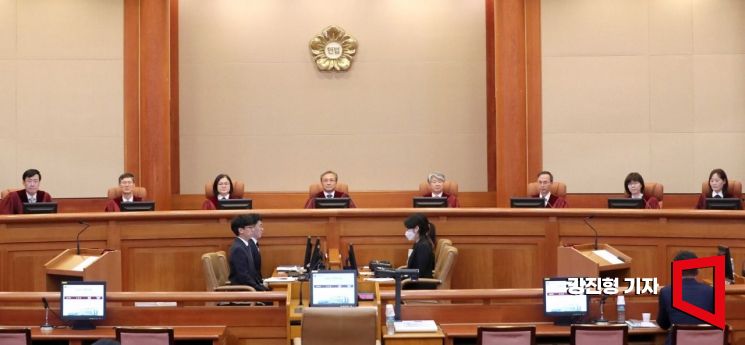
According to the legal community on the 9th, the Constitutional Court unanimously accepted Mr. A's constitutional complaint, who claimed that the Ulsan District Prosecutors' Office's suspension of indictment violated his right to pursue happiness, and decided to cancel the prosecutor's suspension of indictment.
Mr. A received a proposal from an unidentified person he met through an Instagram advertisement, stating, "If you deposit investment funds, we will return the profits generated." After depositing the investment funds, he provided authentication numbers to receive the profits, but he did not get his investment back. Instead, an account under Mr. A's name was opened and used for voice phishing crimes.
The prosecution judged that Mr. A handed over authentication numbers to the voice phishing criminal while receiving, demanding, or promising compensation, and thus suspended indictment in July 2021. Suspension of indictment is a type of non-prosecution disposition, but unlike a dismissal due to lack of evidence, it is applied when there is sufficient suspicion of a crime and prosecutorial conditions are met, but the prosecutor decides not to bring the case to trial considering the suspect's criminal record, extent of damage, agreement with the victim, degree of remorse, and other factors.
Mr. A argued that he sent the documents and authentication numbers necessary for identity verification to the unidentified person to withdraw the money he transferred, not to open an account, so he did not hand over the account while receiving, demanding, or promising compensation. He claimed that the prosecution's suspension of indictment violated his right to pursue happiness and filed a constitutional complaint.
The Constitutional Court found that the prosecution's suspension of indictment against Mr. A violated his rights to equality and to pursue happiness. The Court stated, "The time when the petitioner was asked to hand over the access medium was after he was informed that profits had been generated from his investment, so there is no correlation between the delivery of the authentication number and the occurrence of profits," and "Moreover, until the authentication number was handed over, the petitioner had no knowledge from the unidentified person about opening an account."
Furthermore, the Court ruled, "It is difficult to recognize any economic benefit corresponding to the petitioner's delivery of the access medium, and it is also difficult to acknowledge that the petitioner had the awareness of handing over the access medium while receiving, demanding, or promising compensation," adding, "Despite the inability to recognize the existence of compensation and the petitioner's awareness of it, the suspension of indictment was imposed by acknowledging the petitioner's guilt, which constitutes arbitrary exercise of prosecutorial power and infringes upon the petitioner's rights to equality and to pursue happiness."
© The Asia Business Daily(www.asiae.co.kr). All rights reserved.

















