The Korea Disease Control and Prevention Agency (KDCA) announced on the 7th that a domestic infection case of leishmaniasis, transmitted by sandflies living overseas, has occurred for the first time in two years.
Last month, the KDCA received a test request from Korea University Anam Hospital, a tertiary hospital, for a skin tissue specimen from Mr. A, who showed suspected symptoms of leishmaniasis such as skin lesions. The test detected leishmania-specific genes and confirmed a positive result. Epidemiological investigation revealed that Mr. A had traveled to Central and South American regions including Mexico and the Galapagos Islands before symptom onset.
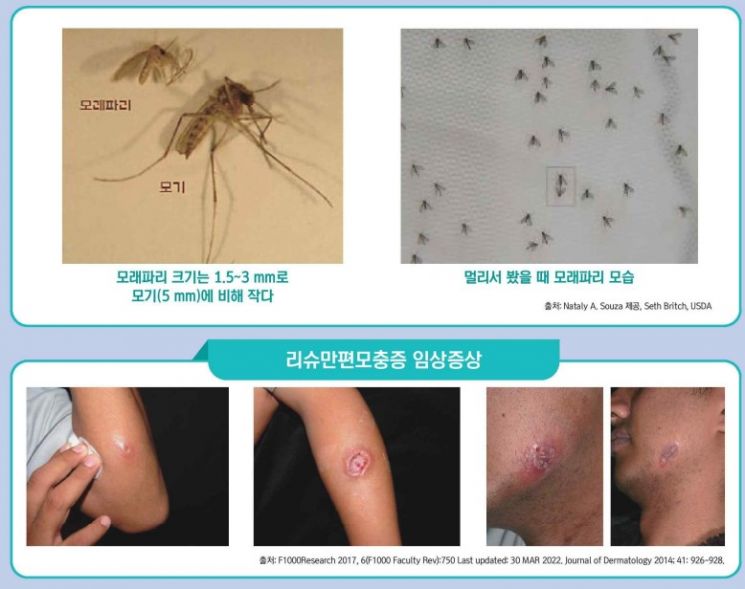
Leishmaniasis is classified as a Category 4 legally designated infectious disease under imported parasitic infections. Sandflies, blood-sucking insects of the order Diptera, transmit the parasite Leishmania to humans when they bite. Depending on the infection site, leishmaniasis is classified into cutaneous, mucocutaneous, and visceral forms. Since the first reported case in Korea in 1978, 29 imported cases have been confirmed. Most infections occurred in travelers to Central and South America including Mexico, Africa, the Middle East, Central Asia, and Southern Europe.
Cutaneous leishmaniasis spreading on the skin is not fatal, but the bitten area and surrounding skin become itchy, followed by papules, blisters, and nodules. Skin ulcers may develop after a short period of two weeks to several months. However, visceral leishmaniasis, caused by Leishmania invading internal organs, has a high fatality rate of 7%. There are currently no developed treatments or vaccines for infection prevention.
The KDCA emphasized, "Since sandflies do not inhabit Korea, most leishmaniasis infections occur during overseas travel, so travelers should exercise caution." They advised avoiding outdoor activities at night, when sandflies are active, and if unavoidable, wearing long clothing to minimize skin exposure. They also recommended applying insect repellents to exposed skin.
© The Asia Business Daily(www.asiae.co.kr). All rights reserved.
![Clutching a Stolen Dior Bag, Saying "I Hate Being Poor but Real"... The Grotesque Con of a "Human Knockoff" [Slate]](https://cwcontent.asiae.co.kr/asiaresize/183/2026021902243444107_1771435474.jpg)











