Collaboration with Korea Institute of Ocean Science and Technology, Final Selection... Total Investment of Over 7.3 Billion KRW Including 4.5 Billion KRW in Government Funding
Detailed Project for Creating New Marine ICT Industry Led by Korea Insti
The Ministry of Trade, Industry and Energy’s call for proposals for the ‘Regional Innovation Cluster Development Project’ targeting local governments has resulted in the final selection of the project submitted jointly by Busan City and the Korea Institute of Marine Science and Technology Promotion (KIMST) (Principal Investigator Dr. Im Hak-su): “Establishment of a Smart Marine Open Innovation Platform Based on Marine Satellite Information.”
In the Ministry of Trade, Industry and Energy’s ‘Regional Innovation Cluster Development Project,’ Busan is responsible for the ‘Marine Information and Communication Technology (ICT) Convergence’ sector.
In this project, the city plans to develop and demonstrate an intelligent (smart) marine service platform and establish marine observation information immersive content services by utilizing marine satellite data, based on a national innovation convergence complex with high growth potential in the marine ICT new industry.
The Korea Institute of Ocean Science and Technology (KIOST), which will play a leading role in this project, has led related industries by conducting the first phase of the marine ICT convergence project from 2018 to 2022, including ▲development of a marine disaster safety simulation platform ▲development of virtual reality (VR) for practical ship safety training ▲domestication projects through reverse engineering of marine plant systems.
This project is a follow-up to the first phase and aims to develop core technologies to create a new industrial ecosystem in the marine ICT sector that can prepare for future society. It will be promoted over five years starting this year with a total investment of approximately 7.3 billion KRW.
Specifically, the detailed projects include ▲building datasets and collecting data using marine satellites ▲developing and demonstrating intelligent (smart) marine service platforms and immersive content services ▲strengthening the international (global) market competitiveness of marine services, fostering innovative companies, and strategizing service exports.
The dataset refers to the collection of 270 related data items gathered for specific tasks.
Marine services refer to the development of 13 services, including port greenhouse monitoring, sea surface temperature, marine pollution, and port congestion.
In particular, through this project, it is expected to leap forward as the region’s largest innovation hub for marine ICT new industry creation and to lead the spread of new industries across the region and zones.
Additionally, through corporate support projects in the marine ICT sector, it is expected to create 350 jobs (35 direct employment and 315 indirect employment) and increase sales by 15.1 billion KRW.
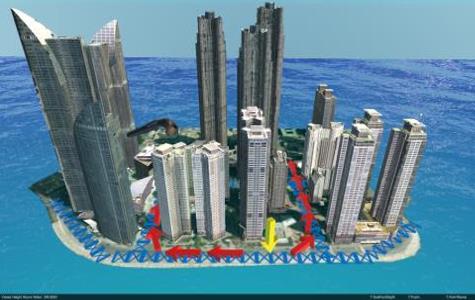 Development of disaster safety simulations (storm surge, flooding, erosion, and other marine environments).
Mayor Park Hyung-jun stated, “Yeongdo-gu, where the Dongsam Innovation District is located, has the best location for the growth of the marine ICT new industry and ecosystem formation.” He added, “Through this project, we will strengthen the collaboration functions among industry, academia, research, and government to lead marine new industry innovation, and through revitalizing public-private cooperation, we will do our best to make Busan a good city for companies and a good city for youth to work.” He also said, “We will not hesitate to invest in establishing a marine digital industrial base to continuously expand achievements through future follow-up projects.”
© The Asia Business Daily(www.asiae.co.kr). All rights reserved.
!["I'd Rather Live as a Glamorous Fake Than as a Poor Real Me"...A Grotesque Success Story Shaking the Korean Psyche [Slate]](https://cwcontent.asiae.co.kr/asiaresize/183/2026021902243444107_1771435474.jpg)
















