‘Lawsuits to Cancel Comprehensive Real Estate Tax Imposition’ Consecutively Lost
‘Comprehensive Real Estate Tax Refund’ Expected Following Constitutional Court's Unconstitutionality Ruling
As the government has decided to maintain the current 60% fair market value ratio for the Comprehensive Real Estate Holding Tax (종합부동산세, 종부세), attention is focused on whether the Constitutional Court, which has been reviewing the constitutionality of the current 종부세 for a year, will make a decision before the retirement of Chief Justice Yoon Nam-seok in November.
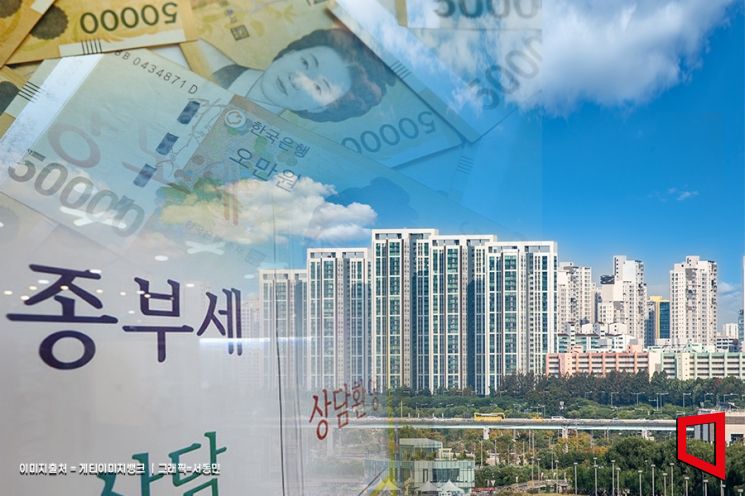
According to a comprehensive report by Asia Economy on the 11th, the Constitutional Court is currently reviewing a total of 35 constitutional complaints related to the 종부세 Act as of this date. It has been confirmed that related cases have been continuously filed from August last year, when the first constitutional complaint was received, through May of this year.
The Moon Jae-in administration raised the fair market value ratio, which determines the publicly announced price ratio used to calculate the 종부세 tax base, from 80% before 2018 to 85% in 2019, 90% in 2020, and 95% in 2021, resulting in a sharp increase in the number of taxpayers. Consequently, due to the rapid rise in real estate prices and the government's increase in housing publicly announced prices in 2021, citizens hit by the 종부세 shock filed a class-action lawsuit.
Some legal professionals directly filed constitutional lawsuits, arguing that the government's tax rate policy violates the Constitution. They formed a 종부세 unconstitutionality lawsuit group and assembled a large team of lawyers. They claim that the unexpected sharp increase in taxes violates the principle of legality in taxation and the principle of equitable taxation, infringing on citizens' property rights, thus violating the Constitution.
Regarding the 종부세 Act, criticism has been consistently raised that it excessively restricts property rights in pursuit of the policy goal of stabilizing real estate prices, and issues of unconstitutionality have been continuously discussed, with the Constitutional Court having previously ruled some parts unconstitutional.
While the Constitutional Court has delayed its decision on the 종부세 unconstitutionality lawsuits for a year, courts have consecutively ruled in lawsuits filed by 종부세 taxpayers seeking cancellation of tax imposition orders that "there is no problem with the 종부세," raising concerns that a major confusion could arise depending on the Constitutional Court's future decision.
The courts have stated, "The 대상 and scope of 종부세 taxation, as well as the calculation methods, must timely respond to complex socio-economic phenomena such as fluctuating real estate prices and differing local finances by region, along with tax burden equity. While the taxation conditions are set by law, delegation to flexible administrative legislation is permitted," rejecting taxpayers' claims that their property rights were infringed by 종부세 imposition. Meanwhile, courts have continuously dismissed taxpayers' requests to the Constitutional Court for constitutional review of the law, stating that the Constitutional Court should determine the constitutionality of the 종부세.
The issue is whether taxpayers who lost in the cancellation lawsuits for 종부세 imposition orders can receive relief if the Constitutional Court rules the 종부세 unconstitutional.
In the legal community, it is analyzed that since the cancellation lawsuits for 종부세 imposition orders are still ongoing in the first and second trial stages and have not yet received a final judgment from the Supreme Court, the possibility of relief remains open. The Supreme Court holds that the effect of the Constitutional Court's unconstitutionality ruling applies to general cases judged under the relevant law after the decision. Ultimately, the conclusion of the 종부세 imposition cancellation cases, which have not yet been finalized by the Supreme Court, will be determined according to the Constitutional Court's ruling on constitutionality.
A court official said, "If the government takes administrative action based on a certain law, but later the Constitutional Court rules that the law underlying the administrative action is unconstitutional, that administrative action is effectively recognized as having no legal basis." However, "even in this case, the unconstitutionality ruling of the law only provides grounds to file a lawsuit to cancel the administrative action executed before, and the unconstitutionality ruling does not automatically invalidate the related prior administrative actions." Even if the 종부세 is ruled unconstitutional, the already paid 종부세 is not automatically canceled or refunded, and those who paid must individually file cancellation lawsuits.
If the Constitutional Court rules the 종부세 unconstitutional, those who paid 종부세 this year can file cancellation lawsuits to receive refunds. Those who paid 종부세 before last year can receive refunds if cancellation lawsuits are ongoing at the time of the unconstitutionality ruling, but if they did not file lawsuits and later file them after the ruling, they cannot receive refunds.
© The Asia Business Daily(www.asiae.co.kr). All rights reserved.

















