"Creating a Competitive Environment with Big Tech Comes First"
"Soft Regulation Needed to Support AI Risk Management"
A claim has emerged that soft regulations such as guidelines or directives are necessary to catch two rabbits at once: the development of the artificial intelligence (AI) industry and risk management. This is because introducing regulations when risks are unclear could cause the AI industry to lose its competitiveness.
The AID (AI·Information·Data) Society, a federation of the Korean Information Law Association, the Korean Data Law Policy Association, and the Korean Artificial Intelligence Law Association, held a forum on the 5th at the Bankers Hall in Myeongdong, Jung-gu, Seoul, under the theme "Issues and Tasks of Data and AI Law in the Era of Super-large AI."
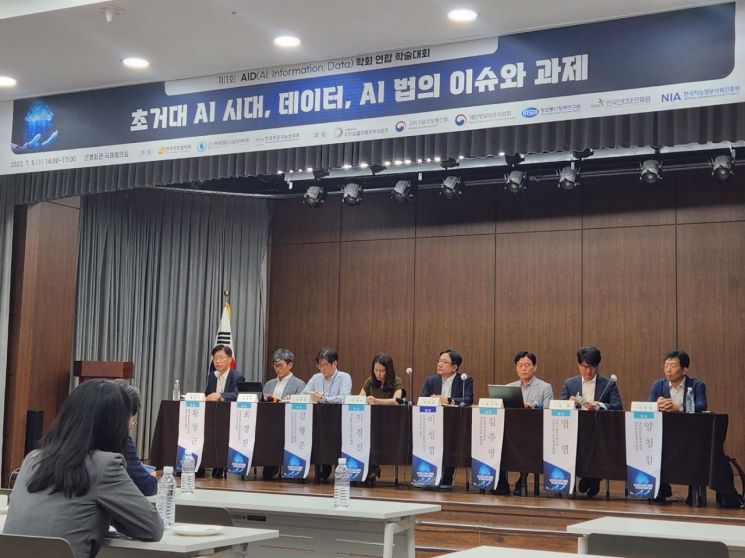 The AID (AI·Information·Data) Society, a federation of the Korean Information Law Society, the Korean Data Law and Policy Society, and the Korean Artificial Intelligence Law Society, held a forum on the 5th at the Bankers' Hall in Myeong-dong, Jung-gu, Seoul, under the theme "Issues and Challenges of Data and AI Law in the Era of Super-large AI."
 [Photo by Choi Yuri]
With generative AI, led by ChatGPT, rapidly emerging, various legal issues are coming to the forefront. A representative issue is copyright: whether AI can use copyrighted works during data training, and whether AI-generated content should be recognized as copyrighted works. There are also concerns about privacy infringement when AI scrapes data circulating on the internet, and what rights information providers have regarding decisions made based on such data. Current laws define copyright holders only as humans, leaving regulatory gaps. Accordingly, countries including the European Union (EU) are pushing for the introduction of AI regulations. The United Nations Security Council, scheduled to meet on the 18th, will also address AI regulation as a major agenda item.
Experts agreed on the need for discussions to minimize regulatory gaps. However, they suggested that speed control is necessary to avoid slowing down industrial development. Professor Choi Kyung-jin of Gachon University (President of the Korean Artificial Intelligence Law Association) explained, "Foundation models aiming for general-purpose AI are applied across various ecosystems, so from a competition law perspective, this becomes a global issue," adding, "This is why we need to keep pace with overseas countries when approaching risks." Professor Hwang Chang-geun of Hongik University (President of the Korean Information Law Association) also said, "The EU’s approach of tightly regulating risks is not necessarily appropriate," and added, "Since risks are unclear, it is also necessary to take a step behind."
Concerns were also raised that if AI regulations are introduced first domestically, it could create reverse discrimination between global big tech companies and domestic firms. This could threaten AI sovereignty. Lee Kyung-sun, a research fellow at the Korea Information Society Development Institute, predicted, "Regulations could become a blade only against domestic companies while strengthening big tech monopolies," and "Innovative startups may not be able to respond swiftly to market changes." She argued that efforts should be made jointly by the public and private sectors rather than delegating obligations or responsibilities solely to companies. Lee emphasized, "We need to create a competitive environment from the perspective of AI sovereignty," and "Risk management support should be provided so that regulatory costs do not act as market entry barriers."
In response, Eom Yeol, Director of AI-based Policy at the Ministry of Science and ICT, said, "If we do not participate in creating international normative systems or regulations for AI, we will be left behind," adding, "We need to take leadership by actively participating in the regulatory system so as not to hinder industrial development."
© The Asia Business Daily(www.asiae.co.kr). All rights reserved.

















