"Lee Jae-yong Missed 'Once-in-a-Lifetime Opportunity' in 8 Years of Global 4th Industrial Revolution"
Samsung's Silence Prolonged Without Innovation to Change Group's Structure
Samsung Electronics is at risk of its operating profit margin (operating profit as a percentage of sales) falling into single digits for the first time in 12 years. There are criticisms that its unique technological leadership and innovation DNA have weakened.
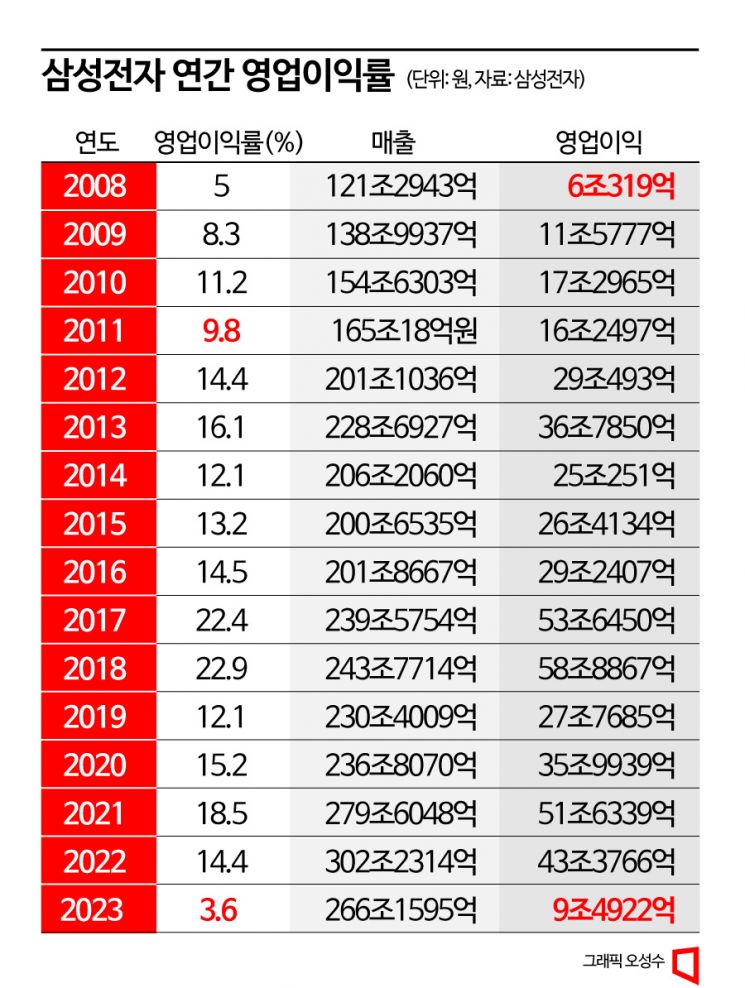
On the 6th, financial information firm FnGuide compiled the average forecast for Samsung Electronics' consolidated operating profit margin this year, as presented by securities firms, at 3.6%. This is the value obtained by dividing the estimated operating profit (KRW 9.4922 trillion) by the projected sales (KRW 266.1595 trillion). If the estimates hold true, sales will decrease by KRW 36.0719 trillion (11.9%) and operating profit by KRW 33.8844 trillion (78.1%) compared to last year. The last time Samsung Electronics' operating profit margin fell below 5% was 15 years ago, in 2008. It has been 12 years since the operating profit margin dropped to single digits, last recording 9.8% in 2011.
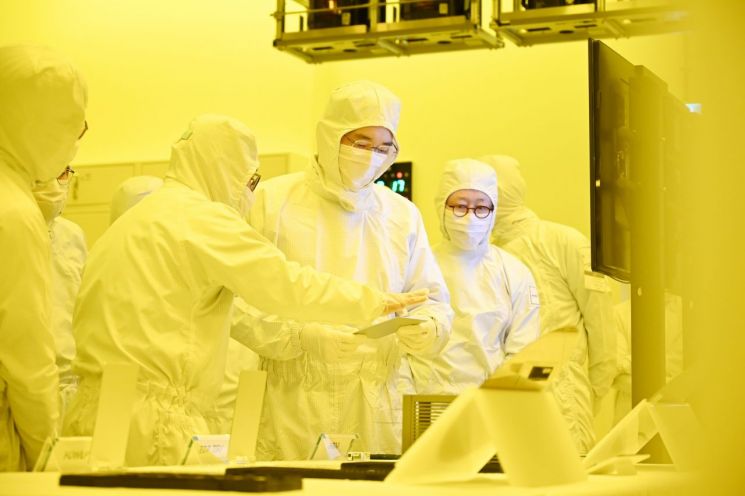 Samsung Electronics Chairman Lee Jae-yong visited the Samsung Electronics Cheonan Campus on February 17 to tour the packaging line and review business strategies. [Photo by Samsung Electronics]
The 3.6% margin is even lower than the manufacturing industry average. According to a survey by the Korea Institute for Industrial Economics and Trade, the manufacturing industry's operating profit margin ranged between 4% and 8% from 2018 to 2022. A decline in operating profit margin can be divided into two cases: when the sales growth rate (denominator) exceeds the operating profit growth rate (numerator), or when operating profit sharply decreases. Samsung Electronics falls into the latter category. If Samsung Electronics' operating profit remains in the 9 trillion won range this year, it will be the first time since 2008 (KRW 6.0319 trillion) that it falls below 10 trillion won. According to estimates, annual sales will also decline for the first time in eight years since 2015.
Even considering that the estimate was made in early July rather than at year-end, an operating profit margin of 3.6% is evaluated as "too low." Oilseon, head of CXO Research Institute, said, "A 3% margin means earning 3 won for every 100 won invested, which is a poorer figure than the food industry, known for its low operating profit margins," adding, "Since operating profit margin, operating profit, and sales volume are all decreasing simultaneously, it is necessary to increase profits while thoroughly managing costs such as manufacturing expenses and employee salaries."
Signs that Samsung Electronics is feeling a sense of crisis are detected in several areas. The DS (semiconductor) division replaced a vice president-level executive in the memory and foundry (semiconductor contract manufacturing) business units on the 3rd. This executive change occurred outside the regular year-end personnel reshuffle for two consecutive years. In June last year, the head of the semiconductor research institute was replaced due to low yield (ratio of good products). Park Jugeun, CEO of Leaders Index, said, "Given that last year's early personnel change was reportedly due to low yield, the replacement of a vice president-level executive this year also indicates a serious problem with the current situation," adding, "This is a sign that among Samsung Electronics' two pillars, 'technology' and 'global supply chain,' technology is in jeopardy."
There are also criticisms that Samsung is falling behind rival companies in areas outside semiconductors, such as artificial intelligence (AI), bio, and electric vehicles. In AI, it is trailing behind Google and Microsoft in the field of large language models (LLM). In bio, its presence in the new drug market is weak. In electric vehicles, it is losing out to rivals in battery materials, charging infrastructure, and finished vehicle manufacturing. Only Samsung SDI is engaged in battery cell manufacturing.
Park said, "Since Lee Jae-yong officially began his role as Samsung's leader in 2015, Samsung Electronics has missed a golden opportunity presented by the global 4th Industrial Revolution over the past eight years," adding, "LG has shut down its mobile and solar businesses and transformed into a B2B (business-to-business) company focused on automotive parts, and Hyundai Motor has improved its structure into a mobility software company, but Samsung has not made such noticeable innovations."
© The Asia Business Daily(www.asiae.co.kr). All rights reserved.


















