Rapid Support for Replacement Workforce When Changing Workplaces
Launch of Task Force for Integrated Management of Foreign Workforce
Strengthening Accommodation Cost Rationalization and Housing Support
From September, foreign workers newly entering the country will only be allowed to change workplaces within certain regions and industries. This measure aims to prevent the concentration of foreign workers in the Seoul metropolitan area and the extinction of local areas. When foreign workers change workplaces after entering the country, employers will be able to hire foreign labor without the domestic recruitment effort period (7 to 14 days).
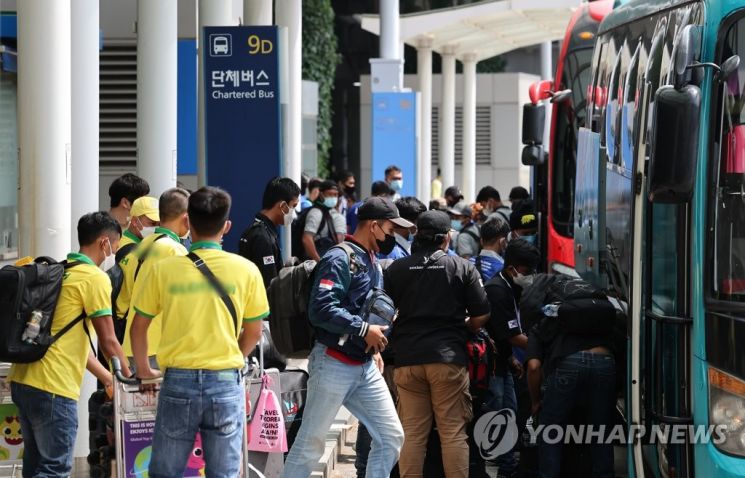
On the 5th, the government announced the results of the “Employment Permit System (E-9) Foreign Workforce Policy Committee” meeting, which centered on these details. The system was significantly revised to enhance the management of foreign labor in response to the decline in the working-age population. Introduced in 2004, the Employment Permit System (EPS) is the main channel for bringing in low-skilled foreign workers to Korea. As of April this year, 278,363 migrant workers are staying in Korea with E-9 visas issued through the EPS.
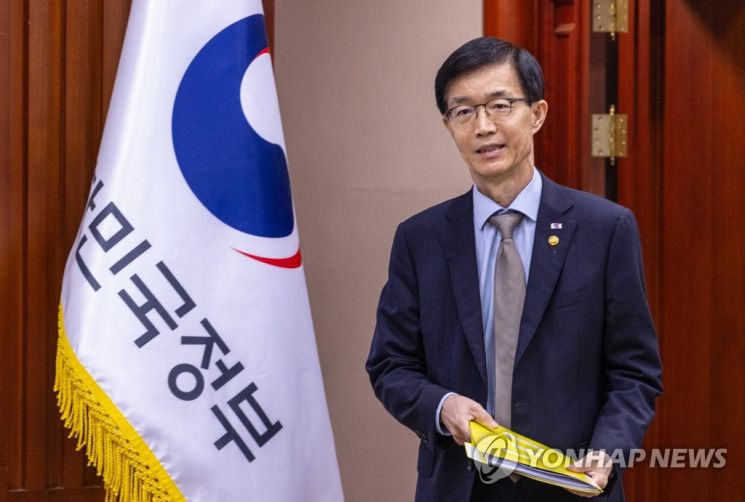
The “Foreign Workforce Integrated Management Promotion Task Force” will also be launched. This is a follow-up measure to President Yoon Seok-yeol’s directive last month to devise a plan to integrate foreign workforce management. Bang Moon-kyu, Director of the Office for Government Policy Coordination, will lead the team. Vice ministers from related ministries including the Ministry of Economy and Finance, Ministry of Justice, Ministry of the Interior and Safety, Ministry of Trade, Industry and Energy, Ministry of Employment and Labor, and Ministry of SMEs and Startups will also participate. Director Bang stated, “We will prepare integrated foreign workforce management measures that respond swiftly to the demands of industrial sites.”
System Improvement to Quickly Support Replacement Workers When Changing Workplaces
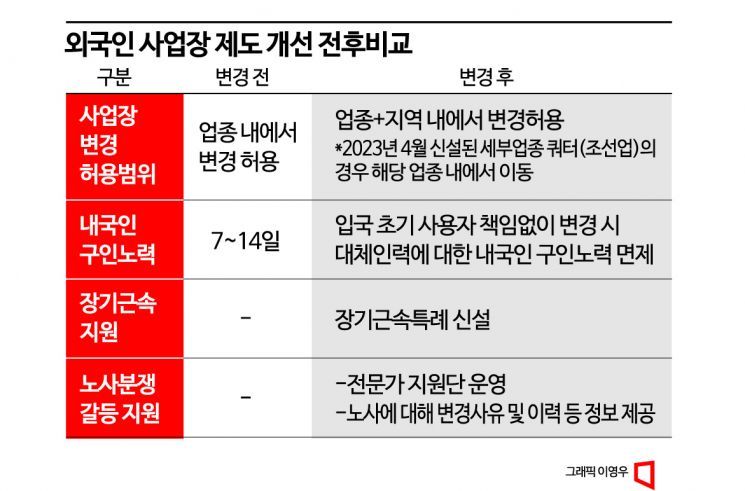
The core of the announced reform plan is to partially restrict workplace changes without employer responsibility during the early period after foreign workers enter the country. When a workplace changes, employers will be able to promptly receive support for replacement workers. In reality, 31.5% of foreign workers move to a different workplace within one year of their initial assignment. In such cases, employers faced difficulties finding suitable workers or the burden of recruiting replacements. The government has allowed employers to apply for foreign workers immediately without the domestic recruitment effort period (7 to 14 days) if the change is not due to employer responsibility. This is to support workforce management at industrial sites by quickly re-admitting skilled workers.
Under the current Employment Permit System, employers must provide a domestic recruitment effort period of 14 days for manufacturing and construction industries and 7 days for agriculture, livestock, and fisheries to protect employment opportunities for domestic workers when hiring foreign workers.
Additionally, from now on, foreign workers will only be allowed to change workplaces within certain regions such as the Seoul metropolitan area, Chungcheong region, and Jeolla-Jeju region, and within specific industries like shipbuilding. This is to prevent concentration in the metropolitan area and the extinction of local areas. The re-entry special case requirements will also be relaxed. The current rule allows re-entry six months after working for the same workplace for 4 years and 10 months; this is being reviewed to grant special cases for those who have worked at their initial workplace for more than one year. A long-term service special case will also be introduced to strengthen incentives for foreign workers. The Foreign Employment Act will be amended to allow continuous work without departure or re-entry if foreign workers work at the same workplace for a certain period.
Rationalization of Accommodation Cost Standards for Foreign Workers and Strengthening of Residential Environment Support
To reduce mismatches between job seekers and employers, information provided to employers and workers will be expanded from the pre-entry placement and labor contract stages. In short, details about the job duties, workplace, and worker’s occupational skills will be shared.
The accommodation cost standards will also be improved. Until now, the Ministry of Employment and Labor guidelines set a collection cap on accommodation fees (8 to 20% of the monthly ordinary wage), which made it difficult to reflect local market prices. There were also disagreements between labor and management. Therefore, guidelines will be provided to allow reasonable accommodation fees by reflecting local market prices (referencing real transaction price systems within regions provided by the Ministry of Land, Infrastructure and Transport). Residential environment support will be strengthened as well. Local governments that install public dormitories will receive incentives. Employment limits per workplace will be raised, and additional points will be awarded. An excellent dormitory certification system will be operated. Before signing labor contracts, foreign workers will be accurately provided with visual information (videos, photos, etc.) about accommodations, and accommodation monitoring will be strengthened.
© The Asia Business Daily(www.asiae.co.kr). All rights reserved.



















