Formation of Response Team and Installation of Tritium Analysis Equipment, etc.
Gyeongsangnam-do announced 15 promotion tasks across 5 sectors on the 4th to respond to the planned discharge of contaminated water from the Fukushima nuclear power plant in Japan this summer.
Kim Je-hong, Director of the Marine and Fisheries Bureau of Gyeongnam Province, stated, “As the discharge of contaminated water approaches, residents' anxiety is increasing, and there are concerns about damage to the fisheries industry and merchants due to unclear information. We have established more systematic and strengthened measures focusing on expanding radiation inspection functions, enhancing communication with residents, and promoting seafood consumption.”
According to the announcement, the province will form and operate the ‘Fukushima Nuclear Power Plant Contaminated Water Marine Discharge Response Team’ led by Executive Vice Governor Choi Man-rim.
The response team, composed of four divisions including the General Management Division, involves six departments such as the Marine and Port Division, Health and Environment Research Institute, and Fisheries Safety Technology Institute to develop response policies and comprehensively respond to related trends.
Following the four iodine gamma nuclide analyzers currently operated at the provincial Seafood Safety Management Center, one liquid scintillation counter for analyzing tritium will be additionally installed to strengthen seafood safety inspections.
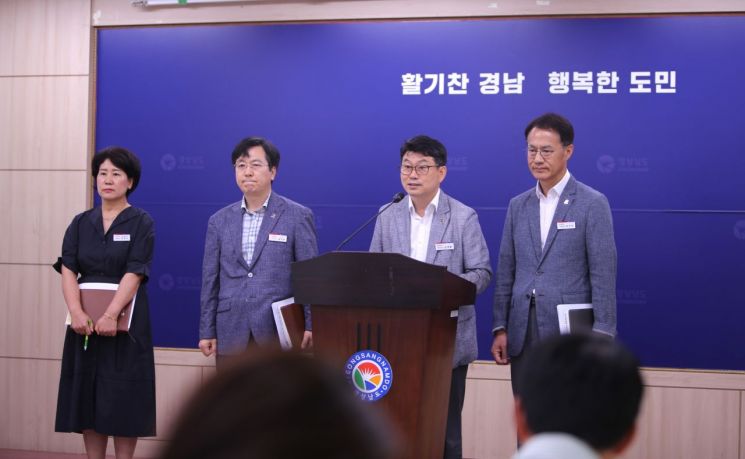 Kim Je-hong, Director of the Marine and Fisheries Bureau of Gyeongnam Province, is announcing strengthened measures to prepare for the discharge of contaminated water from the Fukushima nuclear power plant into the ocean.
 [Photo by Lee Se-ryeong]
Support will be provided to install precision radiation analysis equipment at the National Federation of Fisheries Cooperatives auction sites, and the number of marine survey points in the province will be expanded from the existing 8 to a total of 20 by adding 12 locations including major aquaculture farms and fishing zones. This plan will be proposed to the Ministry of Oceans and Fisheries and the Nuclear Safety and Security Commission.
The province completed radiation inspections of seawater at representative beaches in the province, including Changwon Gwangam, Sacheon Namil-dae, Geoje Hakdong, and Namhae Sangju beaches, which opened on the 1st of this month, concluding that all four are safe, and plans to continue inspections after opening.
Separately from the Ministry of Oceans and Fisheries’ water quality inspections at beach entrances, the provincial Health and Environment Research Institute will conduct seawater and mudflat inspections, and upon residents’ requests, inspections will also be conducted at beaches other than the four mentioned.
About 60 honorary monitors for seafood origin labeling will be appointed and operated, and radiation inspections of seafood produced or caught before auction at four auction sites in the province will be conducted by the National Federation of Fisheries Cooperatives.
The seafood radiation inspection event for residents, first held last month, will be conducted monthly.
An integrated information platform for contaminated water response will be established on the provincial website, and inspection results will be disclosed twice a week.
After the discharge of contaminated water, weekly briefings will be held to provide accurate information and prevent the spread of unclear information.
With a total budget of 1.8 billion KRW, including 300 million KRW secured through supplementary budgeting for the seafood coexistence discount support project, the province will promote seafood consumption recovery projects and plans to use contingency funds if necessary.
During July and August, when the discharge of contaminated water is expected, large-scale seafood consumption promotion events will be held targeting provincial offices, cities and counties, and public institutions, including promotional events at online malls such as home shopping, large supermarkets in major cities, and refund events for traditional market Onnuri gift certificates to revitalize seafood consumption during the Chuseok holiday.
The province will propose including local seafood such as eel and farmed rockfish, which are not among the six seafood items subject to the government’s stockpiling project (mackerel, hairtail, mackerel, pollock, dried anchovy, and croaker).
It plans to request the central government to support temporary storage fees for seafood storage facilities due to consumption decline, amounting to about 3.1 billion KRW, and even if national funds are not received, it will secure provincial contingency funds to implement the project independently.
Director Kim said, “It is absolutely unacceptable for the fisheries industry and merchants to suffer damage due to unclear information related to the discharge of radioactive contaminated water from the Fukushima nuclear power plant. We will do our best to ensure residents can consume seafood with peace of mind through thorough seafood safety management and active communication to minimize the contraction of seafood consumption.”
© The Asia Business Daily(www.asiae.co.kr). All rights reserved.
![User Who Sold Erroneously Deposited Bitcoins to Repay Debt and Fund Entertainment... What Did the Supreme Court Decide in 2021? [Legal Issue Check]](https://cwcontent.asiae.co.kr/asiaresize/183/2026020910431234020_1770601391.png)
















