KIOST "1.8℃ Higher Than 40-Year Spring Average"
Sea Surface Temperature Rapidly Rising Over Past 3 Years
Data has been released showing that the sea surface temperature of the East Sea this spring is the highest in the past 40 years.
The Korea Institute of Ocean Science and Technology (KIOST, President Kang Do-hyung) announced on the 4th that the average sea surface temperature of the East Sea from March to May this year recorded 10.0℃, which is 1.8℃ higher than the average for the same period from 1991 to 2020.
This is the first time the spring sea surface temperature has reached double digits and is the highest value in the past 40 years (1981?2023).
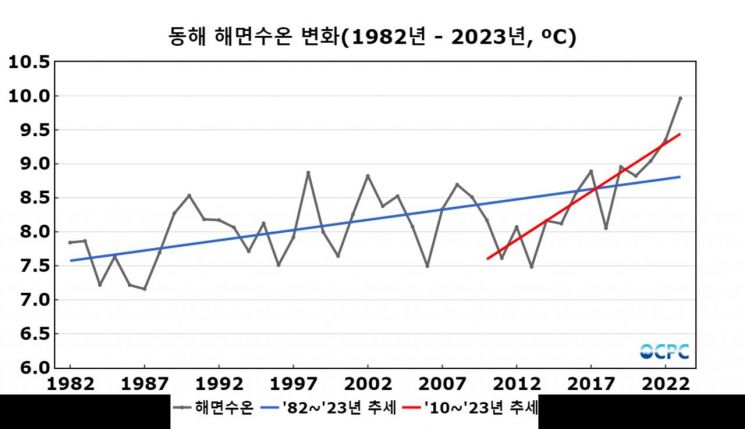 Recent 40 Years' Average Sea Surface Temperature Changes in the East Sea During Spring (March to May).
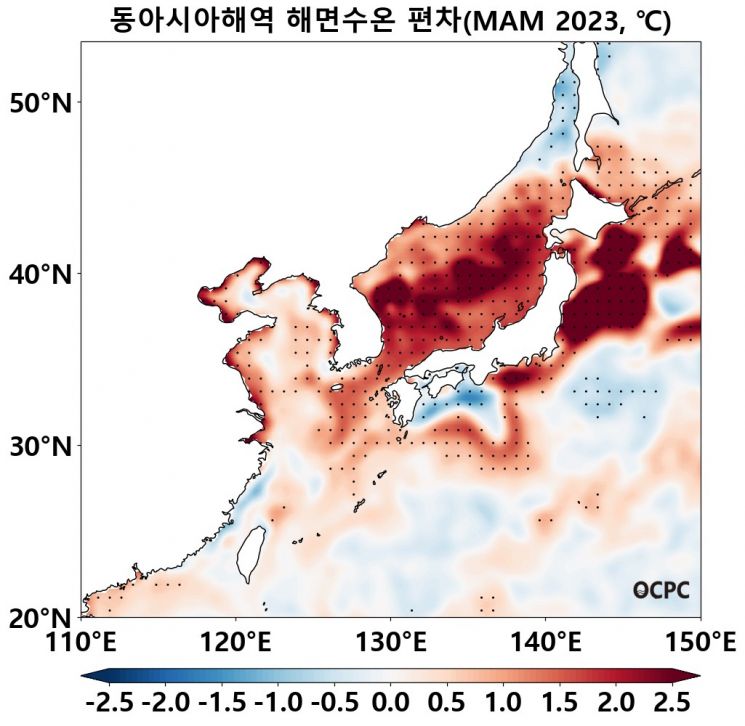 Sea surface temperature anomalies around the Korean Peninsula during spring (March-May average) 2023 compared to the normal period (1991-2020).
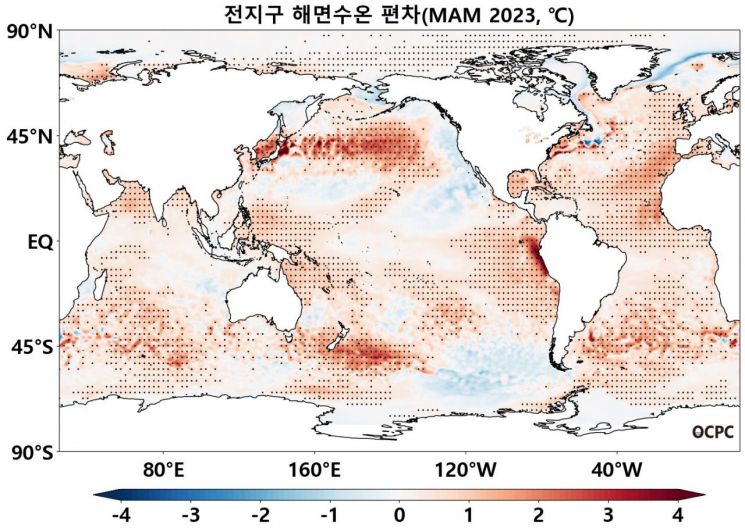 Global sea surface temperature anomalies in spring 2023 (average from March to May) compared to the normal period (1991?2020).
The average spring sea surface temperature of the East Sea was 7.7℃ in the 1980s and 8.3℃ in the 2010s, showing a 0.6℃ increase over 30 years. In comparison, over the past three years since 2021 (9.0℃ in 2021, 9.4℃ in 2022, and 10.0℃ in 2023), it has risen sharply by 1℃.
This rapid increase in the East Sea’s spring sea surface temperature is estimated to have been caused by the reduction of sea ice in the Kara Sea and Barents Sea in the Arctic Ocean north of Russia, and atmospheric responses due to global warming, which led to the development of strong high pressure in the upper layers of the surrounding seas and sustained high temperatures.
According to related research, the impact of Arctic sea ice changes on the East Sea’s sea surface temperature mainly occurs in early summer, but this year, a similar phenomenon appeared during the spring season.
This suggests an acceleration of global warming and may lead to even higher sea surface temperatures in the East Sea this summer, necessitating continuous monitoring and preparedness.
KIOST explained that these results were analyzed by the KIOST Marine Climate Prediction Center based on daily average sea surface temperature data provided by the U.S. National Oceanic and Atmospheric Administration (NOAA).
The center releases monthly analyses of marine climate indicators along with a three-month marine climate pilot seasonal forecast. Citizens interested in marine climate can check the information on the center’s website.
President Kang Do-hyung stated, “The environment and ecosystem of the seas surrounding our country are threatened by global warming, so continuous observation of the sea’s condition is necessary,” adding, “The Marine Climate Prediction Center will provide regular analyses and forecast information to the public not only about the seas around Korea but also about the state and trends of the global oceans.”
© The Asia Business Daily(www.asiae.co.kr). All rights reserved.
!["The Woman Who Threw Herself into the Water Clutching a Stolen Dior Bag"...A Grotesque Success Story That Shakes the Korean Psyche [Slate]](https://cwcontent.asiae.co.kr/asiaresize/183/2026021902243444107_1771435474.jpg)


















