Oxford Economics Warning
There is a warning that Canada's economic growth rate could drop by up to 0.6 percentage points due to the unprecedented wildfire damage that recently struck Canada.
On the 3rd (local time), consulting firm Oxford Economics predicted that Canada's GDP growth rate for the third quarter of this year will fall by 0.3 to 0.6 percentage points. Tony Steelo, who is in charge of the Canadian economy at Oxford Economics, stated, "We believe that the Canadian economy has already entered a recession," and pointed out, "The slowing Canadian economy is worsening due to the wildfire situation."
The wildfire has significantly reduced the harvest in Canada's major timber industry, halted oil and gas operations, and severely contracted the tourism industry. Derek Naiber, president of the Canadian Forest Products Association, said, "Although the exact extent of the wildfire damage has not been precisely estimated, the production decline has become inevitable as timber in planned logging areas has been damaged," adding, "Because the extensive wildfires have damaged forests, local governments are also likely to reduce logging permits in the future."
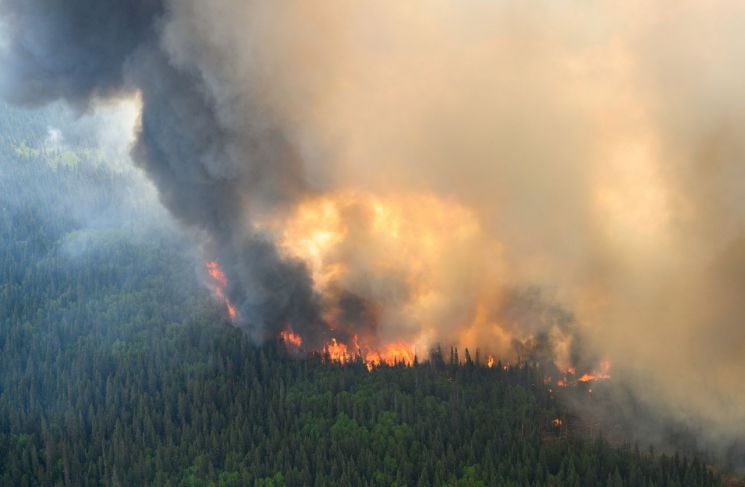
The wildfires have also affected the crude oil and gas extraction industry. Canadian energy companies with oil fields in wildfire-affected areas such as Montney and Duvernay have suspended crude oil and gas production or temporarily closed production facilities.
The tourism industry has also been hit. As the wildfires continued into the summer vacation season, hotel occupancy rates in Tofino, a resort area on Vancouver Island along the Pacific coast popular among Canadians, plummeted from 85% to the 20% range.
According to a paper published by the Canadian Climate Institute (CCI), the economic damage caused by climate warming is expected to reach 25 billion Canadian dollars (approximately 24.6 trillion Korean won) by 2025, potentially reducing the economic growth rate by half.
Dave Sawyer, chief economist at CCI, warned, "Due to climate change, 500,000 jobs will disappear by 2050, household costs will increase, and more government spending will be required."
© The Asia Business Daily(www.asiae.co.kr). All rights reserved.

![Clutching a Stolen Dior Bag, Saying "I Hate Being Poor but Real"... The Grotesque Con of a "Human Knockoff" [Slate]](https://cwcontent.asiae.co.kr/asiaresize/183/2026021902243444107_1771435474.jpg)















