Electric Taxi Fuel Cost Advantage... Increasing Preference Among Private Taxi Drivers
Annual Fuel Cost Half That of LPG Taxis
Acceleration of New Taxi Electrification This Year
"Opposition to LF Sonata Discontinuation" Corporate Taxi Industry Slows Electric Vehicle Transition
Among the taxis sold this year, 4 out of 10 were electric vehicles. Of the newly registered electric taxis, 90% were privately owned taxis. Corporate taxis, which face sluggish business conditions and must consider practical factors such as shift and charging times, have still been slow to switch to electric vehicles.
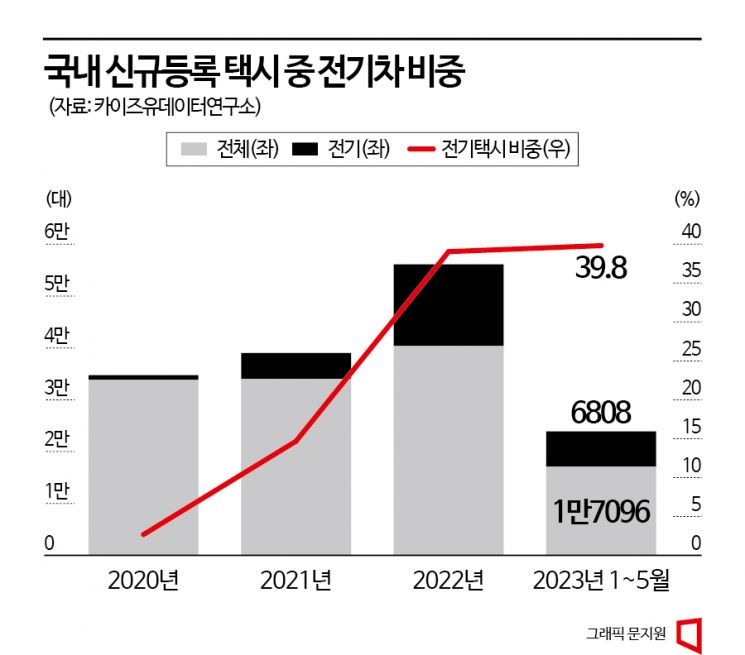
According to data commissioned by this publication from Kaizyu on the 3rd, 39.8% (6,808 units) of the 17,096 newly registered taxis from January to May this year were electric taxis. During the same period last year (January to May), the proportion of electric taxis was around 35%, but the shift to electrification has accelerated this year.
Electric Taxis' Fuel Cost Advantage... Increasing Preference Among Private Taxi Drivers
Until three years ago in 2020, the share of electric taxis among all newly registered taxis was only about 2.6%. It rose to 14% in 2021 and reached 39% annually last year. This is why electric taxis have become a common sight on the streets.
In Seoul, there are over 30 electric taxi models eligible for subsidies, including domestic and imported cars. Among them, Hyundai Ioniq 5 and Ioniq 6, Kia Niro Plus and EV6, which receive the maximum government subsidy of 10.6 million KRW, are popular choices.
The main reason electric taxis are favored by drivers is their low maintenance costs. As of June this year, the annual fuel cost for the Ioniq 6, assuming 20,000 km driven (based on official urban driving fuel efficiency, long-range 5.9 km/kWh), is about 1.17 million KRW. For a comparable internal combustion engine vehicle, the LF Sonata (LPG, 8.3 km/L), the fuel cost for the same distance is about 2.3 million KRW, roughly twice as much. Although the actual purchase price of electric vehicles is usually over 10 million KRW higher than internal combustion engine taxis, considering long-term maintenance costs, electric vehicles are more advantageous.
Additionally, electric vehicles require fewer consumables like engine oil and have lower taxes. Recently, with the establishment of electric vehicle charging infrastructure nationwide, including the metropolitan area, the shift to electric vehicles has increased mainly among private taxi drivers. In the first half of this year, the Seoul city government decided to provide subsidies for 1,500 electric taxis, including 1,400 private taxis and 100 corporate taxis.
"Opposition to LF Sonata Discontinuation" Corporate Taxis Hesitate to Switch to Electric Vehicles
On the other hand, corporate taxi operators are reluctant to switch to electric vehicles. Only about 10% of newly registered electric taxis this year were corporate-registered. Recently, when Hyundai announced the discontinuation of the 7th generation Sonata (LF) taxi model, the corporate taxi industry strongly opposed it. Since the Sonata is virtually the only mid-size taxi-specific model, its disappearance means they would have to purchase more expensive models like the Grandeur, which cost over 10 million KRW more.
However, even with subsidies, the purchase price of electric taxis is high. Additional investment is also required to establish charging infrastructure. Given the difficult business conditions after the COVID-19 pandemic, such large-scale investments seem practically impossible. There is also a realistic limitation in using electric vehicles as corporate taxis, which need to operate continuously without breaks, due to the long charging times of electric vehicles.
The taxi industry unanimously agrees that government-level support is necessary to promote electrification of corporate taxis. They argue that purchase subsidies for corporate taxis should be increased, and additional benefits should be provided for charging infrastructure development and charging fees. Their logic is that the popularization of eco-friendly vehicles can only come when taxis and public transportation, which are always on the road around us, can switch to electric vehicles.
A representative from the National Taxi Transportation Business Association said, "We agree on the necessity of switching to electric taxis, but the initial investment cost for vehicle purchase and infrastructure setup is too high," adding, "The government should increase purchase subsidies for the corporate taxi industry and provide multifaceted support such as charging fee assistance."
© The Asia Business Daily(www.asiae.co.kr). All rights reserved.


















