US CNN Reports on Side Effects of Overheated Private Education in Korea
"Suneung is an Extreme Survival Competition... Everyone Suffers"
American broadcaster CNN covered the 'killer questions' on the College Scholastic Ability Test (CSAT) and detailed the overheating of private education and its side effects in South Korea. The article, titled "South Korea is reducing killer questions on the eight-hour exam (CSAT) blamed for the birth rate crisis," was reported on the 1st (local time). It stated, "Korea's private education, which starts at a young age and continues until eighteen, causes pain for both parents and children."
Reporters Jae Si-young and Seo Yoon-jung explained Korea's situation by saying, "Raising children in Korea is not easy. By the time a child can walk, many parents start looking for prestigious private kindergartens." They continued, "Both parents and examinees must go through a difficult and costly journey to pass the eight-hour CSAT and enter a prestigious university," adding, "Academia, authorities, teachers, and parents all point to this system as a cause of educational inequality and youth mental health issues. It is even cited as a reason for the sharp decline in the birth rate."
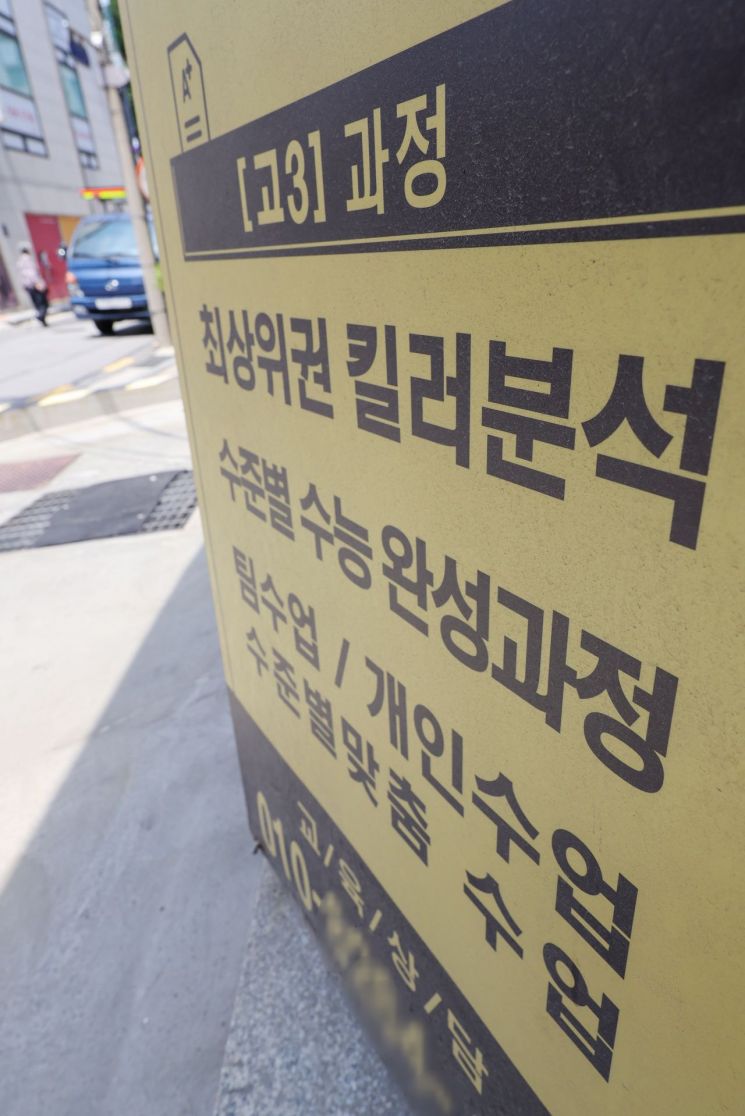 An educational program introduction posted in front of an academy in Daechi-dong, Gangnam-gu, Seoul
[Photo by Yonhap News]
CNN referred to the private academies attended by Korean students using the Korean pronunciation "Hagwon," explaining, "After school classes end, Korean students immediately go to 'Hagwon,' and even after returning home, they continue studying until dawn." They criticized it as an "extreme rat race" and introduced the removal of CSAT 'killer questions' as a measure to address this problem. Regarding killer questions, they elaborated, "They range from advanced calculus that causes headaches to ambiguous literary excerpts."
CNN also detailed South Korea's suicide rates among teenagers and people in their twenties, the number of youth experiencing depression according to last year's government survey, and South Korea's birth rate, which is among the lowest in the world. They criticized, "Over the past 16 years, the South Korean government has spent more than $200 billion (about 263 trillion won) to solve the low birth rate problem but has not achieved significant results." Quoting activists, they emphasized, "Deeper changes are needed, such as dismantling deeply rooted gender norms and introducing more support for dual-income parents."
CNN also reported that the trimming of 'killer questions' is not welcomed by everyone. They explained that with just over four months left before the CSAT, many examinees who have prepared as usual feel ambushed by the sudden change in the exam trend. While some agree on the need for private education reform, they also raise doubts about its effectiveness.
© The Asia Business Daily(www.asiae.co.kr). All rights reserved.

















