Reasons for Continuing Delivery Agency Work
Because It Is Difficult to Find Another Job
Delivery riders were found to work 57 hours per week and earn a monthly net income of 2.56 million KRW. Additionally, one-third of delivery riders experienced involuntary unemployment before choosing this occupation.
According to the report "Industrial Workforce Policy Tasks in Response to the Expansion of Platform Labor" released by the Korea Institute for Industrial Economics and Trade on the 2nd, a survey of 202 delivery riders whose main job is delivery services as of the end of last year showed that delivery riders work an average of 57 hours per week and earn about 2.56 million KRW in monthly net income.
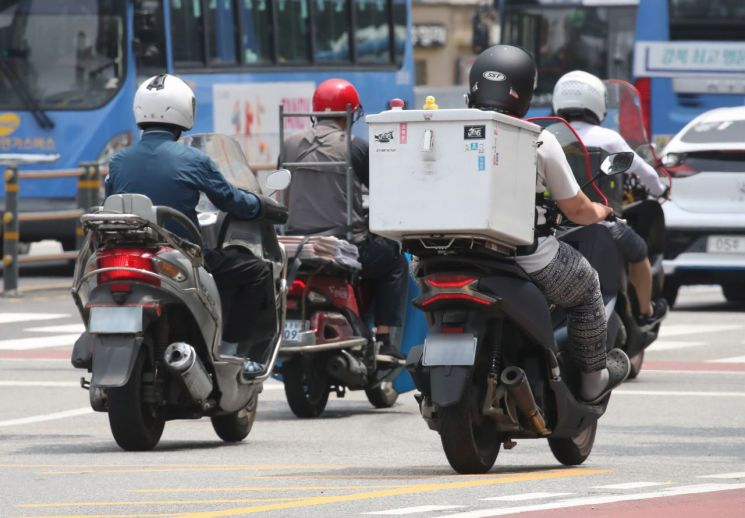
This is significantly higher than the average weekly working hours of 38 hours and 48 minutes for employed Koreans reported in Statistics Korea's "December 2022 and Annual Employment Trends," with a total monthly gross income of 3.54 million KRW. Although this is slightly higher than the average monthly income of 3.33 million KRW for wage workers in 2021, expenses such as equipment rental and insurance fees for motorcycles amount to about 1 million KRW per month.
Despite the high work intensity, 62.4% of delivery riders responded that they would continue working in the delivery service industry. The most common reason, at 29.4%, was "difficulty finding other jobs."
Most respondents had previously worked in traditional industrial sectors and entered this occupation after losing jobs due to business closures or restructuring following the COVID-19 pandemic.
Regarding reasons for leaving previous jobs, the largest share, 33.9%, cited "involuntary reasons such as business closures or restructuring," followed by "low income" (22.0%), "high work intensity" (18.1%), and "long and rigid working hours" (12.6%).
Before becoming delivery riders, their previous occupations included sales and marketing (37.0%), food service (17.3%), general office work (13.4%), and production and technical work (9.5%).
Despite the relatively high work intensity, 57.5% expressed satisfaction with their current delivery work, which is much higher than the 4.5% who expressed dissatisfaction.
The Korea Institute for Industrial Economics and Trade pointed out that the fact that many chose platform labor due to involuntary unemployment contradicts claims that it has become difficult to find workers for traditional industrial sectors because workers have moved to the platform economy such as delivery services.
They emphasized that platform labor, which involves repetitive tasks broken down into specific job units, may weaken labor competitiveness the longer it is performed, and called for policies to help platform workers flexibly move between industrial jobs and platform work.
© The Asia Business Daily(www.asiae.co.kr). All rights reserved.
![Clutching a Stolen Dior Bag, Saying "I Hate Being Poor but Real"... The Grotesque Con of a "Human Knockoff" [Slate]](https://cwcontent.asiae.co.kr/asiaresize/183/2026021902243444107_1771435474.jpg)











