Marking 1 Year Since the Inauguration of Dobong-gu Mayor in the 8th Term: Underground Construction of GTX-C Line in Dobong-gu, Approval of Environmental Impact Assessment for Ui~Light Rail, and Relaxation of Height Restrictions around Bukhansan?Laying the Foundation for Accelerated Local Development with Broad Smiles
 Dobong-gu Mayor Oh Eun-seok has consistently raised the issue of easing the altitude restrictions on Bukhansan to Seoul Mayor Oh Se-hoon, who announced a plan on June 30.
Oh Eon-seok, the mayor of Dobong-gu, is beaming with joy after receiving a significant gift just one year after his inauguration as the mayor in the 8th term.
Having been elected as the mayor of Dobong-gu as a People Power Party candidate in a Democratic Party stronghold, Oh has recently secured major achievements for local development, including the final confirmation last month of the underground construction of the GTX-C line section in Dobong-gu, which had been controversial for two years, as well as the relaxation of height restrictions around Bukhansan.
◆ Mayor Oh Secures Underground Construction of GTX-C Line in Dobong-gu
First, Mayor Oh visited the Presidential Office, the Ministry of Land, Infrastructure and Transport, the Board of Audit and Inspection, and the National Assembly consecutively, resulting in the Ministry of Land, Infrastructure and Transport confirming on the 10th of last month that the Dobong-gu section of the GTX-C line will be constructed underground (deep underground).
The controversy over the aboveground construction of the GTX-C line in Dobong-gu arose in 2020 when the Ministry accepted a proposal from a private operator for aboveground construction due to an unclear basic facility project plan. This led to opposition from Dobong-gu and local residents against the design change, triggering a public audit by the Board of Audit and Inspection and a feasibility study by the Korea Development Institute (KDI).
Since the launch of the 8th term, Mayor Oh Eon-seok has repeatedly visited the Presidential Office, the Minister of Land, Infrastructure and Transport, and the Minister of Strategy and Finance, emphasizing the need to restore trust in government policies, eliminate discrimination against outer areas, and correct procedural issues, insisting that the underground construction of the Dobong-gu section must be realized. The recent confirmation of deep underground construction for the Dobong-gu section has put an end to the controversy over aboveground construction of the GTX-C line in Dobong-gu.
Mayor Oh said regarding the confirmation of the underground construction of the GTX-C Dobong-gu section, “This is the fruit of my efforts to alleviate the concerns of 300,000 Dobong-gu residents worried about all possible damages caused by aboveground GTX-C construction.” He added, “I welcome that the GTX project has regained its original form under the new government and express my gratitude to the government for making this significant decision.”
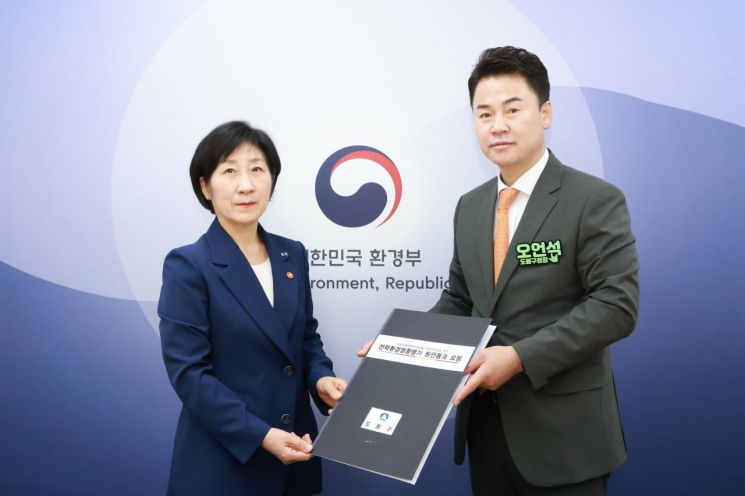 Oh Eun-seok, the mayor of Dobong District, met with the Minister of Environment and requested active support for the strategic environmental assessment of the Ui~Sinseol extension line.
◆ Environmental Impact Assessment Passed for Ui~Banghak Light Rail... Construction Expected to Accelerate
Dobong-gu announced on June 30 that the strategic environmental impact assessment for the Ui~Banghak light rail has been passed.
The strategic environmental impact assessment is a report detailing the environmental impact of constructing the Ui~Banghak line. Last December, the Ministry of Environment rejected the assessment for the Ui New Line extension passing under the national park, stating that it did not qualify as an essential facility allowed to pass through the national park and insisted on rerouting around the park, causing difficulties.
However, on June 14, Mayor Oh Eon-seok met with the Minister of Environment and conveyed concerns that the rerouted line proposed by the Ministry of Environment would pass under apartment complexes and Geumgangsa and Beopjongsa temples, raising worries about collective complaints, non-utilization of existing junctions, and derailment risks due to sharp curves. He requested the Ministry’s cooperation to approve the original strategic environmental impact assessment, considering the inevitability of passing under Bukhansan National Park.
◆ Mayor Oh Persuades Mayor Oh Se-hoon to Relax Height Restrictions around Bukhansan
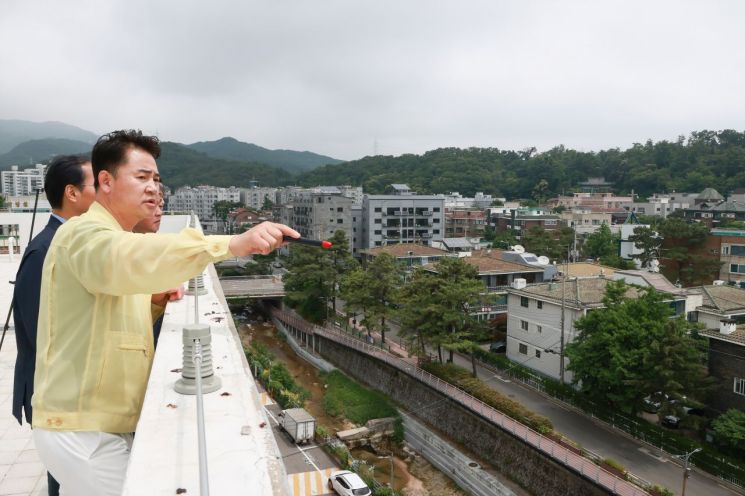
On the morning of the 30th at 11 a.m., Mayor Oh invited Seoul Mayor Oh Se-hoon to the area around the height restriction zone in Ssangmun-dong to explain the current status and local difficulties. Seoul City then announced a “New Height Restriction Zone Plan” that includes relaxation measures around Bukhansan.
This is expected to turn on a green light for the property rights of Dobong-gu residents who have suffered from height restrictions for the past 33 years.
According to the Seoul City announcement, the maximum height for individual buildings will be relaxed to below 28 meters, allowing an increase of 2 to 3 floors. For construction through redevelopment projects, buildings can be constructed up to 15 floors if they comply with landscape management guidelines. Additionally, the first-class general residential area, which overlaps with the height restriction zone, will have the height restriction lifted and be managed as a zoning area.
This relaxation is expected to accelerate various housing maintenance projects such as reconstruction and redevelopment in the height restriction zone, where profitability was previously hindered by building height regulations.
Dobong-gu’s total area is 50% development-restricted zone and 50% livable area, of which about 11% (approximately 350,000 pyeong) was subject to height restrictions. These areas, including Dobong 1-dong, Banghak 2 and 3-dong, and Ssangmun 1-dong, covering 1.163 square kilometers adjacent to Bukhansan, have been designated as height restriction zones since 1990, severely limiting development and causing serious residential aging.
◆ National Assembly Passes Amendment to Relax Floor Area Ratio for Redevelopment in Semi-Industrial Areas, Contributing to Local Development
Dobong-gu announced on June 30 that the partial amendment to the “Act on Maintenance and Improvement of Urban Areas and Dwelling Conditions,” allowing floor area ratio relaxation up to the legal maximum for redevelopment or reconstruction projects in semi-industrial areas, has been finally passed by the National Assembly.
This is expected to boost maintenance projects in semi-industrial areas such as Chang 2-dong and Dobong 2-dong, which had faced difficulties due to floor area ratio issues.
Before the amendment, Article 54, Paragraph 1, Subparagraph 1 of the Act stipulated that floor area ratio relaxation up to the legal maximum was only allowed for residential areas when constructing rental housing during redevelopment or reconstruction projects.
Since the launch of the 8th term last year, Dobong-gu has actively petitioned the Ministry of Land, Infrastructure and Transport to allow floor area ratio relaxation up to the legal maximum in semi-industrial areas as well. The amendment bill passed the Land, Infrastructure and Transport Committee on March 23 this year and was finally approved by the National Assembly on June 30, bearing fruit for these efforts.
Mayor Oh Eon-seok said, “This amendment will be a driving force for residents pursuing redevelopment in Chang 2-dong and reconstruction in Dobong 2-dong, including Samhwan Dobong Apartments, enabling them to proceed with their projects normally.” He added, “We will actively support residents to ensure redevelopment and reconstruction projects in semi-industrial areas proceed swiftly and smoothly.”
By achieving such significant accomplishments for local development within one year of his inauguration, Mayor Oh is expected to solidify his standing within the community.
© The Asia Business Daily(www.asiae.co.kr). All rights reserved.



















