Up to 8 Months Until Final Plenary Submission
Formation of Special Investigation Committee is Key
Opposition "Minimum Responsibility" vs Ruling Party "Politicization of Disaster"
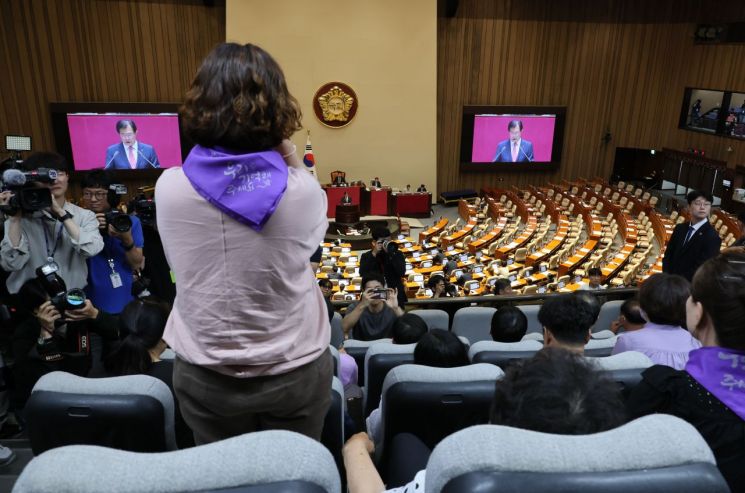
The National Assembly has decided to designate the 'Itaewon Special Act,' which includes provisions for establishing an independent investigative body to uncover the truth behind the October 29 Itaewon disaster, as a fast-track agenda item. While ruling party members who opposed the direct referral vote on the so-called Yellow Envelope Act (amendment to the Labor Union Act) and the Itaewon Special Act all left the session, opposition party members including the Democratic Party voted in favor of the agenda designation. If the Itaewon Special Act does not go through bipartisan agreement, it is highly likely to be brought to the plenary session around the next general election.
On the afternoon of the 30th, the National Assembly passed the 'Consent to Designate the Special Act on Guaranteeing the Rights of Victims of the October 29 Itaewon Disaster, Truth Investigation, and Prevention of Recurrence as a Fast-Track Agenda' in the plenary session. It passed with more than three-fifths of the votes (184 out of 185 members present excluding members of the People Power Party). The vote was conducted by secret ballot.
Thus, the Itaewon Special Act became the fifth bill ever to be placed on the fast-track since its introduction in 2012. Previously, in April, the double special investigation bills (Daejang-dong 5 billion Club and Kim Keon-hee special investigation) were designated as fast-track.
Once designated as a fast-track agenda, it can take up to 11 months before being brought to the plenary session. This is because it requires up to 180 days for the relevant standing committee review, up to 90 days for the Judiciary Committee review, and 60 days for referral to the plenary session, totaling a maximum of 330 days until the vote. Therefore, the vote is expected to take place around March, just before the next general election. The special act can be passed in the plenary session after May 25 next year, before the end of the 21st National Assembly members' term.
Why Did the Itaewon Disaster Special Act Go to Fast-Track?
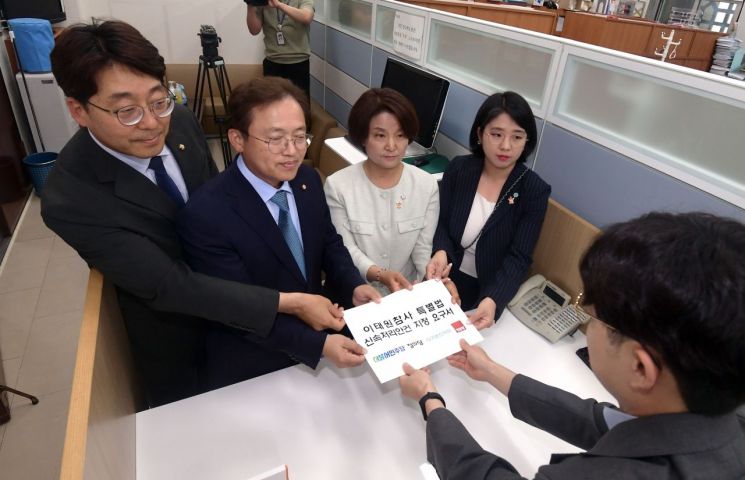
The Itaewon Special Act was jointly proposed last April by the four opposition parties (Democratic Party, Justice Party, Basic Income Party, and Progressive Party). It was then submitted to the National Assembly's Public Administration and Security Committee on the 22nd. The core of the special act is to establish a special investigative committee. Although the National Assembly conducted a state audit after the disaster, the investigation was insufficient due to the short period of 55 days. The special act empowers the investigative body to conduct an investigation into the incident ex officio, order the submission of materials and objects, and request prosecution and investigation. If a special prosecutor's investigation is necessary, the National Assembly can request it, and the standing committee must complete its review within three months.
To support victims, the act establishes a Disaster Victim Relief Deliberation Committee under the Prime Minister's office, and the state is to provide comprehensive support for victims' lives, including medical support payments and psychological assistance. It also includes provisions for developing community recovery programs and creating memorial parks to prevent recurrence. The special investigative committee is to operate for one year (with a possible six-month extension).
Since the 8th, bereaved families of the disaster have been holding a march protest, walking 9 km from Seoul Plaza to Yeouido National Assembly, urging the enactment of the special act. They also began a hunger strike at the protest site in front of the National Assembly from the 20th.
Opposition: "We Must Now Respond to the Bereaved Families' Voices" / Ruling Party: "General Election, Legislation for Political Conflict"
On the day, lawmakers from both sides engaged in intense debates before the vote. Opposition lawmakers criticized the Yoon Seok-yeol administration's response to the disaster and emphasized the necessity of passing the special act. Democratic Party lawmaker Park Jumin quoted a victim's family member known as 'Jooyoung's father,' saying, "It has been over 240 days since my daughter left, and I have repeatedly cried out to know the truth about Jooyoung's last moments and what emergency measures were taken in the critical situation, but I am still a pathetic father crying on the street."
He continued, "Shouldn't the people know how the unprecedented crush accident in Korea, the Itaewon disaster, happened, whether the follow-up response was appropriate, and whether the roles of state agencies were properly fulfilled? Although late, I believe our National Assembly must now properly respond."
Justice Party lawmaker Jang Hye-young also said, "Regarding the October 29 Itaewon disaster that took the lives of 159 citizens in the heart of Seoul, the public officials who should bear responsibility have not taken any responsibility and are just letting time pass, seemingly waiting for this matter to be forgotten by the public. The designation of the Itaewon disaster special act as a fast-track agenda is the minimum responsible politics that the 21st National Assembly can show to the bereaved families and citizens."
On the other hand, ruling party lawmakers opposed the fast-track designation, accusing the opposition of politicizing the disaster. People Power Party lawmaker Lee Man-hee said, "(The Democratic Party) is branding the government and ruling party as a bad regime and heartless party that ignores the pain of the bereaved families who are being neglected." He added, "I cannot agree with this law, which intends to escalate social conflict and politicize the disaster through a special investigative committee lasting one year and a memorial committee lasting up to ten years, with the political purpose of managing the Democratic Party's crisis."
People Power Party lawmaker Cho Eun-hee also said, "Pushing this bill before receiving judgments from investigative agencies and courts, which have the primary responsibility for truth-finding, is a hasty legislation with the order reversed." She added, "The Sewol Ferry Disaster Special Act in 2014 was enacted after the first trial verdict for Captain Lee Jun-seok and related parties." She further pointed out procedural problems, saying, "There are many problems in the content as well. The special investigative committee's right to request a special prosecutor and the Board of Audit and Inspection's right to request audits grant numerous ultra-constitutional powers. The provision allowing forced dispatch of public officials without inter-agency consultation contradicts current law procedures and disregards existing administrative procedures."
© The Asia Business Daily(www.asiae.co.kr). All rights reserved.
![Clutching a Stolen Dior Bag, Saying "I Hate Being Poor but Real"... The Grotesque Con of a "Human Knockoff" [Slate]](https://cwcontent.asiae.co.kr/asiaresize/183/2026021902243444107_1771435474.jpg)

















