Ruling Party: "Destroying the Legal System" Opposition: "Must Reflect the Changed World"
The Yellow Envelope Act (Amendments to Articles 2 and 3 of the Labor Union and Labor Relations Adjustment Act) has been submitted to the plenary session of the National Assembly. Afterward, through agreement between the ruling and opposition parties or the Speaker's decision, the bill can be formally introduced and put to a vote in the plenary session.
On the 30th, the National Assembly held a plenary session and conducted a secret ballot on the submission of the Yellow Envelope Act to the plenary. Of the 184 members present, 178 voted in favor, 4 against, and 2 invalid votes, resulting in approval. The People Power Party walked out entirely just before the vote on the Yellow Envelope Act.
The Yellow Envelope Act includes provisions that allow those who are not parties to the employment contract but who have a position to substantially and concretely control and determine the working conditions of workers?such as the original contractor?to be regarded as employers, and it limits claims for damages related to labor disputes. The bill was proposed during the 21st National Assembly, triggered by the trial of the subcontractor union strike at Daewoo Shipbuilding & Marine Engineering.
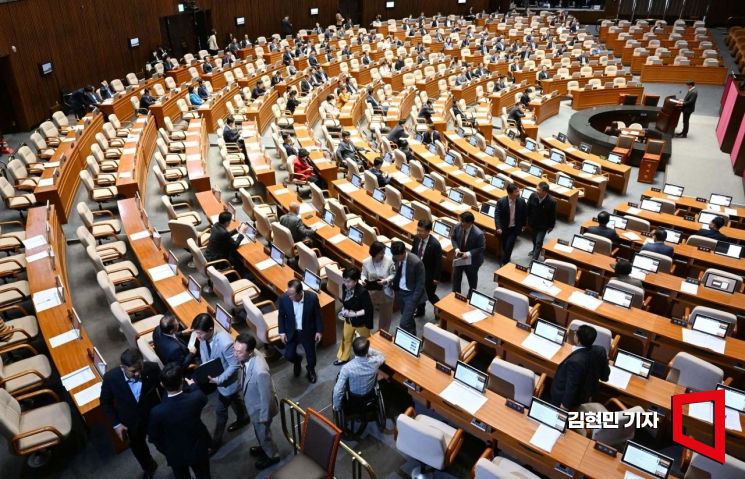 On the 30th, members of the People Power Party are leaving during the debate on whether to submit the "Yellow Envelope Act" (Amendment to the Labor Union and Labor Relations Adjustment Act) at the National Assembly plenary session. Photo by Hyunmin Kim kimhyun81@
From the review process, the ruling and opposition parties had sharply contrasting positions. The opposition emphasized the necessity of handling the bill, while the ruling party expressed opposition and showed a passive attitude during the bill’s review. As a result, on February 21 this year, the Environment and Labor Committee passed the bill solely with opposition members. However, when the Legislation and Judiciary Committee, responsible for detailed examination, failed to complete the review within 60 days, the Environment and Labor Committee held a plenary meeting on the 24th of last month and decided to directly submit the bill to the plenary session.
That day’s plenary session was about deciding whether to submit the bill to the plenary following the direct submission decision made last month. The actual enactment of the Yellow Envelope Act requires a separate plenary vote procedure.
Fierce Debate Between Ruling and Opposition Through Pros and Cons Discussion
Before the vote, the ruling and opposition parties engaged in a heated debate, divided over support and opposition to the Yellow Envelope Act.
Im Ija, the People Power Party’s secretary of the Environment and Labor Committee, warned in opposition debate that expanding the concept of employer, broadening the concept of labor disputes, and limiting claims for damages risk undermining the existing legal framework. Im pointed out, "If the employer concept is expanded as in the amendment, becoming ambiguous, subcontracted or indirectly employed labor unions could request collective bargaining with the original contractor employer, and if the employer refuses to negotiate without their knowledge, they could face criminal punishment." Regarding damages, she said, "Legal responsibility must be borne for illegal acts, and when multiple people jointly commit illegal acts, joint and several liability requires all participants to compensate fully. The amendment damages the civil law framework by individually determining the scope of responsibility for damages based on each liable party’s fault and contribution regarding union illegal acts."
Lee Sujin, the Democratic Party’s secretary of the Environment and Labor Committee, argued for the necessity of legislating the Yellow Envelope Act in response to changing labor conditions. Lee said, "Since around the 1997 IMF crisis, the number of irregular workers has increased exponentially, and special employment, indirect employment, and platform labor have rapidly grown. In such a diversified employment society, designating the original contractor employer who can substantially and concretely control working conditions as the employer under the Labor Union Act aligns with the legislative purpose of the law." After listing names of those who took their lives due to the burden of damages, Lee explained, "Behind these tragic deaths were indiscriminate damage claims from the government and employers. This bill does not aim to legalize illegal strikes but to clarify liability for damages related to illegal strike actions." She claimed, "(The Yellow Envelope Act) is a bill that can genuinely negotiate with the real employer and solve the dual structure and inequality problems prevalent between original and subcontractors in the industry," calling it the "Industrial Site Peace Guarantee Act, Legal Strike Guarantee Act, and Damage Claim Bomb Prevention Act."
Kim Hyungdong of the People Power Party raised procedural issues regarding the direct submission in opposition debate. Kim introduced, "The bill directly submitted was first brought up on the so-called last day by Kim Youngjin, then subcommittee chair and Democratic Party secretary of the Environment and Labor Committee." Pointing out the neutralization of the agenda adjustment committee, Kim said, "It would be better to hold a plenary meeting and have an open debate in such a setting to better inform the public about the bill’s problems and pros and cons."
Lee Eunju of the Justice Party pointed out that irregular workers cannot exercise the three labor rights, saying, "The government talks about the dual structure of the labor market but does not even pay attention to this dual structure of basic rights. If the original contractor company and these subcontracted workers could have normal negotiations, the strike actions would have been normal." Regarding damages, Lee explained, "The right to claim damages for the losses incurred is the same. The court only determines the degree of fault of each liable party." She emphasized, "South Korea is the only country where people commit suicide because of damage claims related to strike actions. We must submit the Yellow Envelope Act to the plenary to guarantee normal negotiations and improve the indiscriminate recognition of damage claims to end this tragedy."
When the vote began, members of the People Power Party all left the chamber, abstaining from the vote.
© The Asia Business Daily(www.asiae.co.kr). All rights reserved.
!["The Woman Who Threw Herself into the Water Clutching a Stolen Dior Bag"...A Grotesque Success Story That Shakes the Korean Psyche [Slate]](https://cwcontent.asiae.co.kr/asiaresize/183/2026021902243444107_1771435474.jpg)
















