Seoul City Announces 'New High-Density District Plan' for Public Viewing from July
Improving Environment by Lifting Height Restrictions While Preserving Key Landscapes
Complete Deregulation for Guro Oryu and Seocho Court Complex Districts
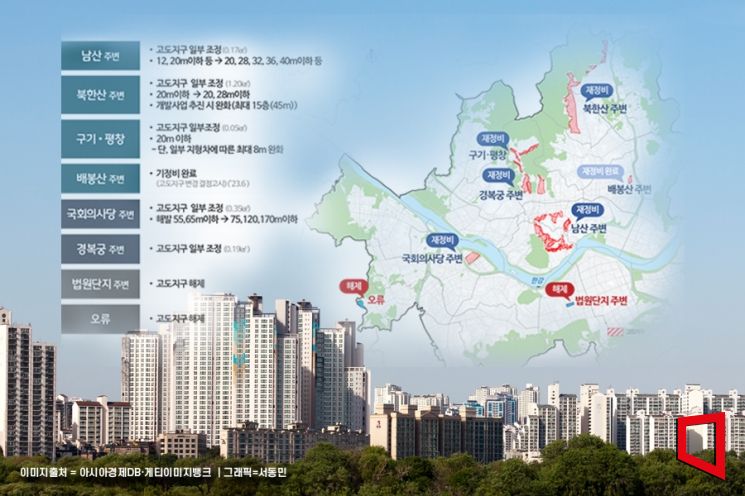
Seoul Mayor Oh Se-hoon's 'New Height Restriction Zone Plan' has been unveiled. The height restrictions around the National Assembly building will be relaxed up to a maximum of 170m, and in the second-class general residential areas near Bukhansan, apartments up to 15 floors can be built. Seoul City plans to improve the aging urban environment by lifting unnecessary height restrictions while preserving key landscapes.
The core of the new height restriction zone plan announced by Seoul City on the 30th is to reorganize areas requiring landscape management with 'customized regulations' and boldly lift restrictions in areas where they are ineffective. A Seoul City official explained, "We are promoting the reorganization of height restriction zones to shift from uniform regulations to rational management that citizens can empathize with."
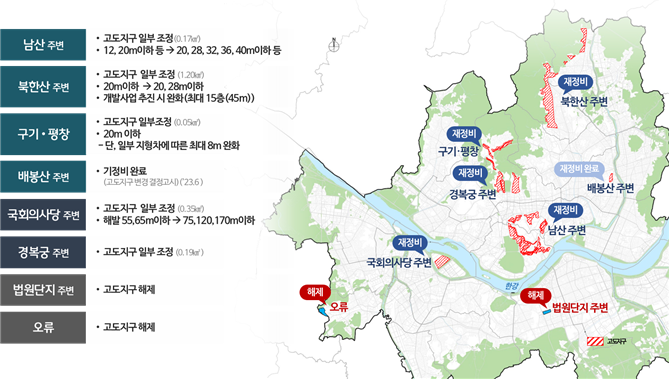
First, the height restriction zone around the National Assembly will be maintained, but the height limits will be significantly relaxed from the current 41m and 51m to 75m, 120m, and 170m as it approaches Yeouido Park. This plan aims to activate urban functions by lifting uniform regulations.
In the largest height restriction zone around Bukhansan, the height limit in the second-class general residential area will be raised from 20m to 28m. If the landscape management guidelines are followed, buildings up to 15 floors (45m) can be constructed during redevelopment projects such as Moa Town.
The height restriction zone around Namsan will also be managed with customized regulations by area to improve the aging urban environment. The height limits of 12m and 20m will be subdivided to range from 12m to 40m. In particular, the quasi-residential area around Yaksu Station will have its height limit relaxed from 20m to between 32m and 40m, considering land utilization.
The height restriction zone in Oryu, Guro-gu, will be completely lifted. This area borders Bucheon in Gyeonggi Province, where height restrictions have been lifted and the area has been developed into apartments, rendering the designation unnecessary. Seoul City plans to manage this area under the 'Onsu Station District Unit Plan' to strengthen industrial competitiveness.
The height restriction zone around the courthouse complex in Seocho-gu will also be lifted. Although the district court and prosecutor's office are not national important facilities, unlike the Supreme Court and Supreme Prosecutors' Office which are national important facilities, height restrictions have been imposed on the entire area, limiting efficient land use in the Gangnam downtown area. Going forward, it will be managed under the 'Seocho-ro District Unit Plan' to activate urban functions.
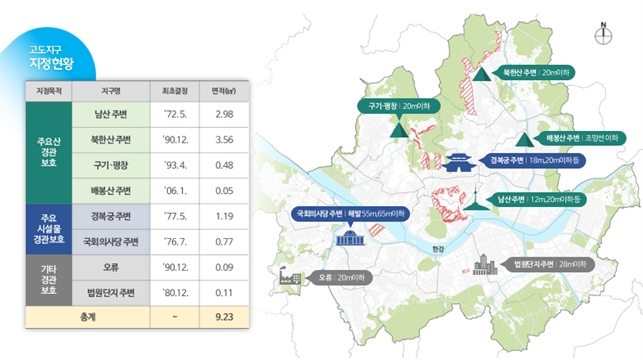
Height restriction zones are urban management plans that set maximum building heights to protect cityscapes and prevent overcrowding. Since first designating a height restriction zone around the Namsan Fortress Trail in 1972, Seoul has managed eight locations (9.23㎢) including areas around Namsan, Bukhansan, and Gyeongbokgung Palace. However, as the system aged, issues such as overlapping height regulations and development disparities due to aging residential environments arose. Consequently, calls to improve height restriction regulations have steadily increased.
A Seoul City official said, "From the 6th to the 20th of next month, a public inspection notice will be held to gather various citizen opinions," adding, "We plan to complete the reorganization of height restriction zones by the end of this year after consultations with autonomous districts and related institutions, strategic environmental impact assessments, and reviews by the Urban Planning Committee."
© The Asia Business Daily(www.asiae.co.kr). All rights reserved.


















