Entrust AI with Content Creation, Inventory Analysis, and Store Management
From Large Corporations to Small Businesses... Significant Cost Reduction Benefits
Since the rapid rise of ChatGPT, artificial intelligence (AI) has been swiftly penetrating various industries. As AI evolves into a versatile business tool for content creation, inventory management, product recommendations, and more, companies ranging from large corporations to small business owners are utilizing it. They are seeing significant benefits such as increased productivity and cost reduction.
The area where AI has penetrated the fastest is marketing. This is because AI can create promotional copy or videos for products, resulting in substantial cost savings. Gmarket, which applied the video generation AI V-Cat, is a prime example. V-Cat creates dozens of promotional videos and banners within one minute by inputting a product URL. After adopting V-Cat, Gmarket’s two in-house designers produce 600 banner ads daily?work that previously required outsourcing. By September, they plan to increase banner production to 1,500. Due to its high efficiency, companies like Amorepacific, LG Electronics, and Lotte ON are using V-Cat. Discussions are also underway with Samsung Electronics and Hyundai Motor Company. Jeong Beom-jin, co-CEO of V-Cat, said, "Large corporations with various brands and products deploy hundreds of personnel solely for marketing. They want to internalize AI technology to streamline this."
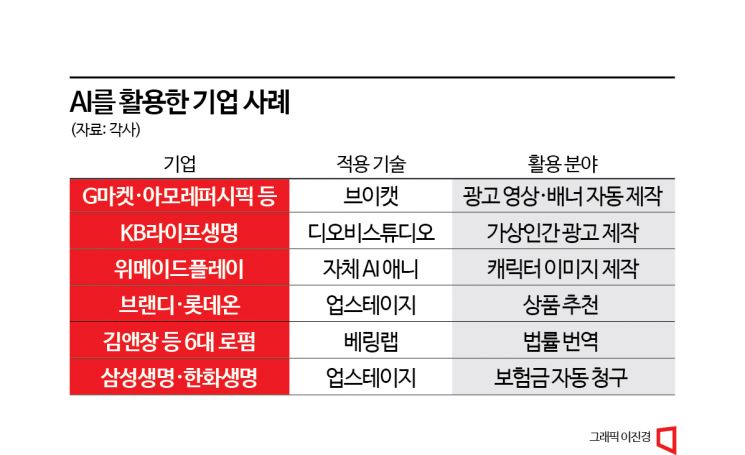
Even expensive content like virtual humans becomes an efficient marketing tool when AI is used. KB Life Insurance recently summoned actress Youn Yuh-jung’s 20s in an advertisement. Virtual human content company Diovis Studio recreated Youn’s 20s using AI. Previously, virtual humans were created by stitching together hundreds of images made with visual effects (VFX). In contrast, Diovis Studio applies AI-generated images onto stand-in actors. This method involves a person wearing the AI-drawn image as a mask during filming, speeding up the process. The production time for a 30-second video was reduced from about two months to 2?3 days, and costs were cut by more than 50 times. Min Byung-jun, director at Diovis Studio, explained, "Companies want to consistently upload virtual human content to engage consumers, but long production times and high costs made this impossible. AI has lowered this barrier."
The gaming industry, which creates content directly, is increasing productivity with AI. Wemade Play, developer of the mobile puzzle game "Anipang," plans to apply AI "Annie"-created characters in the game as early as July. For example, if you request a "character wearing a Taegukgi costume with an Olympic background" via text, AI generates it. While background work for a character typically takes about two weeks, Annie reduces this by approximately 25%. This allows humans to focus on detailed tasks like retouching, and the company can speed up content updates.
In the distribution industry, AI is used more broadly. It plays an active role in product recommendations, inventory management, and store management. Fashion shopping app Brandy increased sales using Upstage’s product recommendation AI. The AI analyzes users’ search patterns, cart contents, and post-purchase reactions to display products they are likely to want. As a result, the purchase conversion rate per exposure jumped nearly 60% compared to before. Food company A applied Emro’s demand forecasting AI, a supply chain management software. The AI predicts future demand by combining past sales, inventory, production volumes, and competitor information for over 3,200 product groups. Based on this, A plans sales not only weekly but also 4?5 months ahead. This reduced out-of-stock costs by 20% and inventory by over 5%. Even small neighborhood stores are no exception. On the 26th, Seoul’s Seocho District saw the first unmanned store operated solely by AI solutions. Developed by Finders AI, this store automates operations, inventory management, and payments. Instead of expensive equipment like LiDAR, AI detects customer movements and changes on shelves. It identifies products taken by customers and automatically charges pre-registered payment methods. The cost to implement the solution in a 30?60㎡ convenience store is under 200 million KRW. Considering that labor costs alone for running a 24-hour convenience store at this year’s minimum wage amount to about 100 million KRW annually, the cost efficiency is high.
AI has also penetrated specialized fields such as law and finance. Bering Lab provides legal translation services using AI, translating overseas precedents and contracts. It is used by six major law firms including Kim & Chang, Bae, Kim & Lee, and Sejong, as well as corporate legal teams like Kakao Games. While translating 10 documents takes humans 3?5 days, AI completes it within 48 hours. The cost, previously 50,000?70,000 KRW per page, has been reduced to 30,000 KRW. Kim Jae-yoon, co-CEO of Bering Lab, emphasized, "Legal translation requires expertise, so even when outsourced to foreign translation companies, internal review is necessary. We have streamlined this process."
In finance, Samsung Life Insurance and Hanwha Life Insurance collaborated with Upstage to speed up insurance claim processing. AI extracts necessary information from documents such as medical receipts and automatically processes claims. This reduced time and costs by 82% compared to manual processing.
The scope of AI application is expected to continue expanding. Oh Seong-mi, head of Modern Work Business at Microsoft Korea, said, "While digitalization has improved productivity, the flood of information has increased work for the sake of work. Applying AI to such tasks will help generate innovative ideas."
© The Asia Business Daily(www.asiae.co.kr). All rights reserved.



















