Public Healthcare Setbacks Due to Staff Shortages
"Cannot Stand By as Medical Collapse Looms"
7 Major Demands Presented... General Strike on 13th Next Month
The Korean Health and Medical Workers' Union (KHMU) has announced a general strike scheduled for the 13th of next month. If the KHMU's general strike takes place, it will be the first in 19 years since the general strike held in 2004 to secure a five-day workweek, making chaos in the medical field inevitable.
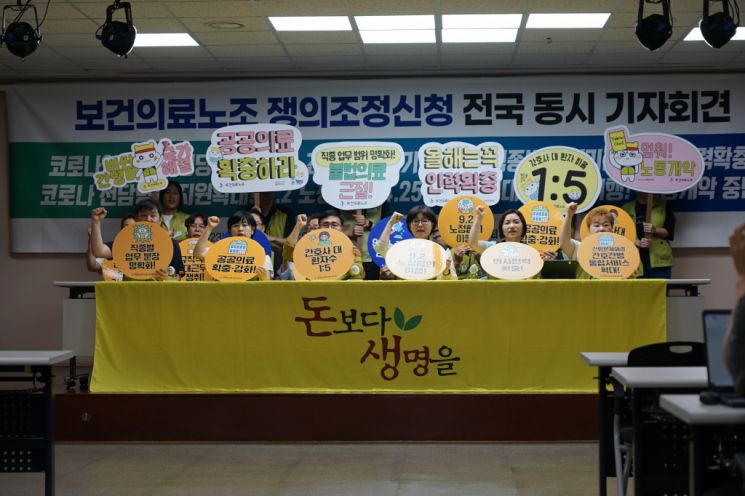 The National Health and Medical Industry Labor Union (Health and Medical Labor Union) held a press conference on the 28th to announce the filing of a dispute mediation request and warned of a general strike in July.
 [Photo by Health and Medical Labor Union]
Although strikes have occurred within its affiliated branches, the KHMU has rarely launched an actual general strike. During the COVID-19 pandemic in September 2021, a general strike resolution was reached, heightening tensions, but it was dramatically withdrawn after a labor-government agreement was reached. Given that the union represents workers who protect public health, the weight of a KHMU general strike is naturally significant. Nevertheless, the union’s announcement of another general strike after two years is based on the assessment that South Korea’s healthcare system is in a state of total crisis.
Labor Dispute Applications Filed Against 147 Medical Institutions Nationwide... 60,000 Participants
On the 27th, the KHMU filed simultaneous labor dispute adjustment requests with the Labor Relations Commission. This involved 128 branches and 147 workplaces, surpassing the 124 branches and 136 workplaces involved in 2021. The total number of union members participating from these medical institutions reached 61,311, accounting for 82.6% of all union members. Participating branches include 21 private university hospital branches (29 institutions), 12 special-purpose public hospital branches, 26 Korean Red Cross branches, 26 local medical center branches, 19 private small and medium hospital branches, 7 branches from psychiatric, rehabilitation, and nursing medical institutions, and 10 non-regular worker branches (16 institutions) including cleaning, parking, facilities, and security, covering all sizes and types of medical institutions. The KHMU plans to launch a full-scale general strike at 7 a.m. on the 13th of next month if core demands are not resolved during the dispute adjustment period ending on the 12th.
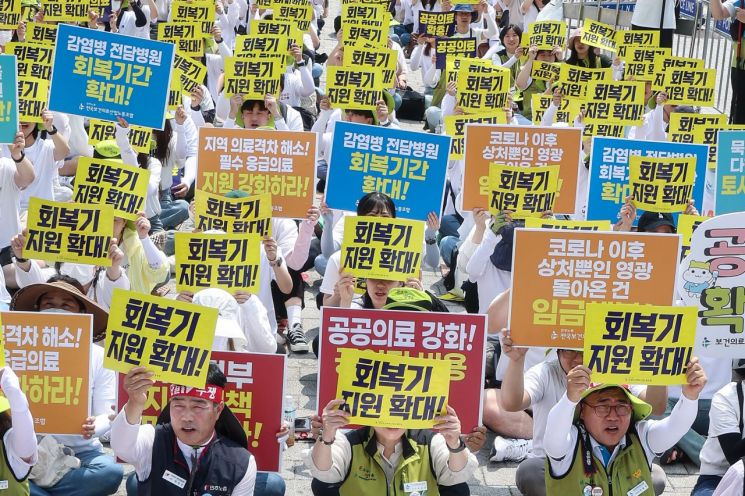 On the 27th, near the Presidential Office in Yongsan-gu, Seoul, the Health and Medical Workers' Union is shouting slogans demanding the expansion of public healthcare and the extension of the support period for recovery hospitals dedicated to infectious diseases. [Image source=Yonhap News]
The reason the KHMU has adopted a hardline stance is the imminent reality of medical system collapse. The union points out that the recurring 'emergency room cycling' incidents and gaps in essential medical services are direct reflections of the collapsing state of South Korea’s healthcare system. The staffing crisis in medical workplaces is severe, leading to shortened or closed pediatric services, disrupted treatments, and patient harm caused by illegal medical practices. The union claims that healthcare workers are experiencing burnout and being driven to leave their jobs due to harsh conditions, such as one nurse caring for more than 15 patients.
In particular, the union strongly criticizes the severe collapse of public healthcare, which played a frontline role in protecting the public during the COVID-19 pandemic. The union stated, "Public hospitals that took on the role of COVID-19 dedicated hospitals are operating at only around 40% bed occupancy, and government support has been cut off," adding, "Instead of supporting recovery and strengthening public healthcare infrastructure, there has been bed reduction, neglect of deficits, and promotion of private outsourcing?in short, a betrayal after use."
Seven Major Demands Including Staffing Expansion and Nursing Care Fee Resolution
The union has presented seven major demands, including resolving nursing care fees, fully expanding integrated nursing and caregiving services, assigning nurses to patients at a 1:5 ratio, establishing appropriate staffing standards by occupation, eradicating illegal medical practices and expanding physician staffing, expanding public healthcare and recovery support, and ensuring fair compensation and wage increases while blocking labor deterioration. Since May, the union has pursued negotiations with employers and government consultations, but according to the union, no party has shown a responsible willingness to resolve the issues.
The union criticized, "The government ignores research, pilot projects, institutional improvement consultations, and implementation monitoring results for staffing and public healthcare expansion, stating 'It is difficult to immediately prepare and implement detailed plans' and 'We plan to implement them,' showing no active will to resolve the issues. If the government does not implement the September 2 labor-government agreement and swiftly push institutional improvements, labor-management negotiations cannot escape deadlock." During the 2021 labor-government agreement, the union and government agreed on strengthening public healthcare, establishing an infectious disease response system, and implementing various policies to expand healthcare personnel. The union added, "This was a promise by the government and is included in the Yoon Suk-yeol administration’s pledges and policy tasks. The government must keep its promises."
Furthermore, the union appealed, "If the attitudes of employers and the government do not change, South Korea’s healthcare system will inevitably move from crisis to collapse. Without solutions, the public’s suffering and damage from medical system collapse cannot be overcome, and healthcare workers will be driven to the brink of despair due to poor working conditions and a bleak future."
© The Asia Business Daily(www.asiae.co.kr). All rights reserved.


















