'The Era of Mega AI, Data Opening and Sharing' Seminar
Experts: "Korea Imitates European-Style Regulation"
"Europe Strengthens Regulations Due to Lack of Domestic Competitiveness"
"Korea Competes Globally, Needs US-Style Approach"
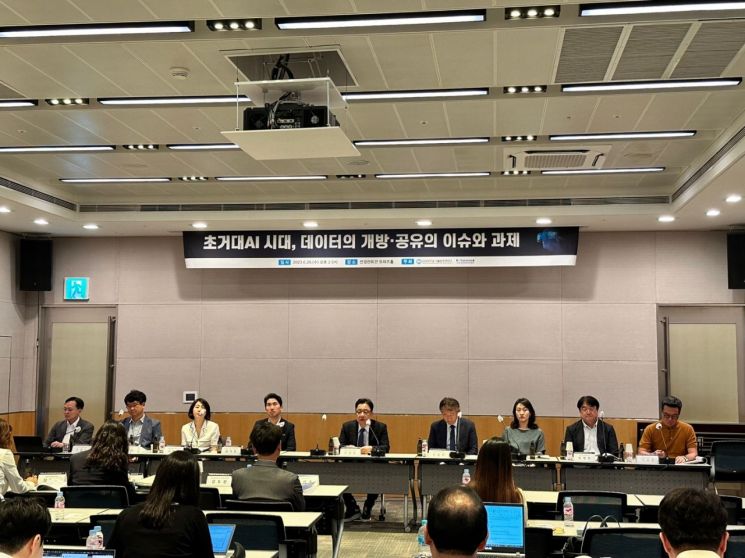 On the 28th, Korea University Technology Law Policy Center and Korea Internet Corporations Association held a seminar titled "The Era of Supermassive AI: Issues and Challenges of Data Opening and Sharing" at the Federation of Korean Industries Building in Yeouido, Seoul.
Experts have diagnosed that to survive in the hyper-large AI dominance competition triggered by ChatGPT, South Korea needs to revise its current regulatory direction. Currently, authorities such as the Fair Trade Commission are considering introducing the 'Online Platform Fairness Act (Onple Act)' inspired by the European Union's (EU) Digital Markets Act (DMA), which focuses on preemptive regulation.
At a seminar titled 'Issues and Challenges of Data Openness and Sharing in the Hyper-Large AI Era' held on the 28th at the Federation of Korean Industries building in Yeouido, Seoul, hosted by Korea University’s Technology Law Policy Center and the Korea Internet Corporations Association, experts unanimously agreed that regulations are acting as obstacles in the hyper-large AI competition.
While the EU’s data-related laws, which South Korea is emulating, focus on activating competition in industries through data, South Korea’s data-related laws emphasize strengthening the rights of data subjects, raising questions about the effectiveness of competition activation.
Professor Park Hee-jun of Yonsei University’s Department of Industrial Engineering stated, “Europe continuously creates regulations because its platform and data industry competitiveness is weak and it needs to protect its domestic industries. Since we have our own market and competitiveness compared to Europe, we actually need a U.S.-style approach with almost no regulations. Our market situation and laws are out of sync.”
Professor Yoo Byung-jun of Seoul National University’s College of Business said, “We are one of the few countries competing in the global portal and AI markets after the U.S. and China,” adding, “Regulating according to Europe’s standards is something we really need to reconsider.”
Professor Yoo also criticized the political demand that algorithms be disclosed in cases of unfair platform transactions, saying, “It is questionable whether the government can respond just by seeing the algorithms, and there are also issues of technology leakage in this process, so it is inappropriate.”
On the other hand, Kim Jik-dong, Director of the New Technology Personal Information Division at the Personal Information Protection Commission, said, “Considering the time and cost required to train hyper-large AI, it is important to prepare in advance rather than overturning things later,” adding, “If only ex-post regulations are applied, as seen in the Iruda incident which shook the AI chatbot industry, anxiety among hyper-large AI users could intensify and the market could shrink.”
Meanwhile, at the seminar, opinions were also raised that the 'data rich get richer, poor get poorer' phenomenon could deepen in the hyper-large AI era. The data concentration around large platforms could accelerate.
Kim Hyun-soo, Senior Research Fellow at the Platform Policy Research Center, said, “The dependency of business users (tenant businesses) on generative AI will strengthen,” adding, “Especially if generative AI acts as an intermediary, tenant businesses may find it difficult to switch platforms because they cannot secure user data.” He diagnosed that major companies like Google and Apple, which dominate the mobile operating system (OS) and app market, could monopolize user data and hinder competition and innovation. Accordingly, Research Fellow Kim argued for the introduction of preemptive regulations related to data portability.
However, there was also a counterargument that guaranteeing data portability could exacerbate the concentration of large corporations. Dr. Park Yuri of the Korea Information Society Development Institute said, “It is questionable how effective data portability implemented domestically is,” and countered, “A 2020 survey showed that users preferred to move data to companies they know well rather than unfamiliar ones. This could strengthen data concentration toward large corporations.”
© The Asia Business Daily(www.asiae.co.kr). All rights reserved.

















