- Creation of the World's Largest 'Seoul Unicorn Startup Hub' on a 100,000㎡ Site at Seoul Forest Parking Lot
- Synergy with Seongsu-dong Global Business District ... Spotlight on Seongsu-dong Knowledge Industry Center
- Double Subway Line Access at Line 2 and Suin-Bundang Line ... Well-Organized Road Network in a Key Transportation Hub
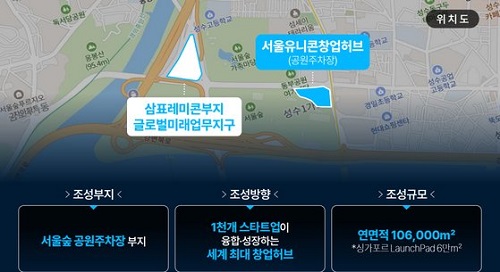
The Seoul Metropolitan Government has unveiled a blueprint to revitalize the startup ecosystem by creating the world's largest Seoul Unicorn Startup Hub in Seongsu-dong, aiming to elevate Seoul to the world's 5th largest startup city.
On the morning of the 21st, Seoul Mayor Oh Se-hoon personally announced the 'Seoul Startup Policy 2030' at the city hall briefing room, declaring the goal to nurture 50 global unicorn companies?unlisted startups with a corporate value exceeding 1 trillion KRW?by 2030.
To achieve this, a 100,000㎡ Seoul Unicorn Startup Hub, the largest in the world, will be established in Seongsu-dong by utilizing the Seoul Forest parking lot site next to Seongsu Sampyo Remicon. The hub will accommodate 1,000 startups, ranging from early-stage startups to prospective unicorn companies, and a dedicated fund worth 100 billion KRW will be created to support resident companies.
In line with this, Seongdong-gu announced plans to focus its support capabilities on startups, including social ventures, to develop Seongsu-dong into a global startup hub. Seongdong-gu has formulated and is implementing the ‘Global ESG Startup Support Plan.’
The comprehensive support plan for the ‘Global ESG Startup Valley Development’ includes five areas and 29 projects: ▲expansion of financial support ▲space and market access support ▲creation of a business-friendly city ▲foundation for global market entry ▲leap to a global startup valley.
Seongsu-dong is the largest cluster of social ventures nationwide, housing about 530 social economy enterprises and intermediary support organizations, attracting companies from various fields such as advanced technology, robotics, fashion, and culture and arts. Seongdong-gu plans to expand the Seongsu IT Industry and Distribution Development Promotion District and establish a district unit plan for the semi-industrial area in Seongsu to foster it as a hub for jobs and future industries.
Along with these large-scale benefits, Seongsu is considered prime land in Seoul due to its strategic location connecting Gangbuk and Gangnam, easy access to Seongsu Bridge and Gangbyeonbuk-ro, and beautiful natural scenery. Evidence of this is seen as fashion and entertainment companies, which previously insisted on Gangnam, are relocating to Seongsu or building new headquarters, creating large office complexes.
Most offices in Gangnam are over 20 years old and aging, and with no land available for new construction, companies seeking headquarters are choosing Seongsu as an alternative. A representative from RSquare, a commercial real estate data specialist, evaluated the current situation, saying, “It’s partly because there are no vacancies suitable for Gangnam, but seeing luxury brands choosing Hannam and Seongsu suggests that perceptions of Gangbuk have changed compared to the past.”
Seongsu-dong is expected to supply about 200,000 pyeong (approximately 660,000㎡) of office facilities over the next five years, with offices accounting for about 75%. Considering that GBD (Gangnam Business District) will supply 68,000 pyeong and YBD (Yeouido Business District) 60,000 pyeong during the same period, Seongsu, once a sub-area of GBD, is expected to serve as an alternative leasing site due to the shortage of core business area supply.
Moreover, Seongsu-dong attracts major domestic companies by captivating the MZ generation, who lead trends, with its unique retro atmosphere and proximity to Gangnam. The MZ generation is the fastest to recognize sophisticated culture and spread it quickly. Seongsu-dong, the sacred place for the MZ generation, is thus being used as a promotional marketplace by major domestic companies.
Recently, luxury brands such as Dior, Cartier, Gentle Monster, Louis Vuitton, and Lush have been opening or preparing to open stores. Instead of Gangnam, Hongdae, or Itaewon, they are opening pop-up stores here to promote products and services to customers. They also create showrooms and hold various events and exhibitions to intensify promotion and marketing.
Unicorn companies leading the fashion and cultural industries and IT startups are also choosing Seongsu-dong. IT company Krafton purchased the Emart headquarters building in Seongsu-dong last year and plans to develop it into a complex building including its headquarters. Musinsa also acquired land in Seongsu-dong 1-ga and is currently constructing its headquarters. Additionally, various cultural and content companies are preparing to relocate their headquarters to Seongsu-dong.
Seongsu-dong has locational advantages adjacent to Gangnam and easy access to Gyeonggi-do via the Bundang Line, leading to expectations that it will secure its status as an independent business district faster than Pangyo. The Seongsu-dong area is becoming a unique region where entertainment, fashion, gaming business districts, retro culture, and knowledge industry centers coexist, making it hard to find anywhere else in Seoul.
Seongsu-dong is a distinctive area combining retail and business districts, attracting hot interest from overseas investors. Thanks to these favorable conditions and development potential, higher investment returns are expected compared to other office districts, leading to intense courting from asset management companies and developers.
Amid the rising value of the Seongsu-dong area, a knowledge industry center nearing full pre-sale has become a hot topic. The protagonist is the ‘Seoul Forest The Space Knowledge Industry Center,’ being built in Seongsu-dong 1-ga, Seongdong-gu, Seoul, with Hyundai Asan as the construction company.
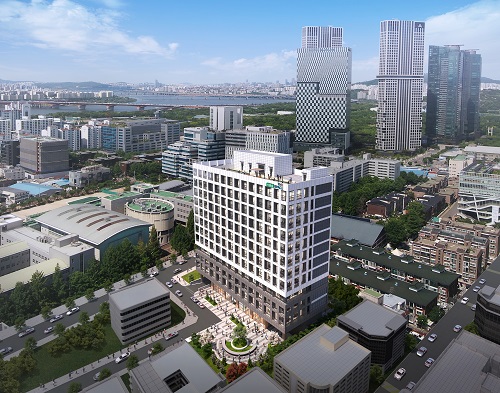
‘Seoul Forest The Space’ will be constructed with five basement floors and 12 above-ground floors, covering approximately 25,000㎡ of total floor area, and will include a knowledge industry center and neighborhood living facilities. The exclusive area ranges from 30㎡ to 115㎡, offering a wide selection for prospective tenants.
This knowledge industry center is expected to serve as a growth platform for cultural and content production companies, which are high value-added industries based on advanced knowledge.
The greatest strength of this knowledge industry center lies in its excellent location rivaling Gangnam. Both Suin-Bundang Line’s Seoul Forest Station and Subway Line 2’s Ttukseom Station are within a five-minute walk, making commuting easy for employees of tenant companies.
The surrounding road network is also well developed. Crossing Seongsu Bridge or Yeongdong Bridge nearby leads directly to Gangnam (Apgujeong-dong, Cheongdam-dong). Additionally, via Gangbyeonbuk-ro and Olympic-daero, one can quickly reach central business districts such as Gangnam (Samseong-dong), Jamsil, Hannam-dong, Yongsan, and Yeouido. Access to Dongbu Expressway and Internal Circulation Road is also convenient. In fact, Seongsu-dong is practically a transportation hub of Seoul.
Employees of tenant companies can easily enjoy rest and leisure activities through nearby convenience facilities, and Seoul Forest, one of Seoul’s representative large parks, is also close by.
The sales promotion center is located near Ttukseom Station on Seoul Metropolitan Subway Line 2 in the metropolitan area, and visitors can receive more detailed information by making a phone reservation in advance.
© The Asia Business Daily(www.asiae.co.kr). All rights reserved.
![User Who Sold Erroneously Deposited Bitcoins to Repay Debt and Fund Entertainment... What Did the Supreme Court Decide in 2021? [Legal Issue Check]](https://cwcontent.asiae.co.kr/asiaresize/183/2026020910431234020_1770601391.png)

















