Prosecutors, Police, and Ministry of the Interior Focused... Only Justice Council Deliberation Left
Constitutional Court Quickly Ends Oral Arguments... Possible Ruling Before 180 Days
As the trial for the impeachment of Minister of the Interior and Safety Lee Sang-min, requested by the National Assembly due to the inadequate response to the Itaewon disaster, comes to a close, attention is focusing on the Constitutional Court's final decision timing. The prosecution, investigating whether there were issues in the response to the Itaewon disaster, the police preparing disciplinary actions against related personnel, and the Ministry of the Interior and Safety, where important decisions are being delayed due to the minister's prolonged absence, are all closely monitoring the outcome of the minister's impeachment trial.
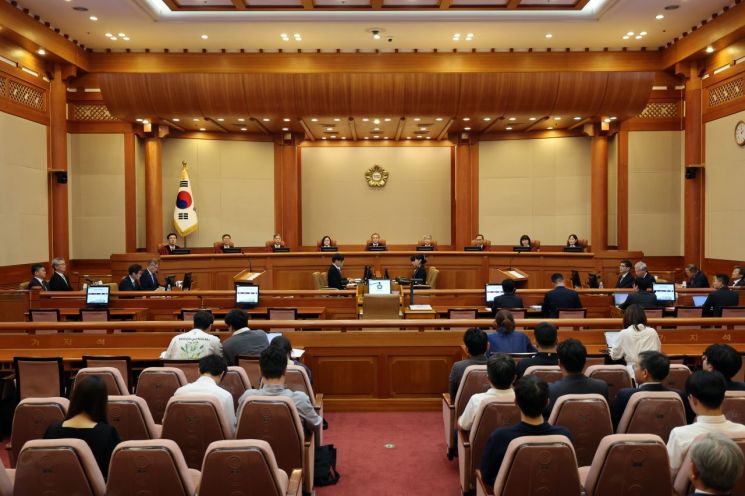 On the 27th, the fourth defense hearing for Lee Sang-min, Minister of the Interior and Safety, who was impeached amid controversy over the inadequate response to the Itaewon disaster, took place at the Grand Courtroom of the Constitutional Court in Jongno-gu, Seoul. Chief Justice Yoo Nam-seok and other constitutional justices entered and took their seats.
 [Photo by Yonhap News]
According to the legal community on the 28th, the impeachment trial must be concluded within 180 days from the date the case is received, but since this is not a mandatory provision, a ruling after 180 days is not problematic.
However, in this case, the Constitutional Court did not accept the National Assembly's request for an on-site inspection, which took some time during the issue-sorting process before the trial began. After the trial started, hearings were scheduled quickly at intervals of 2 to 3 weeks, concluding the trial procedure. This has led to speculation that a decision could be made within 180 days. The 180-day mark from the case reception date is August 7.
From the Constitutional Court's perspective, Chief Justice Yoo Nam-seok is scheduled to retire in November this year, so there is limited time for prolonged deliberation. There are important cases that must be swiftly concluded and decided before Chief Justice Yoo's retirement. In the impeachment trial of former Chief Judge Lim Seong-geun in 2021, which was held just before this minister's impeachment trial, the ruling was made 79 days after the conclusion of the trial.
With the trial procedure completed, the remaining step before the ruling is the deliberation (評議) attended by all nine constitutional justices, where they exchange opinions on the case. The deliberation proceeds with the presiding justice summarizing the review content either orally or in writing, followed by other justices presenting their opinions and engaging in discussions to reach a consensus.
The decision on the case is also made during the justices' deliberation. The presiding justice drafts the decision document based on the majority opinion of the justices. In impeachment trials, unlike constitutional review or constitutional complaint cases, the presiding justice's opinion is known to have relatively less influence on the conclusion. An impeachment decision requires the approval of at least six justices to remove the respondent from office.
The Constitutional Court views the key issues in the impeachment trial as whether Minister Lee violated the obligations for pre-disaster prevention measures and post-disaster response measures, and whether there were inappropriate remarks or conduct after the disaster occurred.
Specifically, the issues include ▲whether there was an obligation to plan and prepare measures for crowd-related accidents and if so, whether that obligation was properly fulfilled ▲whether there was an obligation to establish and advance the disaster safety communication network ▲whether it is true that the Central Accident Response Headquarters (Jungsu-bon) was not established, and if so, whether this constitutes a legal violation ▲whether it is true that the Central Disaster and Safety Countermeasures Headquarters (Jungdaebon) was not immediately activated, and if so, whether this constitutes a public official misconduct under the law ▲whether the national disaster management system was not properly utilized during the response process after the disaster, and if so, whether this constitutes a violation of duty ▲whether police and other response personnel were not deployed in a timely manner during the disaster ▲whether remarks made after the disaster damaged the dignity of public officials or violated the duty of dignity.
Inside and outside the legal community, there is analysis that the Constitutional Court may apply a lower threshold for what constitutes a ‘serious legal violation’ warranting dismissal from public office in the case of an appointed minister.
© The Asia Business Daily(www.asiae.co.kr). All rights reserved.
![Clutching a Stolen Dior Bag, Saying "I Hate Being Poor but Real"... The Grotesque Con of a "Human Knockoff" [Slate]](https://cwcontent.asiae.co.kr/asiaresize/183/2026021902243444107_1771435474.jpg)
















