No Parliamentary Rules on Conflict of Interest
"Civic Groups Request Information Disclosure... No Regulations, So It's Kept Confidential"
As the full investigation of virtual assets owned by members of the National Assembly concludes on the 30th, it appears unlikely that any conflicts of interest will be confirmed. This is because the National Assembly's regulations have not yet been established, effectively blocking oversight of conflicts of interest among lawmakers.
According to the National Assembly on the 29th, the Ethics Review Advisory Committee is collecting registrations of members' virtual asset ownership status and transaction history until the 30th. This follows a hurried amendment to the National Assembly Act aimed at preventing potential conflicts of interest related to virtual assets, after allegations of coin investment involving independent lawmaker Kim Nam-guk surfaced.
During last month's amendment process of the National Assembly Act, a separate supplementary provision was established regarding the registration of interests that must be filed upon election of a member, requiring the reporting of virtual asset ownership status and transaction history.
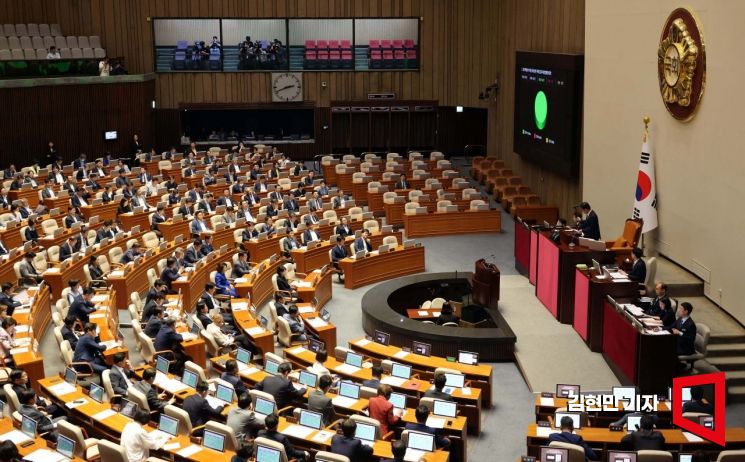 On the 21st, the partial amendment bill to the Special Act on the Punishment of Sexual Violence Crimes was passed at the plenary session held at the National Assembly. Photo by Hyunmin Kim kimhyun81@
The issue lies in its effectiveness. According to the amended National Assembly Act, the Ethics Review Advisory Committee is to review virtual asset ownership status and related matters. However, detailed regulations governing this process have not been enacted in the National Assembly rules. In fact, Chapter 4-2 of the National Assembly Act, titled "Prevention of Conflicts of Interest for Members," stipulates that most procedures, methods, and management related to registration, change registration, disclosure, and submission of explanatory materials concerning private interests are to follow subordinate rules, namely the "National Assembly Rules."
However, since the introduction of the National Assembly Act to prevent conflicts of interest in 2021, prompted by the real estate speculation scandal involving employees of the Korea Land and Housing Corporation (LH), no related National Assembly rules have been established.
As a result, when the Citizens' Coalition for Economic Justice requested disclosure of information related to conflicts of interest of lawmakers last year, the Ethics Review Advisory Committee decided not to disclose the information, citing that although disclosure is stipulated under the National Assembly rules, the relevant rules have not been enacted. Even after the virtual asset registration is completed, if the related National Assembly rules are not established, information regarding conflicts of interest will remain inaccessible.
This directly contradicts the purpose of the National Assembly Act. Article 38-2 of the Act, which deals with conflicts of interest, states that "within the scope where information disclosure is not prohibited, matters concerning the member themselves among the following items may be disclosed." Although the law permits disclosure, the absence of National Assembly rules effectively prevents verification of conflicts of interest.
There is a high possibility that the situation where civic groups request information disclosure and the Ethics Review Advisory Committee refuses will recur after August. The committee must submit the results of the conflict of interest registrations received by this day to the Speaker of the National Assembly and the floor leaders of the ruling and opposition parties by the end of July. The Citizens' Coalition for Economic Justice is considering filing an information disclosure request related to virtual asset conflicts of interest, but unless current regulations change, the Ethics Review Advisory Committee may repeatedly refuse disclosure citing lack of rules. However, a National Assembly official explained, "This (virtual asset-related conflict of interest) registration is being accepted as a special case under the supplementary provisions, not the main text of the National Assembly Act, so the Ethics Review Advisory Committee will make the judgment."
 Independent lawmaker Kim Nam-guk and People Power Party lawmaker Cho Kyung-tae are greeting each other at the Education Committee plenary meeting at the National Assembly on the 12th. Photo by Kim Hyun-min kimhyun81@
Earlier, the National Assembly's Special Committee on Political Reform began discussions earlier this year to establish related National Assembly rules. On January 25, the Political Reform Special Committee's Subcommittee on National Assembly Modernization held a meeting to review the rules. However, at that time, lawmakers expressed reluctance to enact the rules, raising concerns about the exposure of personal information of independent livelihood family members. Regarding this, Kim Young-bae, a Democratic Party lawmaker newly appointed as chair of the subcommittee on the 20th, stated, "Since being appointed as subcommittee chair, I have been reviewing related matters," and added, "Discussions will proceed going forward."
A representative from the Citizens' Coalition for Economic Justice said, "Every time a virtual asset issue arises, (the public) has to wait for lawmakers to voluntarily disclose information," and explained, "The provision requiring lawmakers to register and disclose private interests was included because the scope of their duties is very broad and they hold positions that can do almost anything, so unforeseen conflicts of interest may arise, necessitating a process to review and resolve them." They continued, "If information disclosure does not occur, fundamental questions arise about whether such conflicts are properly avoided," and said, "Only through a process of resolving these suspicions can trust be built."
© The Asia Business Daily(www.asiae.co.kr). All rights reserved.


















