Remote Work Not Allowed During Pandemic
Increase in Deaths from Illness and Overwork Reported
Management Accepts Negotiation Proposal Due to Labor Shortage
On-site workers who were unable to work from home during the pandemic are demanding so-called 'hero bonuses' in wage negotiations with management. They argue that companies should compensate them as they were more exposed to COVID-19 infection than office workers.
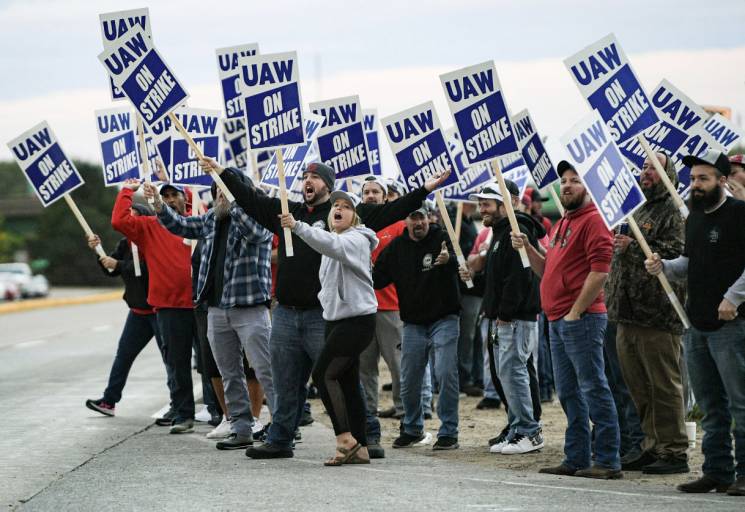 Workers are holding a protest supporting a strike at the facility of John Deere, an American agricultural machinery manufacturer located in Illinois, USA.
 [Image source=AP Yonhap News]
According to the WSJ on the 26th (local time), this month, U.S. freight carriers signed a six-year contract that includes a 32% wage increase and a total bonus payment of $72 million (92.7 billion KRW) for drivers who worked along the West Coast during the pandemic. It is reported that the drivers demanded bonuses during the wage negotiations, arguing that they risked infection while transporting cargo during the COVID-19 outbreak.
The WSJ also reported that voices demanding 'hero bonuses' or 'pandemic appreciation bonuses' are growing across blue-collar industries, including truck drivers, bus drivers, and manufacturing plant workers. The WSJ stated, "While white-collar workers were able to work from home during the COVID-19 outbreak, blue-collar workers had to remain on the industrial front lines and were thus exposed to risks," adding, "They are demanding compensation for these risks."
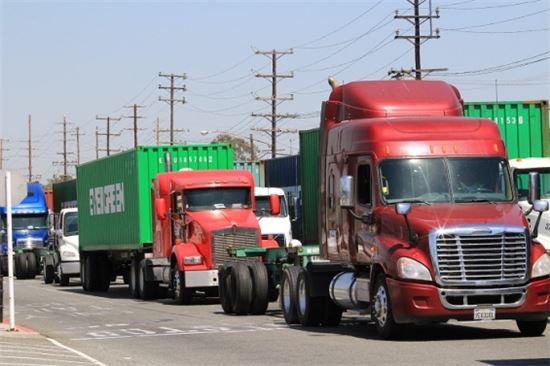
The labor unions claim that the number of workers who died during the pandemic significantly increased. According to the Transport Workers Union (TWU) in the U.S., 110 transportation-related workers in New York City died during the first six months of the COVID-19 outbreak. In the southern California ports, 43 workers lost their lives while on duty.
TWU President John Samuelson explained, "Workers will not move for quite some time (until their conditions are met)," and added, "These demands are appearing across all industries."
Furthermore, labor unions pointed out that the logistics and delivery industries have made enormous profits due to increased online orders during COVID-19 but are monopolizing these gains. According to the U.S. research firm C Intelligence, the global shipping industry's operating profit last year is estimated at $208 billion. Among them, the Danish maritime logistics company A.P. Moller-Maersk recorded an operating profit of $31 billion. The U.S. delivery company United Parcel Service (UPS) saw its operating profit increase by $5.3 billion to $13.1 billion compared to the previous year.
Management generally seems to be accepting workers' demands. This is because workplaces are suffering from severe labor shortages as workers who left due to COVID-19 have not returned. The food processing and packaging industries have also promised to pay workers hazard pay ranging from $2 to $8 per hour in accordance with union demands.
Mark Perron, president of the National Food Commercial Workers Union, stated, "The labor market is still tight," and added, "Many people are unwilling to take risks and work for low wages."
© The Asia Business Daily(www.asiae.co.kr). All rights reserved.
![From Bar Hostess to Organ Seller to High Society... The Grotesque Con of a "Human Counterfeit" [Slate]](https://cwcontent.asiae.co.kr/asiaresize/183/2026021902243444107_1771435474.jpg)

















