Gita Gopineus IMF Deputy Managing Director's Remarks
"Must Focus on Fighting Inflation"... Concerns Over Financial Turmoil
"Financial Tensions Rising in Korea, UK, and US"
The International Monetary Fund (IMF) has forecasted that global inflation could become entrenched for a prolonged period. The IMF assessed that despite economic slowdowns, central banks around the world must remain committed to the war against inflation; however, financial turmoil arising during this process could prolong the battle into a long-term conflict. It particularly warned that countries like South Korea and the United States could fall into such financial turmoil.
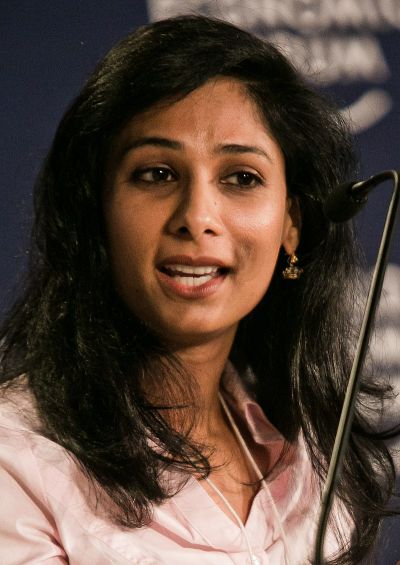
IMF Deputy Managing Director: "We Must Fight Inflation"
Gita Gopinath, IMF Deputy Managing Director, said on the 26th (local time) at the European Central Bank (ECB) annual meeting held in Sintra, Portugal, "It is taking too long for inflation to return to target levels," adding, "This means there is a risk that inflation could become entrenched." She pointed out that while the overall consumer price inflation rate has eased considerably, service prices remain at a high level, identifying service prices as the main culprit of inflation.
She diagnosed that central banks worldwide are facing an 'uncomfortable truth.' They are at a crossroads between raising interest rates to curb inflation or ending tightening to prevent a financial crisis and enduring high inflation. Gopinath advised that although some highly indebted countries may be vulnerable to financial crises, the policy of raising interest rates should continue. She emphasized, "Despite the risk of economic slowdown, central banks including the ECB must remain committed to the fight against inflation," warning that "delaying the response to inflation could result in higher costs."
As she mentioned, central banks in the United States and Europe have been sending signals that tightening is not over. The ECB raised its benchmark interest rate by 0.25 percentage points on the 15th, and the Bank of England (BOE) also raised its benchmark rate by 0.5 percentage points on the 22nd, the first increase in four months.
However, market perceptions differ. There is an overly optimistic view of inflation. Deputy Managing Director Gopinath warned investors who believe that high inflation and high interest rates will not damage economic growth to "keep in mind that historically, such precedents are rare."
Concerns Over Financial Instability Due to Tightening in South Korea as Well
Gopinath also expressed concern that financial instability could worsen if the interest rate hike trend continues. She particularly noted rising financial tensions in South Korea, the United Kingdom, and the United States. She predicted, "Once reality hits, asset prices will be readjusted, potentially triggering financial turmoil such as the collapse of Silicon Valley Bank (SVB) and the sale of Credit Suisse (CS)." She explained, "Financial stress can create tension for central banks between inflation and financial stability goals," adding, "At such times, to avoid systemic stress, it may be acceptable to tolerate a slower pace of recovery toward the inflation target."
However, she stressed that while the pace of monetary policy should be adjusted, the direction must maintain tightening until the core inflation rate clearly enters a downward path. Although the U.S. Federal Reserve (Fed) skipped an interest rate hike this month, Fed officials left a forecast through the dot plot indicating that "two more rate hikes remain this year."
In addition, Deputy Managing Director Gopinath recommended that governments reduce fiscal spending to ease inflation. She said, "To reduce the magnitude of interest rate hikes, governments must also help fight inflation by cutting deficit spending," adding, "Both high inflation and record fiscal deficits require fiscal tightening. Looking at fiscal deficit forecasts for the Group of Seven (G7) countries, the levels have been too high for too long."
© The Asia Business Daily(www.asiae.co.kr). All rights reserved.
![User Who Sold Erroneously Deposited Bitcoins to Repay Debt and Fund Entertainment... What Did the Supreme Court Decide in 2021? [Legal Issue Check]](https://cwcontent.asiae.co.kr/asiaresize/183/2026020910431234020_1770601391.png)















