Hyosung Hydrogen·GS Construction Roundtable
Former Nuclear Society President Professor Jeong Dong-wook of Chung-Ang University Moderates
"After Introducing CFE, a Grading System Should Be Created to Verify Achievement Levels"
Editor's NoteThe government has pledged to achieve carbon neutrality by 2050 and the 2030 Nationally Determined Contribution (NDC) for greenhouse gas reduction. However, companies respond that it is not easy to realize. They also believe that the CFE campaign, which recognizes all zero-carbon power sources including nuclear and hydrogen as eco-friendly energy, fits Korea's circumstances better than RE100, which aims to cover 100% of electricity with renewable energy.
We reviewed the status of corporate energy business in South Korea in 2023 with Son Soon-geun, Executive Director of Hyosung Hydrogen, Lee Jong-hwa, Executive Director in charge of Renewable Development and Nuclear Business at GS Engineering & Construction (stock code 006360), and Professor Jung Dong-wook of the Department of Energy Systems Engineering at Chung-Ang University. The discussion took place on the 20th at Asia Media Tower in Jung-gu, Seoul.
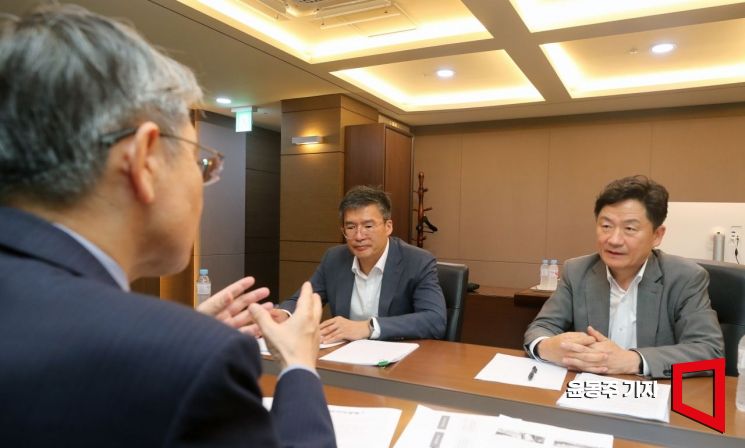 Lee Jong-hwa, Executive Director in charge of New Renewable Development and Nuclear Business at GS Construction ECO Business Division (clockwise from the left), Son Soon-geun, Executive Director at Hyosung Hydrogen, Jeong Dong-wook, Professor at the Department of Energy Systems Engineering, Chung-Ang University. Photo by Yoon Dong-joo doso7@
Company Businesses
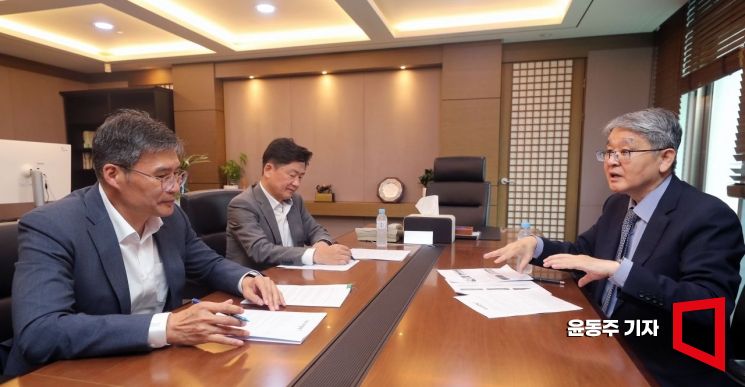 Jonghwa Lee, Executive Director in charge of New Renewable Development and Nuclear Business at GS Construction ECO Business Division (clockwise from the left), Sunkun Son, Executive Director at Hyosung Hydrogen, and Dongwook Jung, Professor in the Department of Energy Systems Engineering at Chung-Ang University. Photo by Dongju Yoon doso7@
◆Moderator=Professor Jung Dong-wook, Department of Energy Systems Engineering, Chung-Ang University
I understand that Hyosung plans to start commercial production of liquefied hydrogen by the end of the year. It is the fastest among domestic companies. What was the driving force behind building the hydrogen value chain early on?
Hyosung Heavy Industries has been engaged in compressed natural gas (CNG) bus refueling equipment business. Around 2008, Hyundai Motor Company requested collaboration with Hyosung Heavy Industries. From then on, we started the hydrogen refueling station business. Currently, about 130 refueling stations are installed domestically. Subsequently, we naturally participated in gaseous hydrogen equipment and refueling business. Through this, we connected with Linde, the world's largest industrial gas producer based in Germany. There was also an aspect of participating in ESG (Environmental, Social, and Governance) management. Hyosung Chemical was already producing gaseous hydrogen. From that time, we started the hydrogen refueling station business. Currently, about 130 stations are installed domestically. Subsequently, we naturally participated in gaseous hydrogen equipment and refueling business. Through this, we established ties with Linde in Germany via hydrogen.
Was it byproduct hydrogen from chemical production plants within the Hyosung Group?
Yes. Together with Ulsan City, we linked business items that could increase added value such as byproduct hydrogen and proceeded with the liquefied hydrogen business.
So you have been in this business for about 15 years. There are currently 132 refueling stations in Korea; does Hyosung supply all of them?
Hyosung does not supply all; we supply 37 stations. We hold the number one market share, about 25-30%.
Are you also involved in storage-related business besides refueling?
Yes. When liquefied hydrogen is produced at manufacturing plants, it is transported by trailers. We also operate refueling equipment business.
Did you develop a new hydrogen manufacturing process to liquefy the gas?
Correct.
So Hyosung is expanding the hydrogen value chain by developing new processes. GS Engineering & Construction also seems to be expanding its hydrogen production business recently. Which areas are you focusing on?
One of GS Engineering & Construction's representative businesses is plant construction. We operate in gas, petrochemical, refinery plants, incineration, and power plants. GS E&C is familiar with oil & gas plant business. As carbon neutrality by 2050 became a key issue, we internally took interest since the late 2010s and established the Future Technology Research Institute last year. Currently, about 300 people work there. The institute has various research labs related to future businesses, including hydrogen production research. We focus on production and transportation among hydrogen production, storage, transportation, and utilization. We conduct research on membrane technology, equipment technology evaluation, and develop water electrolysis technology. We also research ammonia transportation and liquefaction technologies.
Are you integrating hydrogen production with your existing petroleum refining business?
Our current oil and gas-related business is somewhat distant from carbon neutrality, so we became interested in hydrogen business as a new zero-carbon energy source.
Since hydrogen business has similarities with chemical business, it can be utilized well.
Exactly. The engineering process for hydrogen is also familiar.
Please elaborate more on your hydrogen-related business review.
First is water electrolysis technology production, second is transportation. Being familiar with petrochemical business, we are engaged in ammonia conversion and liquefaction transportation of hydrogen. Our experience in liquefied natural gas (LNG) plant business made this possible. Transportation technology is being researched jointly with public enterprises under national projects. The idea emerged to package small modular reactor (SMR) business, water electrolysis, and desalination business together. That led to signing a business agreement with Uljin County for nuclear clean hydrogen promotion. Overseas, we are also considering developing hydrogen production business linked with renewables.
Are you planning to produce blue hydrogen?
You could say that, but we are also considering green hydrogen production development projects.
Hyosung focuses on refueling, storage, and distribution, while GS focuses on production. There could be synergy between companies.
Hyosung is engaged in hydrogen liquefaction, distribution, and refueling business. Currently, we use byproduct hydrogen, but it would be good to have domestic hydrogen production technology.
Although the two companies have slightly different business areas now, the business content is interesting. I understand GS E&C signed an MOU for a clean hydrogen plant construction in Uljin County. Please explain in more detail.
Clean hydrogen production can use electricity from Shinhan Units 1 and 2. We thought domestic demonstration is necessary before exporting the iSMR (innovative SMR) currently under development. After discussions, we agreed to proceed at the Uljin Nuclear Hydrogen Industrial Complex and signed an MOU with Uljin County last October. We proposed installing two iSMRs in the complex along with an annual 30,000-ton hydrogen production facility and a 7 million-ton desalination plant. Currently, GS E&C is building a 100,000-ton-per-day desalination plant in Daesan.
Daesan refers to the west coast, right?
Yes. The desalination technology is handled by GS Inima, a Spanish subsidiary. Using GS Inima's technology, we will install a desalination plant in the Uljin Nuclear Hydrogen Industrial Complex and simultaneously operate two iSMRs, water electrolysis, and desalination businesses.
So you are doing not only hydrogen but also desalination.
Correct. For example, exporting SMRs to water-scarce Middle Eastern regions requires desalination plants. Water is also necessary to properly implement water electrolysis technology. Therefore, the three businesses?desalination, water electrolysis, and SMR?are being pursued as a package.
That's a good idea.
Yes. We proposed this carbon neutrality-related business to Korea Hydro & Nuclear Power so that hydrogen can be produced and used without problems even in water-scarce countries.
Hyosung Heavy Industries also signed an MOU with Uljin County for nuclear clean hydrogen promotion. Was it signed together with GS E&C?
They were signed separately.
What is the focus of the Hyosung-Uljin MOU?
Uljin County planned to demonstrate hydrogen production at existing nuclear power plants and also planned to produce clean hydrogen plants using SMRs. By leveraging Hyosung Heavy Industries' strengths and capabilities, if hydrogen is produced in Uljin, it can be liquefied for transportation. We agreed to cooperate in liquefaction plant and transportation fields.
For hydrogen business using electricity generated at Uljin nuclear power plants, liquefaction, storage, and transportation are critical. Does this mean Hyosung focused on these areas in the MOU?
Yes.
Since electricity production using SMRs will take some time, you plan to use electricity from existing nuclear power plants first?
Correct.
Since developing iSMRs will take some time, before that, the business should use electricity from large nuclear power plants.
GS produces hydrogen, and Hyosung handles storage, transportation, and refueling.
Collaborating with Hyosung could create significant synergy.
Synergy would be great if you work together on the iSMR project. The U.S. is conducting pilot projects at Nine Mile Point and Palo Verde nuclear power plants.
Hyosung Group plans to establish a hydrogen value chain by 2027, from hydrogen refueling station operation (Hyosung Heavy Industries) to liquefied hydrogen production and supply (Hyosung Heavy Industries) and byproduct hydrogen production and supply (Hyosung Chemical). What impact will this have on domestic and international industries?
That is the long-term plan. Currently, we are building a 10,000-ton liquefied hydrogen production plant.
Is the raw material byproduct hydrogen?
Yes, the raw material is byproduct hydrogen, which we liquefy. We are partnering with German company Linde in the liquefied hydrogen business.
So the current capacity is 10,000 tons, and you plan to increase it fourfold by 2027?
Yes, assuming the hydrogen market grows accordingly.
If production capacity increases fourfold as planned, what market do you see absorbing the produced hydrogen?
When we started the liquefied hydrogen business, it was motivated by ESG management and increasing the added value of byproduct hydrogen. However, the government's hydrogen economy roadmap announced in January 2019 included plans for hydrogen vehicle deployment. This plan increased business motivation. Since Hyosung Heavy Industries' main items are production and refueling stations, the target market is mobility and vehicles. However, the hydrogen vehicle market is growing slower than expected, so we will monitor the market expansion and expand production capacity accordingly.
To realize carbon neutrality, hydrogen use must increase.
The hydrogen market must grow quickly.
Hyosung currently operates gray hydrogen business. Considering Korea's hydrogen market growth speed, eventually, you must move to blue and green hydrogen stages. Are you considering blue hydrogen business?
Blue hydrogen business is currently under review. To produce blue hydrogen, carbon capture is necessary, along with utilization and storage. It is still in the review stage. Hydrogen business has a clear rationale for carbon neutrality, but it needs more verification of financial performance and marketability before introduction to business sites.
I always tell reporters that companies do not lack technology to do hydrogen business. Blue hydrogen requires CCUS (Carbon Capture, Utilization, and Storage) technology, and green hydrogen requires growth in nuclear and offshore wind renewable energy industries. Nuclear power electricity can be used in Uljin, and is there a plan to use offshore wind electricity in the long term?
We are obtaining certification for wind power equipment to re-enter the wind power industry. We previously produced 6 MW offshore wind turbines and are now trying to re-enter. One of Hyosung's advantages related to renewables, especially offshore wind, is that we operate power system equipment businesses such as high-voltage direct current (HVDC) transmission and energy storage systems (ESS). The Australian market is opening recently, where demand for core power equipment related to renewables is high, providing opportunities.
GS E&C is expanding hydrogen-related infrastructure business. Do you plan carbon neutrality businesses using energy sources other than hydrogen?
As a construction company, we operate various businesses. One example of expanding beyond traditional business is the development of wooden modular housing.
Is it a building energy-saving business?
Yes. Using wood instead of concrete reduces carbon emissions, so we started promoting wooden housing.
Wood has good insulation but is expensive. Do you plan to activate carbon neutrality housing construction businesses?
Yes. Using mineral carbonation (CO2 injection) precast concrete (PC) reduces cement usage by 4-5%. Injecting CO2 reduces cement amount and CO2 emissions simultaneously, a twofold effect. PC strength also improves by about 5%. GS E&C is the first in Korea to develop this technology. We built a factory in Eumseong County, Chungcheongbuk-do, and started commercial sales last year.
Using PC means reducing carbon emissions during curing?
Correct. GS E&C continues developing technologies related to net-zero cities and buildings. We are also actively developing renewable energy technologies such as wind and solar power.
For example?
We are promoting a 300 MW solar power plant development project with Renew Power in India and investing in Australia. Domestically, we are establishing a joint venture (SPC) with companies related to Southwest Sea offshore wind. Nuclear power, renewables, and wind energy are major pillars of GS E&C's zero-carbon business. We are also investing in fuel cell development projects gaining attention in Korea.
It is hard to connect construction business with fuel cells.
We actively operate businesses related to carbon neutrality beyond construction. It aligns with ESG management policies and carbon neutrality trends. We invest in solar, wind, fuel cells, and SMR development.
You are undertaking many businesses.
We also own a desalination company, GS Inima. We plan to use reverse osmosis (RO) systems for desalination, which consume a lot of electricity in pumps. We are researching ways to desalinate with less energy.
So you are researching to improve desalination efficiency?
Yes. We plan to produce prototypes by September. GS E&C's subsidiary Energy Materials (formerly Enerma) operates lithium-ion battery recycling business. Trial operation at the Energy Materials Pohang plant will start in September.
GS E&C is reborn as a carbon-neutral company.
We are researching necessary carbon capture, utilization, and storage technologies.
Aren't you mentioning too many technologies? Can you do all?
We have the Future Technology Research Institute, so we believe it is possible.
So we can understand that GS E&C is expanding business areas through technology development at the Future Technology Research Institute. Where is the institute located?
It is located with GS E&C headquarters 'Grand Seoul' in Cheongjin-dong, Jongno-gu, Seoul. We will move to Nambu Terminal in Seocho-dong, Seocho-gu, Seoul in October. We plan to increase staff as needed.
Please tell us the strengths and areas for improvement in GS E&C's new carbon neutrality business.
Of course, there are areas for improvement. In the past, construction companies focused on simple subcontracting, executing fixed orders. As Korea entered the ranks of advanced countries, labor and other costs rose, changing the business landscape. The old model lost competitiveness somewhat. Therefore, GS E&C believes that incorporating 'finance' into existing business is necessary to operate advanced development projects. With financial capabilities, proposing good projects can secure many clients. Developing development-type business capabilities is important.
You mean to become a leading company by combining financial business with project engineering?
If 'project engineering' and 'finance engineering' create synergy, we can develop good projects in underdeveloped countries and be welcomed. To activate this business model, we need to train people, both construction and financial engineers.
Do you have a corporate model you aim for?
You can think of it as a general trading company model. Understand that a construction company has a general trading company business model.
Carbon Neutral Business
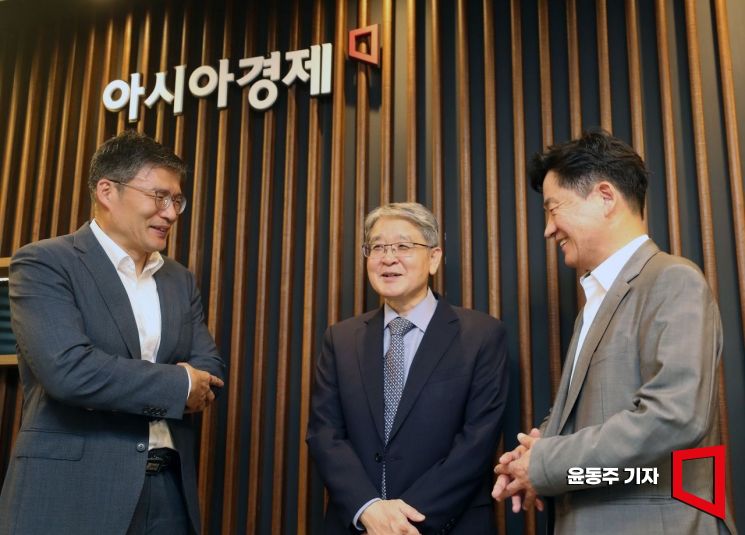 Lee Jong-hwa, Executive Director in charge of New Renewable Development and Nuclear Business at GS Construction ECO Business Division (clockwise from the left), Son Soon-geun, Executive Director at Hyosung Hydrogen, and Jeong Dong-wook, Professor in the Department of Energy Systems Engineering at Chung-Ang University. Photo by Yoon Dong-joo doso7@
From Hyosung's perspective, carbon neutrality can be both an opportunity and a challenge. What are the opportunity and threat factors?
Disclosure regulations such as Scope 3 are being strengthened. Companies must submit sustainability reports annually, including climate change response items. Compliance requirements naturally follow. The group must establish a carbon disclosure system. An interesting point in hydrogen business is that the production cost of green hydrogen per kg is about 15,000 KRW, over 10 USD, which is unaffordable for the market (demand companies). However, as Scope 3 disclosure spreads and carbon border taxes increase, there is hope and expectation that demand companies will be motivated to use expensive green hydrogen. But there is a huge cost gap in green hydrogen production among Australia, Europe, and Korea, mainly due to electricity prices. Overseas hydrogen production costs are around 2-3 USD per kg, with electricity costs close to zero.
How is electricity cost nearly free? Is it subsidized?
The weakness of renewable energy is intermittency (power generation varies with weather). Using surplus power cannot be fully accepted by transmission and distribution networks, so production must be stopped.
So overseas use surplus renewable power, making electricity costs low and green hydrogen competitive?
That could be the case. Renewable energy prices in Korea are still high. If carbon taxes and emission regulations strengthen, demand companies' costs increase, so demand for green hydrogen may rise despite higher prices.
The opportunity factor is that carbon emission regulations will increase emission costs, potentially enhancing green hydrogen competitiveness?
Yes.
You said Hyosung publishes sustainability reports and works on carbon reduction. Please explain specifically.
First, manufacturing plants use a lot of heat. Until now, engines or external heat sources were mainly used. Now, we are shifting to using waste heat from factories and waste incineration plants.
So instead of fossil fuels, you reduce carbon emissions by using waste heat?
Yes. At the Hyosung Group level, we also produce 'eco-friendly products.' (Hyosung TNC) produces recycled fiber products called 'Regen.' Global companies pay more for recycled yarn products because purchasing them signals active ESG management.
You mean selling recycled products at higher prices for carbon neutrality?
Such products become brands.
Can you share your carbon emission reduction targets?
The government set a 2030 industrial sector reduction target of 11.4% compared to 2018. The industry is striving to meet this. If companies cannot reduce emissions to this level, they must purchase renewable energy certificates (REC), which is a cost.
What are the difficulties and efforts of GS E&C in controlling carbon emissions?
From January 2026, Europe will implement carbon tax regulations. The U.S. plans similar rules. Korea is a top 10 industrial and export-oriented country but has a relatively low share of zero-carbon power generation including renewables. Conversely, companies like GS E&C expanding carbon neutrality business portfolios will find many opportunities in Korea.
So Korea's low zero-carbon power generation share means carbon neutrality policies may offer more business opportunities to companies?
Yes. Korea declared 2050 carbon neutrality and 2030 NDC implementation plans, so many business opportunities will arise in carbon neutrality. GS E&C is investing or planning investments in solar and wind power. We directly trade with companies in various industries or purchase RECs. We will continue investing in renewable and zero-carbon energy sectors.
Corporate activities and construction generate significant carbon emissions. You mentioned reducing emissions using high-strength PC.
GS E&C's annual emissions are 225,000 tons. Above 250,000 tons, companies are subject to mandatory carbon emissions trading. GS E&C's emissions are not yet at that level. Reducing emissions is not only GS E&C's effort. Carbon emissions come from using diesel-powered heavy equipment during construction. To reduce emissions, diesel equipment must be replaced with hydrogen-powered heavy equipment. Switching to electric vehicles and forklifts can reduce emissions. Developing new concrete technologies also offers emission reduction potential.
You mean to reduce emissions below the current 230,000 tons per year?
For reference, 225,000 tons includes Scope 3 emissions.
The government launched the CFE forum. Some see CFE as competing with RE100, but since CFE covers zero-carbon energy, it encompasses RE100. Do you think the CFE forum will help or burden corporate activities?
Yes. Overseas companies request compliance plans for RE100. CFE includes nuclear and fuel cells. Korea is a nuclear powerhouse, so switching to CFE rather than RE100 will help Korean companies strengthen competitiveness and reduce difficulties in exports.
You mean CFE should become an internationally accepted standard like RE100?
Yes. Hyosung exports many materials. If CFE expands, we can maintain cost competitiveness. CFE also recognizes fuel cells as eco-friendly energy. Currently, fuel cell businesses mostly use byproduct hydrogen or LNG-reformed hydrogen. As technology develops, blue and green hydrogen use will increase. If nuclear power expands, 'pink hydrogen' produced using nuclear power will also increase. Increased supply will drive demand creation.
You mean electrolyte development technology needs further advancement?
Yes.
Then you can ask GS E&C.
(laughs)
LNG power generation with CCUS technology will also be recognized as CFE. That would be a plus for Hyosung Heavy Industries, right?
If carbon from blue hydrogen production using LNG is captured, it will be recognized as green hydrogen.
Having even some carbon capture capability helps reduce carbon emissions in hydrogen business?
Yes.
After the Russia-Ukraine war, Korea is increasingly integrated into Western global value chains. I think adopting CFE is appropriate. The key is whether CFE is recognized as an international standard. Whether led by private or international organizations, mutual recognition and adherence are necessary.
So the government is not the main actor?
Correct. The Korea Chamber of Commerce and Industry should collaborate with overseas private organizations to establish CFE standards. For example, grading achievement levels like 40% CFE, 100% CFE is needed. Especially, domestic CFE achievements should be allowed to be recognized as EU ETS credits. If carbon taxes can be reduced according to CFE grades, adopting CFE is appropriate.
You mean CFE should be internationally recognized and operated as a voluntary corporate participation system rather than government regulation, with a grading system introduced.
Yes.
If overseas competitors produce products with lower carbon emissions and higher price competitiveness, Korean companies may face difficulties.
This is called 'transition risk.' For example, if global customers require environmental certifications for carbon reduction and companies fail to meet them, they may be excluded or restricted from new bids, even losing contract opportunities. There is difficulty in proactively responding to overseas customer requirements.
Can CFE help reduce transition risk?
It will help.
CFE will also help GS E&C?
Yes.
Any message regarding carbon neutrality promotion?
In the energy transition era, legitimacy and economic feasibility may conflict. Companies may face difficulties in such conflicts. The state's role is to ease these conflicts. The U.S. somewhat eased conflicts through the Inflation Reduction Act (IRA). Europe created similar laws like the Critical Raw Materials Act (CRMA). Korea does not yet have such institutional or legal measures.
Implementation programs have not yet emerged.
Regardless of large company favoritism controversies, similar support policies exist in the U.S., Europe, and even China. If companies bear the burden alone when legitimacy and economic feasibility clash, they will inevitably lose to foreign companies. The government can support through finance, tax incentives, and other means. Creating support systems similar to foreign cases will provide practical help to companies understanding carbon neutrality.
Carbon neutrality requires balancing legitimacy and practicality. Companies inevitably prioritize practicality. The government needs to prepare measures such as financial and tax support to complement corporate competitiveness during carbon neutrality realization.
© The Asia Business Daily(www.asiae.co.kr). All rights reserved.
![Clutching a Stolen Dior Bag, Saying "I Hate Being Poor but Real"... The Grotesque Con of a "Human Knockoff" [Slate]](https://cwcontent.asiae.co.kr/asiaresize/183/2026021902243444107_1771435474.jpg)


















