Official Documents Interpreted by 'Man Age'... Legal Drinking and Smoking Age Maintained
Lee Wankyu, Head of the Ministry of Legislation, "Efficiency Will Improve by Aligning with International Standards"
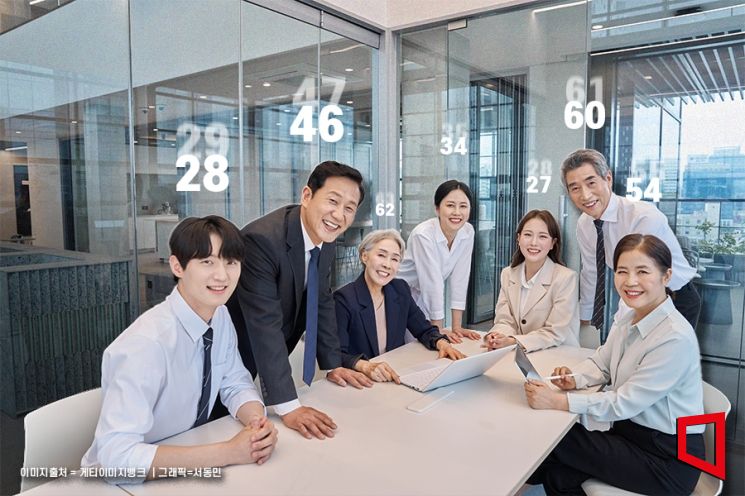
The "Full Age Unification Act," which standardizes the legal and social age criteria, will come into effect on the 28th. However, even after the Full Age Unification Act is implemented, full age will not apply to school entry age, legal drinking and smoking age, military service obligations, and similar cases.
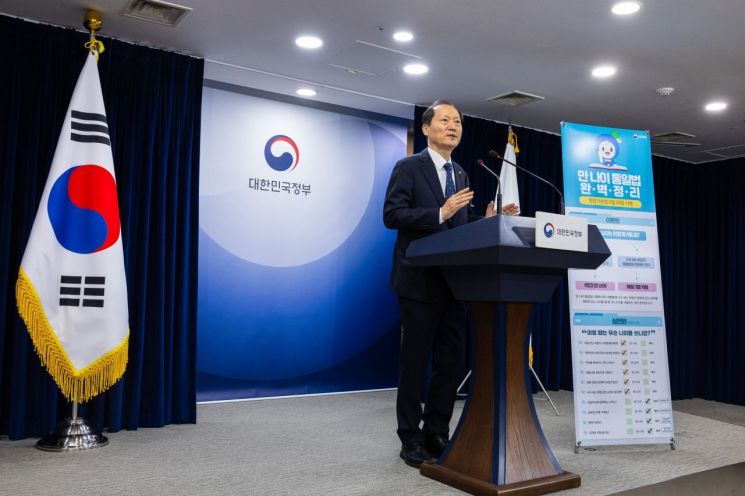
The Ministry of Government Legislation (Minister Lee Wankyu) announced on the 27th that the "Full Age Unification Act," which partially amends the Framework Act on Administrative Regulations and the Civil Act, will be enforced from the 28th. The Full Age Unification Act is a national agenda promoted by the Yoon Seok-yeol administration to resolve social and administrative confusion and disputes caused by differences in legal and social age calculation methods. It is one of President Yoon Seok-yeol's key election pledges.
In South Korea, three different age calculation methods?"Korean age" (Seneun nai), "year age" (Yeon nai), and "full age" (man nai)?have been used interchangeably. However, internationally, the "full age" method, which starts at 0 at birth and adds one year on each birthday, is commonly used. Once the Full Age Unification Act is enforced, age will be calculated starting at 0 on the date of birth and increasing by one each birthday.
From the 28th onward, unless otherwise specified, ages indicated in laws, contracts, and official documents should be interpreted as full age. However, systems that already use full age, such as voting rights and pension eligibility, will remain unchanged, and full age will not apply to school entry age, legal drinking and smoking age, or military service obligations.
The school entry age remains the same as before. Children enter school on March 1 of the year following the year in which they turn 6 years old. With the enforcement of the Full Age Unification Act, there may be issues with age differences among students in the same grade. However, the Ministry of Government Legislation anticipates that as people become accustomed to using full age, the hierarchical culture that strictly distinguishes age differences of one or two years will gradually disappear.
The age related to military service obligations under the Military Service Act is also calculated by subtracting the birth year from the current year. Based on this, regardless of birthday, those born in 2004 will undergo military physical examinations this year.
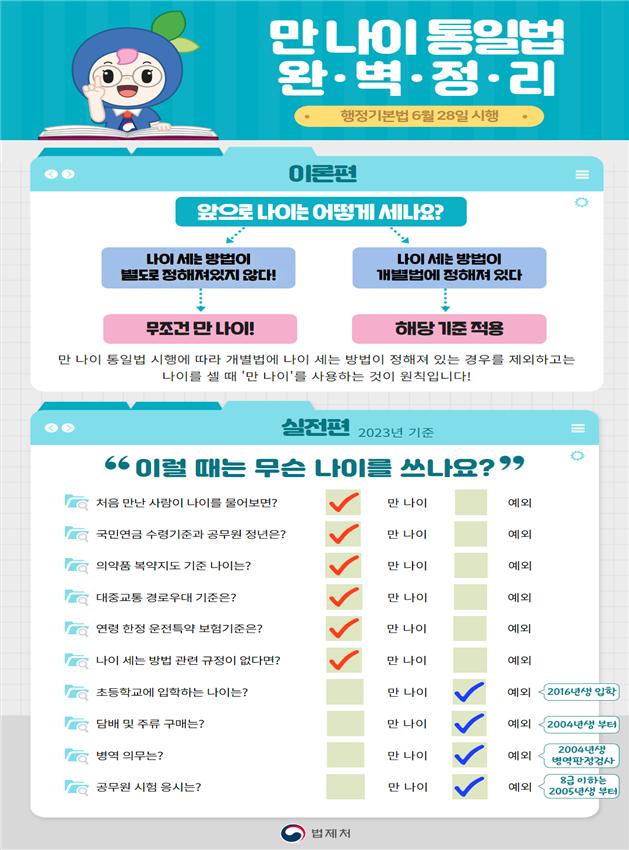
Since the youth age under the Youth Protection Act remains unchanged, the legal age for purchasing alcohol and tobacco also remains the same. The current Youth Protection Act defines youth as "persons under the age of 19, excluding those who have reached January 1 of the year they turn 19." Based on this, those born in 2004 are allowed to purchase alcohol and tobacco this year.
The youth age standard was established to guarantee free social and educational activities for those considered adults by social convention, such as university students and working youth, and the same standard has been applied since 2001.
Social customs and culture based on the Korean age system, such as the traditional celebrations for the 70th and 80th birthdays, will not change. The Ministry of Government Legislation judged that these private customs should not be forcibly altered.
Minister Lee Wankyu of the Ministry of Government Legislation stated, "There can be various disputes at civil complaint centers regarding pension eligibility age and lawsuits related to full age and Korean age in private contracts. This will reduce such social costs. Most countries use full age in international dealings, but Korea alone has used Korean age, causing confusion that required separate explanations about age in documents. Aligning with international standards will be more efficient," he explained.
© The Asia Business Daily(www.asiae.co.kr). All rights reserved.



















