Korea Employers Federation Analyzes Factors Affecting 2024 Minimum Wage Adjustment
The business community cited the difficulty of raising the minimum wage next year, pointing out that a significant number of small and micro-sized businesses managed by CMS lack the capacity to pay higher minimum wages. They also noted that the minimum wage has already reached a level sufficient for maintaining livelihoods, and labor productivity has not increased proportionally with the rise in minimum wages so far.
The Korea Employers Federation (KEF), representing the employers' side, released an analysis report on the factors influencing next year's minimum wage adjustment on the 25th, making these claims. From the perspective of payment capacity, they argued that since it is no longer possible to apply differentiated rates by industry, the minimum wage should be decided based on a kind of lower limit, i.e., industries that cannot currently afford the minimum wage.
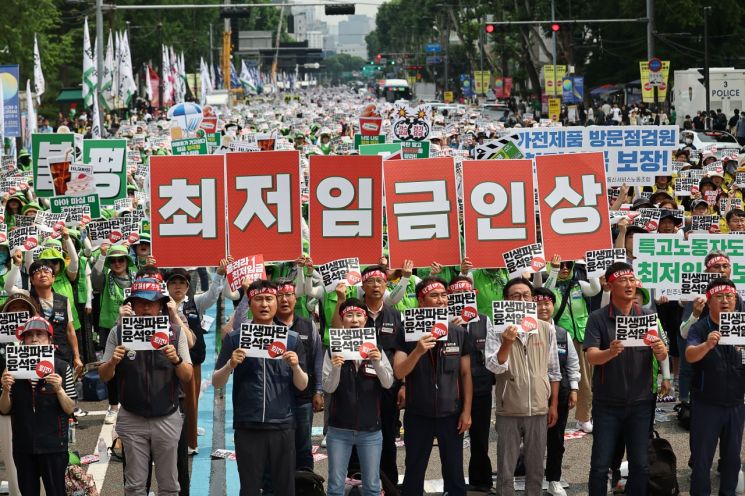 On the 24th, near Hyehwa Station in Seoul, members of the Korean Confederation of Trade Unions held up hand placards demanding an increase in the minimum wage at the "National Workers' Rally for the Resignation of the Yoon Seok-yeol Administration."
 Last year, the rate of businesses paying below the minimum wage was 12.7%, with the rate reaching 30% particularly in the accommodation and food service industries and in small businesses with fewer than five employees. The value added per employee is also relatively low. Additionally, the number of corporate bankruptcy filings from January to May this year was 592, a 56% increase compared to the same period last year. There is also a survey result showing that half of small business owners earn less than 1 million KRW per month.
Considering living expenses, they pointed out that the policy target for the minimum wage should be low-wage, single, unmarried workers rather than the entire workforce. According to the Minimum Wage Commission's analysis, the actual living expenses for all single, unmarried workers including high-income earners is about 2.41 million KRW. Using a different standard, based on the third income quintile of low-wage workers, living expenses drop to about 1.75 million KRW.
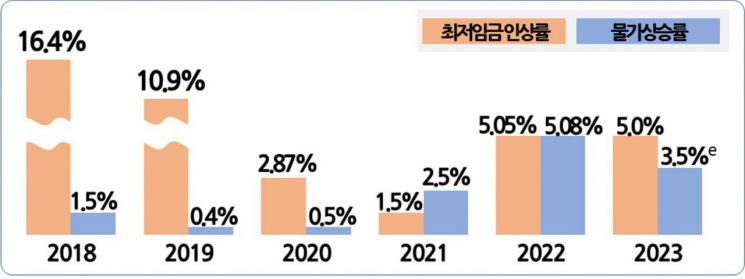 Trends in Minimum Wage Increase Rate and Inflation Rate Compared to the Previous Year from 2018 to 2023
They also highlighted that while prices have risen by 12.5% over the past five years, the minimum wage has increased by 27.8%. The KEF stated, "During 2018-2019, when the inflation rate was only 1.9%, the minimum wage was sharply increased by 29.1%. Despite low inflation at that time, the minimum wage was raised significantly, and now that inflation is high, the argument to raise the minimum wage again substantially is difficult to accept."
Furthermore, they cited that the domestic minimum wage has already exceeded 60% of the median wage, labor productivity per person has only increased by 0.2% over the past five years, and the minimum wage has had almost no effect on improving income distribution as reasons why the minimum wage cannot be raised.
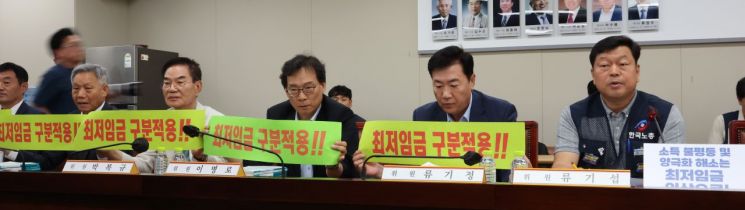 On the afternoon of the 22nd, at the 7th plenary meeting held in the Minimum Wage Commission meeting room at the Government Complex Sejong in Sejong City, Ryu Gi-seop, Secretary General of the Federation of Korean Trade Unions and a worker representative (right), began speaking. Meanwhile, employer representatives, including Ryu Gi-jeong, Executive Director of the Korea Employers Federation, held up signs emphasizing the need for differentiated application of the minimum wage.
 Lee Dong-geun, Vice Chairman of KEF, said, "By comprehensively reviewing the most important factors in wage determination such as payment capacity and the four decision criteria exemplified by law, it was clear that it is difficult to raise the minimum wage next year." He added, "This is judged to be because the shock from the high rate of minimum wage increases accumulated in the domestic labor market has not yet been resolved amid the recent economic downturn."
The deadline for submitting the minimum wage proposal this year is the 29th of this month. This year, the minimum wage rose by 5.0% to 9,620 KRW, and if it is decided at a similar level next year, it will exceed 10,000 KRW. The labor side has proposed a 26.9% increase, and the employers' side plans to present their initial proposal at the 8th plenary meeting on the 27th.
© The Asia Business Daily(www.asiae.co.kr). All rights reserved.



















