3rd National Climate Crisis Adaptation Plan Development
The government will enhance flood defense capabilities by raising the design frequency for small stream flooding from 100 years to 200 years. Additionally, related adaptive infrastructure such as deep tunnels, underground drainage channels, and riverside retention basins will be expanded.
On the 22nd, the Ministry of Environment announced at the plenary meeting of the ‘2050 Carbon Neutral Green Growth Committee’ held at the Government Seoul Office that the ‘3rd National Climate Crisis Adaptation Enhancement Plan’ with these contents has been reviewed and finalized.
First, the climate monitoring and forecasting system will be scientificized, and public access to adaptation information will be improved. Social infrastructure will be upgraded reflecting future climate risks. Climate change scenarios will be strengthened considering future trends in population and energy use. An integrated adaptation information platform providing climate change adaptation information by ministry will be established to facilitate public access to information.
To prepare for climate disasters, infrastructure expansion will also be pursued. For flood defense, the design frequency for small stream flooding will be raised from 100 years to 200 years. Related adaptive infrastructure such as deep tunnels, underground drainage channels, and riverside retention basins will be continuously expanded. To effectively respond to drought situations, dams, weirs, and tidal gates will be scientifically linked and operated, and flood control capacity will be reinforced not only for large reservoirs but also for medium and small reservoirs.
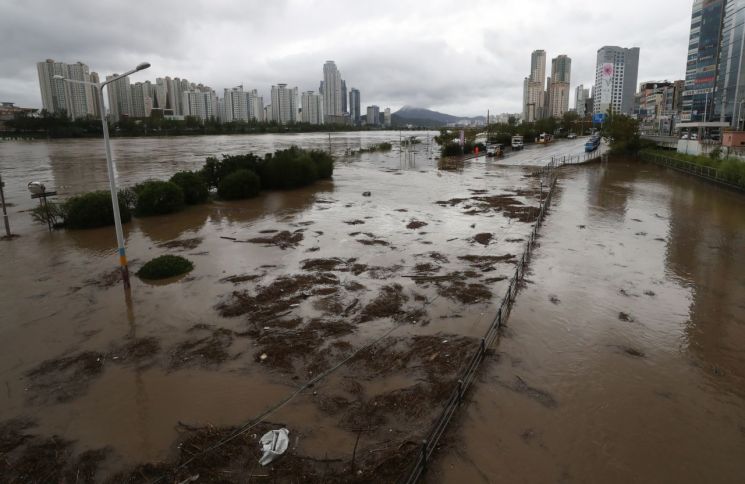
The forecasting system will also be improved. By introducing an artificial intelligence (AI) flood forecasting system, warnings and alerts will be extended from 3 hours in advance to 6 hours in advance. To proactively prepare for wildfires, wildfire prediction information previously provided only for the short term (3 days ahead) will be extended to the medium term (7 days ahead) and long term (1 month ahead), and meteorological drought information will be expanded to over 3 months. To ensure rapid delivery of sudden and extreme heavy rain information, the Korea Meteorological Administration will directly send text messages to citizens’ mobile phones, and heatwave and cold wave information will also be delivered via village broadcasts and mobile texts to enhance prevention capabilities.
Protection for vulnerable groups in the climate crisis will be strengthened. Climate crisis adaptation measures will be institutionalized in administrative plans, and the legal basis related to climate adaptation will be reinforced for conducting surveys on vulnerable groups. Furthermore, to increase the effectiveness of adaptation policies, linkage between adaptation sectors and a methodology for evaluating the joint benefits of adaptation and mitigation will be established.
Han Hwa-jin, Minister of Environment, said, "Based on scientific predictions of intensifying climate change, we will build an adaptation foundation across society that can proactively prevent future climate risks," adding, "We will promote climate crisis adaptation measures through cooperation with all adaptation actors including the public, local governments, civil society, and industry."
© The Asia Business Daily(www.asiae.co.kr). All rights reserved.
![Clutching a Stolen Dior Bag, Saying "I Hate Being Poor but Real"... The Grotesque Con of a "Human Knockoff" [Slate]](https://cwcontent.asiae.co.kr/asiaresize/183/2026021902243444107_1771435474.jpg)
















